SLI home
User login

A BLOG FOR E-COMMERCE LEADERS

  • Blog
  • Resources
  • Webinars
  • Customer Experience Scorecard

SLI Blog

Posts in EPIC Category

Personalization: It’s Kind of a Big Deal

Posted by Cheri WinterbergOctober 15, 2018E-commerce Research, EPIC, Personalization, Uncategorized

Imagine entering a store customized for you. The sales staff anticipates your unique needs, knows your sizes and tastes, and offers discounts on products you actually want. They make relevant suggestions so you don’t miss out, pointing to things you’re sure to like but may not have otherwise noticed. And they remember your previous purchases, recall what worked and what didn’t, and strive to make this visit even better than the last.

It’s every shopper’s dream come true.

In the not-so-distant past, highly-personalized retail experiences like this existed only for elite consumers. Upscale retailers vying for wealthy customers used personal shoppers and concierge services to ensure select clientele were shown products perfectly suited for them. But in the digital age, what was once an exception for the rich and famous is now within the reach of every shopper. And today’s consumers aren’t merely accepting personalization – they demand it.

Why the demand for personalization?

With so many product options, it’s easy for online shoppers to get overwhelmed and become dissatisfied. And when shoppers become dissatisfied, they abandon carts and brands. Personalization delivers a solution. High-functioning personalization strategies enhance a shopper’s journey and mitigate these frustrations. The result? Most consumers today (91%) opt for retailers who offer a personalized experience over those who don’t.    

Just how deep does the desire for personalization run?

Deep. Consider this – a survey by Salesforce revealed a whopping “82% of customers will share relevant information about themselves in exchange for connections between their digital and in-person experiences” and “85% of customers will share relevant information about themselves in exchange for proactive customer service.”

With numbers like this, it’s clear that growing personalization is imperative for retailers interested in getting – and keeping – customers.

And savvy online retailers haven’t failed to notice the increased demand. According to SLI System’s H1 2018 E-commerce Performance Indicators and Confidence (EPIC) Report, one-third (33%) of retailers across the globe say their companies are already giving their customers a personalized online experience and almost half (49%) plan to add it in the next year. In fact, only 7% of retailers worldwide say they are not adding some form of personalization to their e-commerce strategy.

As e-commerce professionals know, Customer Experience can either entice customers to return or drive them to the nearest competitor. And it’s clear personalization is a must in order to deliver a strong customer experience. But personalization isn’t a single-faceted entity. What’s more? Choosing the correct personalization strategies can make or break a shopper’s online experience – and the bottom line.

So how are e-commerce businesses personalizing and how do they plan to expand?

SLI’s EPIC Report indicates that with 57% of those surveyed saying it’s already in use, Emails Triggered by Online Behavior is the top way retailers currently personalize for their online shoppers. And it’s no surprise. MarketingDive explains that personalized email subject lines “can increase open rates by 50% and lead to 58% higher click-to-open rates.” The second most common way to personalize is Recommendations Based on Online Behavior (55%) followed by Segmentation Based on Demographic Data and Offers Triggered by Online Behavior, which tied for third (34%).

Underutilized strategies offer unique pathways to personalization.

Less used forms of personalization reveal opportunities to improve customized shopping experiences through a variety of alternative strategies. But which strategies can retailers use to take advantage of these opportunities? SLI uncovered that Persistent Profiling through a Data Management Platform (DMP) is the least utilized method of personalization with only 6% of those surveyed reporting it is currently in use. DMP is closely followed by Offers Triggered by Offline Behavior (7%) and Recommendations Based on Offline Behavior (9%).

To be successful, personalization must actually be personal.

Conversant found irrelevant content is the number one way to frustrate shoppers and lose sales. So how do retailers ensure their customers’ personalized experiences are, in fact, personal? Tracking and utilizing online behavior in the right ways. And e-commerce strategists are taking advantage of expanding technology in this arena. SLI discovered the top ways retailers plan to expand personalization all center on online behavior.
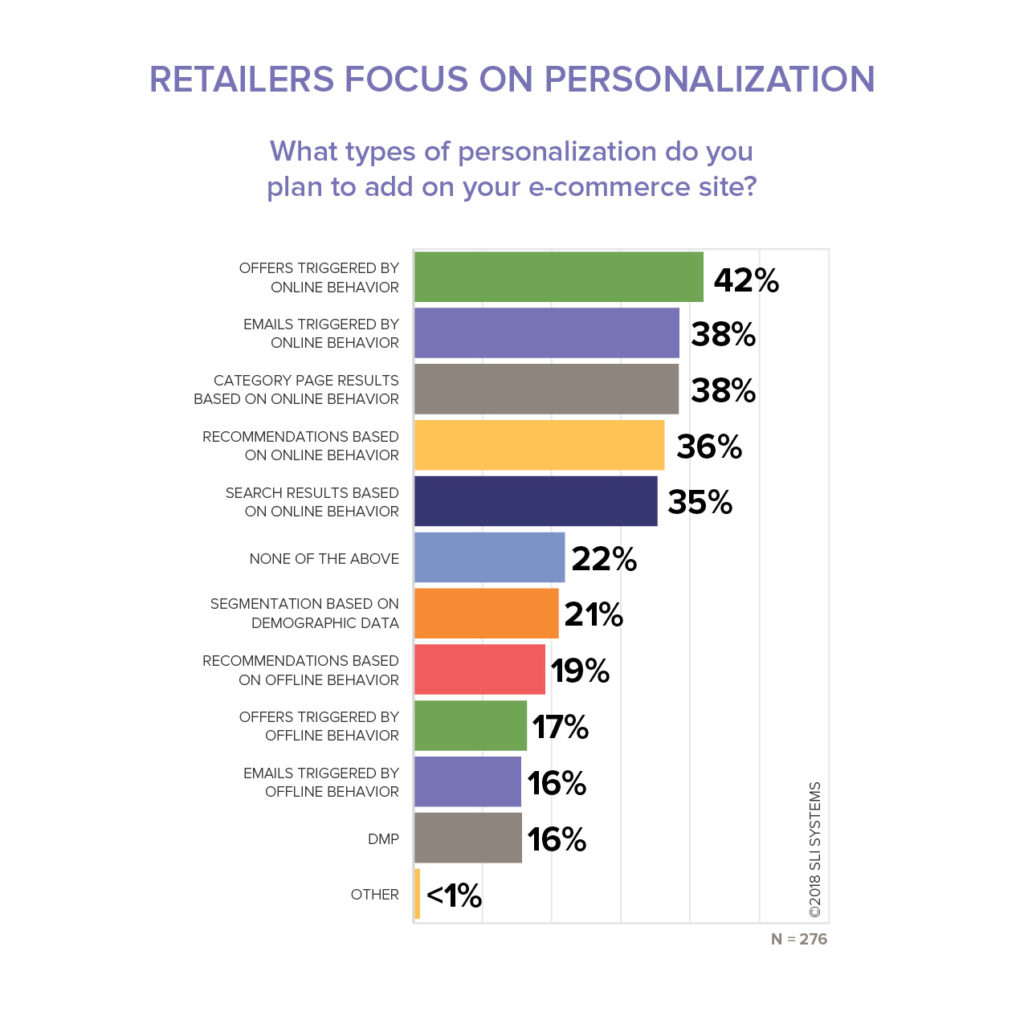
"Offers Triggered by Online Behavior" is the number one way retailers plan to add personalization to their e-commerce site. The top approach selected for implementation this year by 42% of retailers is Offers Triggered by Online Behavior. It was followed by Emails Triggered by Online Behavior and Category Page Results Based on Online Behavior 38% each in second place. Recommendations Based on Online Behavior took third place with 36%.

The Bottom Line

Finding out what your customers want and helping them get it through a personalized e-commerce experience isn’t just good for shoppers, it’s good for business. Sixty percent of those surveyed by SLI believe personalization will increase conversion rates. As technologies to improve personalization expand, retailers must take advantage or risk losing consumers to those who’ve embraced the growing demand for personalization.   

For more on the latest trends in e-commerce personalization, click here to download the H1 2018 EPIC Report.

Survey Says . . . Amazon More E-commerce Foe Than Friend

Posted by Christina StublerApril 27, 2017Amazon, E-commerce Research, EPIC, Uncategorized

epic-competive-threats-chartWhether friend or foe to your online business, Amazon marketplaces are shaking up retail norms globally – from personalization to fulfillment. Even with Walmart and Jet.com encroaching on Amazon’s discount market share, the online mega mall added “tens of millions” of new Prime subscribers in 2016, reports investor site Motley Fool.

Add consumer expectations for relevance, price and fulfillment speed, and retailers face notable challenges in attracting, converting and keeping customers online as they seek to nab their share of retail e-commerce sales that eMarketer forecasts will top $27 trillion in 2020.

Findings in SLI Systems E-commerce Performance Indicators and Confidence (EPIC) Report illustrate the level of concern about various marketplaces among global online and multichannel merchants. The report provides insight from more than 200 e-commerce professionals — nearly 40% of whom sell on at least one Amazon marketplace, with 42% selling on additional marketplaces.

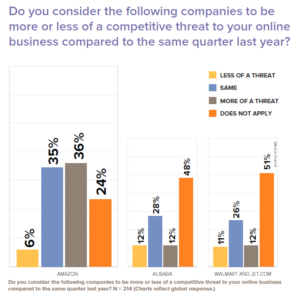
The key takeaway? Only 6% say Amazon is less of a threat.

“The Amazon Factor”

The e-commerce giant continues to challenge online businesses worldwide, with 11 Amazon marketplaces across North America, Europe and Asia.

Only 6% of the SLI study respondents feel Amazon poses less of a competitive threat. Thirty-two percent of U.S. respondents and 38% of those in the UK report that Amazon is more of a competitive threat compared to the same quarter last year.

And in Australia, where Amazon reportedly plans to open a new marketplace, 47% of respondents viewed the e-commerce giant as an increased threat.

Interestingly, Australian merchants chose “Advertising or Paid Search” as their top online retail initiative for the quarter, potentially indicating that the region’s merchants are gearing up for heightened online competition.

Other Mega Competitors

When it comes to Walmart and Alibaba, the “threat level” depends much more on region. Eighteen percent of the study’s U.S. respondents view Walmart/Jet.com as more of a threat. However, a majority of respondents in the UK (67%), Australia (60%) and New Zealand (62%) said the mega retailer was not a threat to their particular online businesses.

Looking at sentiment about Alibaba, the marketplace is a notable contender for APAC, where 20% of Australia-based and 31% of New Zealand-based merchants view Alibaba as more of competitive threat to their online business in Q1 2017 compared to the same quarter last year.

Whether selling on Amazon (friend) and/or competing with Amazon (foe), online retailers are having to keep pace with the giant as it sets the bar for the front office as well as the back office. When asked to select the single most important initiative for their online retail business, Customer Experience earned the top spot from 26% of all respondents, followed by Inventory, Logistics and Fulfillment, which earned 14% of the “votes.”

To learn about practical ways to combat Amazon, read the The Ecommerce Secret Weapon You Haven’t Heard Of on MediaPost’s SearchMarketingDaily.

Findings in the SLI Systems EPIC Report for Q1 2017 are based on a survey conducted between February 6, 2017 to March 6, 2017. For a copy of the full chart-packed report, visit: http://sitesearch.sli-systems.com/Epic-Report.html

New SLI Report Finds E-commerce Confidence Strong Globally

Posted by Chris Brubaker, Chief Marketing OfficerApril 7, 2017Customer Experience, E-commerce Research, EPIC, Uncategorized
epic-reprt-cover2-3d

The Q1 2017 EPIC Report found widespread confidence among online retailers with 94% of respondents selecting at least one area of planned growth during the first quarter of 2017.

I am excited to share SLI Systems’ debut E-commerce Performance Indicators and Confidence (EPIC) Report with you. The Q1 2017 EPIC Report includes findings and analyses from an in-depth survey of retail professionals worldwide and a look at consumer behavior trends based on more than 1.5 billion site search queries.

Survey findings in the first-quarter report represent a mix of retail business models, including pure e-commerce, as well as omnichannel merchants. In addition, 87% of the 200+ respondents work in a manager position or above – with 20% holding VP- or C-level positions. The responses, collected between Feb 6-March 6, 2017, come from a qualified cross-section of retailers around the world, offering a solid benchmark for us to compare retailer confidence and shopping behavior regularly.

We have included dozens of colorful charts in the 13-page report to illustrate the Respondent Overview, Confidence and Performance Indicators, Top of Mind (anticipated business impact of the new U.S. presidential administration) survey findings, as well as Search Trend Analysis, which looks at the average number of words in a site search query.

The best news? Ninety-four percent of retail professionals surveyed expected to expand their businesses during the first quarter.

Here are some other highlights:

Confidence – Eighty percent of respondents expect an increase in online revenues and profits, and 46% expect an increase in in-store revenues and profits.

Key Performance Metrics – Comparing Q1 2017 to Q1 2016, metrics include, among others, that 71% expect increased site conversion (CVR) and 76% expect a decrease or no change in their fulfillment costs per order.

Top Q1 Initiative – With 26% of the “Vote” Customer Experience earned the top spot among priorities. Inventory, Logistics & Fulfillment was second (14%), followed by Mobile Site (12%).

Mobile – An impressive 73% of respondents expect an increase in mobile transactions. Among those who cited mobile as their top initiative, the group selected “Mobile Site” six times more than “Mobile App.”

Amazon – Thirty-two percent of U.S. respondents, 38% of those in the UK, and 47% in Australia, see Amazon as more of a competitive threat compared to the same quarter last year.

Trump – U.S. retailers generally anticipate the new U.S. administration will have a positive impact on corporate taxes, a negative impact on selling internationally, and no impact on online sales taxes. Twenty-three percent of UK respondents expect it will have a somewhat or very negative impact on their online business.

As a global provider of cloud-based e-commerce solutions and services, SLI is in a unique position to analyze retailer confidence and online shopping trends. We hope that EPIC quickly becomes a useful resource for you to check the “pulse” of the e-commerce sector globally.

The complimentary report is available for download. Let us know what you think at research@sli-systems.com, and be on the lookout for future EPIC surveys. We’ll send you the resulting report once it’s published.

Stay up to date with SLI

Featured Posts

  • Maximize Revenue with Enhanced Product Impact Testing
  • Top Five Ways to Prepare for Peak Season
  • Facets, Facets, Who’s Got the Facets?
  • Personalization: It’s Kind of a Big Deal
  • M is the New E: Mobile Commerce Trends and Predictions

Categories

About SLI Systems

  • What We Do
  • Who We Are
  • Why SLI

Learn

  • Webinars
  • News Room
  • Events

Connect

© Copyright SLI Systems, 2018. All Rights Reserved | US: (866) 240-2812 | Legal