SLI home
User login

A BLOG FOR E-COMMERCE LEADERS

  • Blog
  • Resources
  • Webinars
  • Customer Experience Scorecard

SLI Blog

Maximize Revenue with Enhanced Product Impact Testing

Posted by Doug McLeanNovember 1, 2018Uncategorized

Conventional wisdom (and Google data[1]) says that content that appears “above-the-fold” on a web page is almost twice as likely to be seen than content that the user must scroll to see. Experienced online retailers well understand the importance of a product being placed above-the-fold and its impact on business results. The question for merchandisers is how to best use those valuable above-the-fold pixels to maximize conversion rate and cart value. This question is particularly hard to answer for new products with which a retailer has no sales history.

In order to make this question easier to answer, SLI Systems has recently launched new Enhanced Product Impact Testing functionality that allows merchandisers to quickly assess how new products will affect sales. To do this the SLI Product Discovery Platform allows merchandisers to artificially “boost” new products on a search results page to a position that they wouldn’t normally achieve to see how shoppers react to them. Historically, Product Impact Testing has looked at the “age” of products and moved recently added products further up towards the top of the results. The position of new products is determined by a combination of the boost and learning score, but the exact placement of any given new product or group of products could not be determined in advance.

Enhanced Product Impact Testing Boosting is a smarter way to define a product as “new” and provides more control over the position in the result set of where the new products will appear.

  • Defining new products: A product is determined to be new based on the number of times it has been seen by shoppers. Once it reaches a certain threshold, it will no longer be considered as new and Product Impact Testing boosting will no longer be applied. The learning score (or other ranking criteria) will determine its position from then on.
  • Position: Enhanced Product Impact Testing Boosting offers more control over the positioning of new products and defines available location blocks that products can occupy within the result set above the fold. The actual position of new products can change over time.  If more new products exist than available slots, a random selection of new products is shown within the slots available for new products.

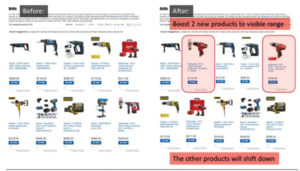
The image below shows how this functionality might work on a sample product results page:
While Enhanced Impact Testing is most frequently used by apparel retailers when they post new seasonal collections, it also has great applicability to specialty retailers that depend upon repeat purchases from their most loyal customers. As long-term customers frequently already own a broad selection of a retailer’s standard merchandise, the very best way to get them to convert again is to make sure they have visibility on new items or categories of items as they appear in a store. Thus, if you’re selling archery equipment to past customers that already have a half dozen bows, lots of arrows, and a selection of targets, a retailer would want to boost new accessories, seasonal clothing items, or new technology upgrades.

[1]https://think.storage.googleapis.com/docs/the-importance-of-being-seen_study.pdf

Read More

Top Five Ways to Prepare for Peak Season

Posted by Amanda Rivera, Director of Marketing at American MeadowsOctober 25, 2018Uncategorized

American Meadows uses product discovery solutions from SLI Systems to deliver an exceptional customer experience to its shoppers.

Getting ready for your company’s busiest shopping season is a challenge no matter the market. From predicting sales to organizing ad campaigns, every department is involved. It’s a lot to balance and keeping track of what needs to be done to make your peak season great can be tricky.

That’s where preparation comes in.   

Recently, I joined Carter Perez, CRO of SLI Systems, in a webinar, “Your Guide to Being Peak-Season Ready.” In it, I shared how we at American Meadows, one of the most respected online retailers of seeds, bulbs, and perennials, prepare for our peak season. Since we’re a garden retailer, our busiest season is spring. But the same ideas apply to any retailer prepping for the peak-season rush. Today, I’ll share the top five ways to get your e-commerce site peak-season ready.

Top Five Ways to Get Peak-Season Ready

1. Fine-tune product names and images

Before your company’s peak season arrives, review product names and images. At American Meadows, we use different buyer personas to consider the different wants and needs of our different types of visitors. Matching product names to the language your shoppers use creates a better search experience and better navigation for your shoppers. Fine-tuning product names leads to a more enjoyable shopping experience. And a more enjoyable shopping experience leads to better sales. It’s the same when it comes to product images. Shoppers want to picture how products will work for them in their space. So before peak season begins, A/B test images to see which deliver the best results. Then update before the busy shopping season begins to maximize returns and optimize the customer experience (CX).

2. Review and refresh product descriptions

Product descriptions help people decide what to buy, especially when they are deciding between products. So as part of your peak-season prep, review descriptions of your top-selling products. Calibrate descriptions to match your customers’ needs and wants – focus on features and benefits for each persona – not only the product. At American Meadows, we do this by tuning descriptions to buyer personas and top keyword searches on our site. By reviewing and updating product descriptions as part of your preparation, you’ll help shoppers make better decisions faster during peak season.

3. Nail down “no results” pages

From glasses to keys to products online, nothing is more frustrating than not being able to find what you’re looking for. This is especially true during peak season when shoppers want to find the perfect product quickly. For example, at American Meadows customers need to find and receive items during the limited planting and growing season. Unhelpful “no results” pages mean shoppers will bounce to the competition. As you prepare for the busy season, pay attention to your “no results” pages. Where you can, add keywords, synonyms, and persona/customer language to search. This reduces the risk of landing on a “no results” page. Many times, “no results” happen when an item has been mistyped. Your “no results” pages should include possible spelling corrections for items you carry. And when a “no results” page is unavoidable, check to see if it ends the shopping journey. If it does, make changes to redirect shoppers to other relevant or best-selling products. Making fixes now means less lost customers during peak season.

4. Make search easy and productive for shoppers

People enjoy a smooth and simple shopping experience – especially during the busy season! Your search box is key in making this a reality. So before peak season, check your search functionality. At American Meadows, we make search easy and productive by helping shoppers with dynamic autocomplete. If you don’t already offer it, think about adding rich autocomplete before peak season begins. Rich autocomplete will offer relevant terms from your company’s most popular search terms. You’ll want to make sure specific products are displayed, not simply product categories. Lessen the risk of sending shoppers to a “no results” page by giving suggestions for misspellings and common synonyms. Make search even better by adding pictures with the text. Pictures help shoppers visualize how the product will fit their needs. This makes it easier for your customers to find the right product. When you make search easy and productive for visitors, you’re creating a better shopping experience. And better shopping experiences mean increased conversion rates, especially during the peak season.

5. Offer relevant recommendations in the right locations

At American Meadows, we understand our shoppers may not always know exactly what they need – or want. Before our busy season we review and identify whether we are offering relevant product recommendations in the right locations. As part of your peak-season prep, review your recommendations strategies to ensure an optimal customer experience. You may find that you can improve conversion rates with recommendations in place on both product pages and the shopping cart. In addition, recommending products based on similar shoppers’ behavior leads to more conversions and better CX. For example, we offer “Customers also bought” from the shopping cart. This helps shoppers see what other products they might want or need to get the most of out what they’re already buying. Reviewing or adding relevant recommendations will help make this peak season your best yet.

Click here to watch the webinar for more peak-season planning tips and strategies, and download your Peak-Season Prep Checklist here. 

Read More

Facets, Facets, Who’s Got the Facets?

Posted by Doug McLeanOctober 18, 2018Uncategorized

Product filters or “facets” are one of the most commonly used tools that online shoppers use to find specific products or discover products they might want based on product attributes such as color, brand, size, etc. Effectively managing facets to accelerate the path to purchase, however, is something of an art. Getting it right can have a dramatic impact on conversion and cart value. Getting it wrong can literally drive shoppers away in frustration. Consequently, care is required in deciding which facet options to show to which shoppers and how to manage those options during any given shopping session.

SLI now offers two complimentary approaches to managing facets to maximize conversion rates and average order values. The first approach completely automates the process of managing how facets are presented and prioritized while the second offers merchandising teams the ability to hand tune their facet presentation based upon their unique knowledge of their product catalog and target customers. This blended automated/manual approach provides merchandisers the “best-of-both worlds” by leveraging automated machine learning while also providing very granular control of search and navigation pages.

As an example of the kind of issues SLI facet management tools address, consider the page on the right. This (artificially generated) page shows all 21 of the facet categories in use by a UK based seller of light fixtures, bulbs, switches, and accessories.

Obviously if they presented all 21 with each product search results page they would overwhelm their shoppers and probably drive many away. The question is which facets should they present on which pages and in what order should they appear?  At SLI we know from long experience that answering these questions correctly can have a dramatic impact on the results achieved by online retailers.

The easiest and most automated approach to answering these questions is to leverage the recently announced Smarter Facet functionality included in the SLI Product Discovery Suite. Smarter Facets automatically calculates optimum facet presentation based upon the behavior of previous shoppers on a store and which facets historically have the most impact on purchase behavior.

For online retailers with larger merchandising teams, SLI also offers Facet Merchandising Controls to allow retailers to boost, suppress, or even hide various product attributes (aka facet topics) based on shopper behavior. These new facet control features allow merchandisers to manually tune filters based upon their business objectives and unique shopper behavior patterns.

Thus, if a shopper searches for “fixtures” on our example lighting site, the results page (left) displayed only shows 6 of the 21 facets we know have historically impacted purchases based on that search term. SLI automatically displays 6-8 of the most relevant facets allowing the shopper to select the refinements that make the most sense to them.

Manual facet control is executed with a modern graphical drag’n’drop console shown below. When used in conjunction with the Results Tuning Console, it gives merchandisers very granular control of how and when facets affect product presentation to shoppers.

So, which of these two facet control tools should a thoughtful merchandiser use and when? The table below provides guidance on this question and if you have further questions, please do reach out to your SLI Customer Success Manager.

Smarter Facets Manual Facet Control
Controlled Facets All facets that are configured to be “smart”. Standard facets are shown first. All facets may be controlled.
Setup Required Yes. Facets to be automatically managed must be identified and marked as such. No. Merchandisers can directly manage all facets from their existing Commerce Console.
Triggered by A set of configurable thresholds related to facet membership for the results on the page A tuning condition similar to the ones available for results tunings or banners


Based Upon Extensions to learning Extensions to merchandising
Manual Facet Control
Controlled Facets All facets may be controlled.
Setup Required No. Merchandisers can directly manage all facets from their existing Commerce Console.
Triggered by A tuning condition similar to the ones available for results tunings or banners


Based Upon Extensions to merchandising
Read More

Personalization: It’s Kind of a Big Deal

Posted by Cheri WinterbergOctober 15, 2018E-commerce Research, EPIC, Personalization, Uncategorized

Imagine entering a store customized for you. The sales staff anticipates your unique needs, knows your sizes and tastes, and offers discounts on products you actually want. They make relevant suggestions so you don’t miss out, pointing to things you’re sure to like but may not have otherwise noticed. And they remember your previous purchases, recall what worked and what didn’t, and strive to make this visit even better than the last.

It’s every shopper’s dream come true.

In the not-so-distant past, highly-personalized retail experiences like this existed only for elite consumers. Upscale retailers vying for wealthy customers used personal shoppers and concierge services to ensure select clientele were shown products perfectly suited for them. But in the digital age, what was once an exception for the rich and famous is now within the reach of every shopper. And today’s consumers aren’t merely accepting personalization – they demand it.

Why the demand for personalization?

With so many product options, it’s easy for online shoppers to get overwhelmed and become dissatisfied. And when shoppers become dissatisfied, they abandon carts and brands. Personalization delivers a solution. High-functioning personalization strategies enhance a shopper’s journey and mitigate these frustrations. The result? Most consumers today (91%) opt for retailers who offer a personalized experience over those who don’t.    

Just how deep does the desire for personalization run?

Deep. Consider this – a survey by Salesforce revealed a whopping “82% of customers will share relevant information about themselves in exchange for connections between their digital and in-person experiences” and “85% of customers will share relevant information about themselves in exchange for proactive customer service.”

With numbers like this, it’s clear that growing personalization is imperative for retailers interested in getting – and keeping – customers.

And savvy online retailers haven’t failed to notice the increased demand. According to SLI System’s H1 2018 E-commerce Performance Indicators and Confidence (EPIC) Report, one-third (33%) of retailers across the globe say their companies are already giving their customers a personalized online experience and almost half (49%) plan to add it in the next year. In fact, only 7% of retailers worldwide say they are not adding some form of personalization to their e-commerce strategy.

As e-commerce professionals know, Customer Experience can either entice customers to return or drive them to the nearest competitor. And it’s clear personalization is a must in order to deliver a strong customer experience. But personalization isn’t a single-faceted entity. What’s more? Choosing the correct personalization strategies can make or break a shopper’s online experience – and the bottom line.

So how are e-commerce businesses personalizing and how do they plan to expand?

SLI’s EPIC Report indicates that with 57% of those surveyed saying it’s already in use, Emails Triggered by Online Behavior is the top way retailers currently personalize for their online shoppers. And it’s no surprise. MarketingDive explains that personalized email subject lines “can increase open rates by 50% and lead to 58% higher click-to-open rates.” The second most common way to personalize is Recommendations Based on Online Behavior (55%) followed by Segmentation Based on Demographic Data and Offers Triggered by Online Behavior, which tied for third (34%).

Underutilized strategies offer unique pathways to personalization.

Less used forms of personalization reveal opportunities to improve customized shopping experiences through a variety of alternative strategies. But which strategies can retailers use to take advantage of these opportunities? SLI uncovered that Persistent Profiling through a Data Management Platform (DMP) is the least utilized method of personalization with only 6% of those surveyed reporting it is currently in use. DMP is closely followed by Offers Triggered by Offline Behavior (7%) and Recommendations Based on Offline Behavior (9%).

To be successful, personalization must actually be personal.

Conversant found irrelevant content is the number one way to frustrate shoppers and lose sales. So how do retailers ensure their customers’ personalized experiences are, in fact, personal? Tracking and utilizing online behavior in the right ways. And e-commerce strategists are taking advantage of expanding technology in this arena. SLI discovered the top ways retailers plan to expand personalization all center on online behavior.

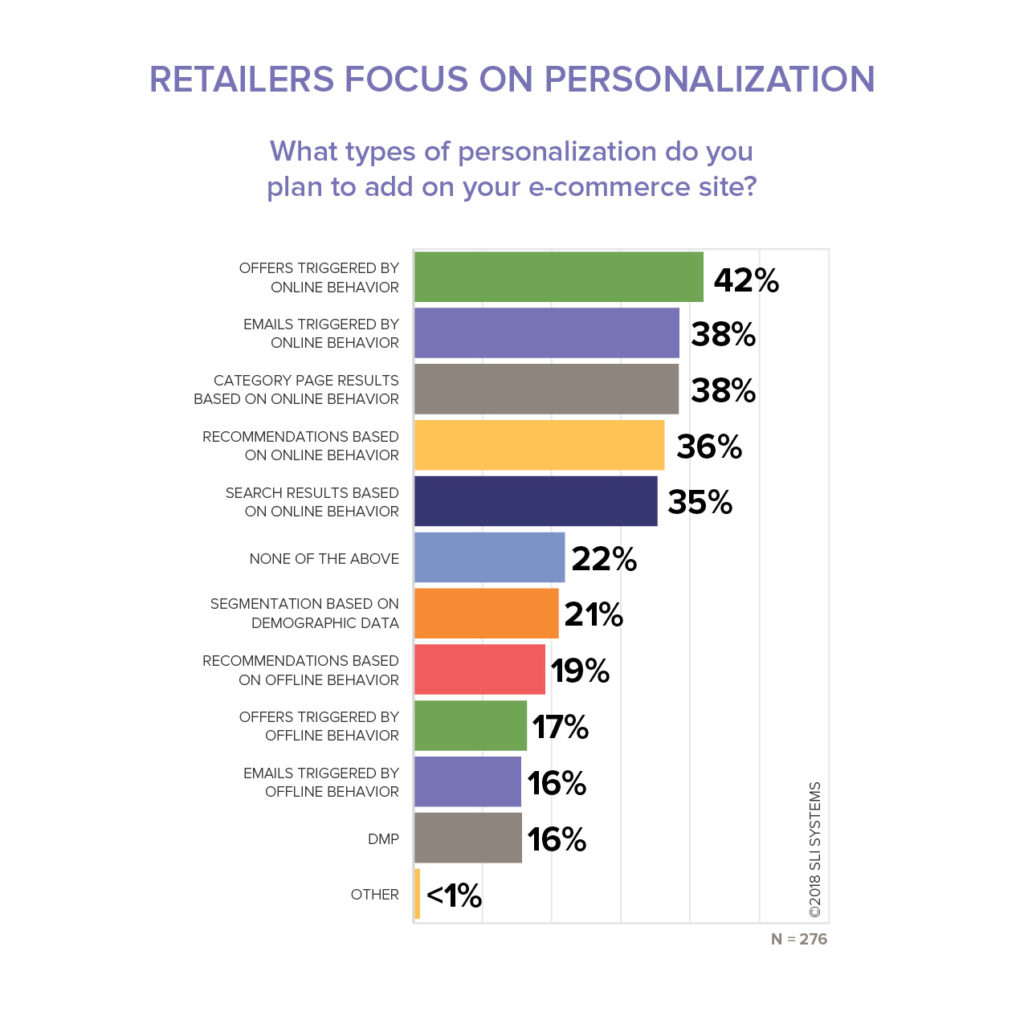
"Offers Triggered by Online Behavior" is the number one way retailers plan to add personalization to their e-commerce site. The top approach selected for implementation this year by 42% of retailers is Offers Triggered by Online Behavior. It was followed by Emails Triggered by Online Behavior and Category Page Results Based on Online Behavior 38% each in second place. Recommendations Based on Online Behavior took third place with 36%.

The Bottom Line

Finding out what your customers want and helping them get it through a personalized e-commerce experience isn’t just good for shoppers, it’s good for business. Sixty percent of those surveyed by SLI believe personalization will increase conversion rates. As technologies to improve personalization expand, retailers must take advantage or risk losing consumers to those who’ve embraced the growing demand for personalization.   

For more on the latest trends in e-commerce personalization, click here to download the H1 2018 EPIC Report.

Read More

M is the New E: Mobile Commerce Trends and Predictions

Posted by Carter PerezSeptember 26, 2018Uncategorized

Most of us can’t imagine life without our mobile phones. From a podcast on our daily commute to seeing who’s at the door when we’re not at home to last-minute holiday shopping, smartphones touch almost every aspect of daily life. Including how we go online. Since 2015, more people access the internet via mobile as compared to desktop or tablet, and in some locations use mobile at four times the rate of fixed access.

Yet many e-commerce companies still don’t give mobile equal treatment.   

Not for long. As consumer trust in mobile shopping rises, faster checkout and payment options become available, and optimization increases, mobile commerce is poised to take center stage. In fact, a recent study by Business Insider Intelligence reports that by 2021, mobile commerce will catch up to e-commerce, accounting for about 45% of sales.

It’s time to give mobile commerce a seat at the table.

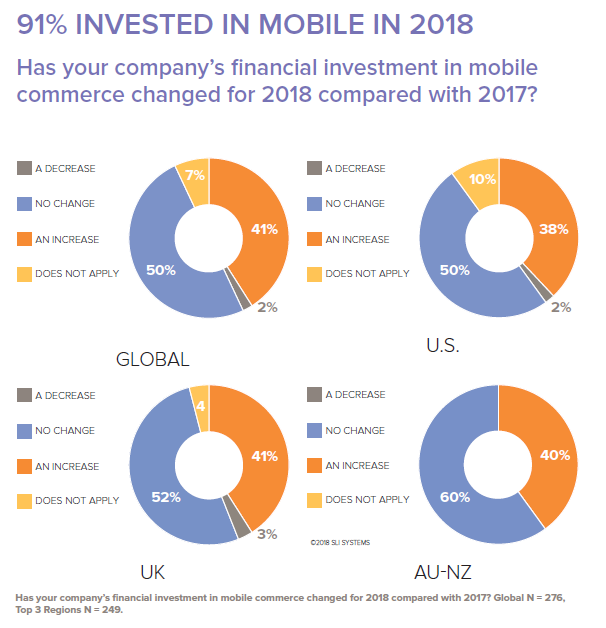
So how are e-commerce professionals preparing for increased mobile commerce? SLI Systems asked qualified retailers about it for our H1 2018 E-commerce Performance Indicators and Confidence (EPIC) Report. The results reveal considerable investment in mobile and high expectations for mobile-related revenue. Ninety-one percent of those surveyed report either maintaining (50%) their 2017 financial commitment or increasing (41%) their monetary investment this year, and almost all expect maintained or increased revenue.

It’s clear that when it comes to small-screen transactions, digital retailers are optimistic.

With only 1% of those surveyed foreseeing a drop in mobile revenue, e-commerce retailers are upbeat about growing consumer confidence in mobile site and app transactions. Eighty-one percent of retailers queried expect overall revenue increases from mobile sites and apps. And more retailers are expecting growth over 21% in the first quarter of 2018 compared to Q3 2017.

91% of retailers surveyed in the EPIC H1 2018 report said they were either maintaining or increasing their company's investment in mobile.

Investment in mobile is happening worldwide.

A look at the three most-represented regions in SLI’s EPIC Report shows close alignment in increased investments: 38% for the U.S., 41% for the UK, and 40% for the Australia-New Zealand region. And worldwide, more than half of those surveyed (54%) report an increase in the number of mobile initiatives and projects for 2018 compared with 2017, indicating retailers continue to anticipate consumer confidence in mobile site and app transactions will grow.

But regions vary in how they expect small-screen revenue growth to occur.

While globally retailers agree mobile is set to grow, there are geographic differences in predicted rates of growth. For example, when it comes to larger scale growth (over 21%), retailers from Australia and New Zealand are the most aggressive with 32% predicting larger revenue jumps for mobile site and app transactions. By contrast, 55% of U.S. respondents predict modest growth of 1-10% while that number remains closer to one-third in the UK and AU-NZ regions (35% and 32%, respectively).

Some industries are more focused on mobile than others.

SLI cross tabulated by industry to find out where retailers expect mobile to boom and where it will grow at a slower pace. Housewares / Home Furnishings leads the way in mobile investment with 65% reporting an increase related to mobile. Only 22% from Sporting Goods, by contrast, make similar plans. Representatives from Food and Beverage expect the biggest jump in small-screen revenue with 95% of respondents predicting an increase, while retailers from Sporting Goods and Media / Publishing were the least optimistic of the top five industries, with 78% and 63%, respectively, predicting an overall mobile site and app revenue increase.   

Digital retailers can’t afford to ignore mobile commerce.

It’s clear that mobile will play a large role in the future of digital commerce. What was once e-commerce’s biggest challenge is quickly becoming it’s largest asset. And the rapid growth predicted for mobile commerce means retailers need to prepare now or face getting left behind.   

For more on the latest trends in mobile commerce initiatives and revenue, click here to download the H1 2018 EPIC Report.

Read More

New and Improved Analytics and Reporting

Posted by Rachel UpsonSeptember 17, 2018Uncategorized

The SLI Reporting Console provides merchandisers with more than 100 metrics, pre-built reports, and an easy-to-use drag and drop interface to create custom reports. These analytics provide the detailed activity and revenue metrics required to understand customer behavior and take action to improve the site search experience. Analytics also provide visibility into the metrics used to calculate billing and assist in budgeting and assess return on investment. Earlier this month SLI Systems announced a suite of new analytics and reporting features that give our customers even more visibility of their shopper’s behavior. The newly launched functionality includes:

New Phrase Metrics

A new suite of top search phrase metrics and updates to our metrics give merchandisers more useful, actionable analytics including:
• Search phrase metrics for device types (mobile and desktop)
• Metrics that focus on search visitors
• Consistency in the way activity is counted across all metrics
• Metrics that report how many shoppers follow which redirects
Impact: The new metrics help merchandisers to understand more about how shoppers engage with their online stores. They can access data about product searches, search terms with poor results and high exit rates, and search performance and trends over time for any phrase. Merchandisers can also see the differences between how mobile and desktop users engage with a site. This information can be used to modify the shopping and mobile device experience, assess the impacts of merchandising activity, or identify opportunities to better meet shoppers’ needs.

Spider Free Metrics

Spider and bot activity can now be removed from the SLI Commerce Console reports using a combination of the International IAB/ABC Spiders & Bots List and user behavior analytics.
Impact: This new functionality will allow your merchandising team to focus their analysis and make decisions based on real user behaviour not malicious bot activity.

New Metrics for Learning Navigation, Site Champion, Learning Search and Log Data

New metrics are available and pre-existing metrics and reports have been enhanced.
Impact: New metrics increase the reporting coverage and level of detail available about how visitors engage with Learning Navigation and Learning Search. Merchandisers can also assess overall traffic with new details about which search engines crawl the site and which produce the most referrals.

Read More

New Merchandising and Analytics Capabilities

Posted by Doug McLeanSeptember 5, 2018Uncategorized

This morning, we announced several enhancements to our SLI Product Discovery SuiteTM – all designed to help retailers drive greater online success. Which retailers are looking to drive more online revenue this year? According to a survey of almost 300 e-commerce professionals – and as reported in Inside Retail— 91% are. Read more about ecommerce growth trends in SLI’s just-published E-commerce Performance Indicators & Confidence Report.

Therefore, if you are in the 91% – or if you’re not, but would like to be – today’s product update is relevant for you. We’ve focused on enhancing the analytics, metrics and merchandising tools retailers need to improve both conversion rates and average order value. New elements include:

  • Improved Product Filtering that allows retailers to boost, suppress, or even hide various product attribute variables based on shopper behavior. These new facet control features allow merchandisers to set up automated filtering rules based on SLI’s industry-leading machine learning and/or to manually tune filters based upon their business objectives and unique shopper behavior patterns. This blended automated/manual approach provides merchandisers with the “best-of-both worlds” by leveraging automated machine learning while also providing very granular control of search and navigation pages.
  • Upgraded Metrics and Analytics that includes new reports on top trending search phrases, desktop vs. mobile search trends, and the dreaded no-results phrases. The new metrics and analytics focus on insights and actionable information to help retailers increase revenue and average order value. The new reports also filter out spider/bot-generated searches. We also now provide global reporting and merchandising functionality for online retailers running multiple sites. New global reporting provides separate, as well as aggregate, reports on all key operating metrics. New merchandising functionality enables shopper behavior learned across individual stores to be applied to multiple sites.
  • Merchandising Tools that include Product Impact Testing and Analytics allow retailers to place new or potentially high-impact products “above the fold” to promote visibility and accelerate learning of shopper reaction to them. Included in this update is support for SLI Enhanced Search PersonalizationTM (ESP) for our customers integrated using the SLI API. There are also new shopper segmentation tools that allow promotions and search results to be segmented based on geography, shopper attributes, and/or device.

On average SLI customers see 70% better shopper conversion and almost double the average order value compared with industry averages. With these new product enhancements, we expect that advantage to continue to grow. These new features are, however, just the tip of the iceberg of the new features we’ll be adding to the SLI Product Discovery Suite over the course of the next year.

For more information on these product enhancements, please visit our Merchandising and Analytics web pages. If you’d like to be notified of the upcoming announcements or learn more about how SLI Systems can improve online retail business results, please get in touch.

Read More

5 Key Differences Between Mobile and Desktop Shopping

Posted by Lucy TahtAugust 20, 2018Mobile/Tablets, Rich Auto Complete, User Experience

It’s critical to optimize your e-commerce site for both mobile and desktop users in order to maintain a strong online presence. The goal is to create a seamless shopping experience for your customers regardless of the device they use to access your site. 

In this article, we’ll highlight the five top differences in desktop and mobile shopping. This should shed some light on how to best create an enjoyable customer shopping experience.  

1. Autocomplete is key for mobile users

Mobile shoppers don’t want to type out long search queries on small, touch screen keyboards. Online shoppers expect a robust autocomplete system that anticipates the products they’re looking for as they type in their search query.   

Implementing an intelligent auto-prediction search function on your site will quickly guide your mobile shoppers to the products they wish to see. Your desktop shoppers will appreciate this function as well, and will come to expect it if they have previously shopped on a mobile device on your site.   

Autocomplete creates a seamless shopping experience across devices, while driving customers to the products they are most likely to purchase. 

2. Mobile shoppers want advanced filtering options

Mobile shoppers want the ability to quickly jump not only to specific products, but also to brand or item-type product levels. Ensure that your site’s search functionality can incorporate smart filtering into results. This allows your mobile shoppers to efficiently navigate your site, whether they want to view a specific product or scroll through many similar products.   

For mobile shoppers operating on small screens, not having to go to multiple menus to navigate to product type or brand pages creates a more pleasant overall shopping experience that they are more likely to repeat. 

3. Mobile screen sizes are significantly smaller, and vary between devices and brands

One of the biggest differences between mobile and desktop shoppers is the difference in hardware and capabilities. Ensure your site functions similarly across devices, regardless of screen size.   

This means paying attention to whether site functionality is maintained across different brands and models of mobile devices, which can include tablets with 13-inch screens, and phones with 4-inch screens. Customers should have an optimized shopping experience on every device. 

4. Mobile wireless connections are slower than desktop broadband

Part of maintaining a seamless shopping experience is accounting for differences in loading times between mobile and desktop devices. In general, desktop devices have more robust hardware and broadband connections capable of loading image or flash-heavy sites much more quickly than their mobile counterparts.   

Mobile devices access your site from a variety of connections, including 3G, 4G LTE, and wireless broadband. Verify that your site design allows mobile devices to load your website’s pages with as little delay as possible. There is nothing more frustrating for mobile shoppers than clicking on the item they want and being greeted by a lengthy loading screen.   

Mobile customers won’t wait for slow sites. This affects customer retention and conversion rates. If your site isn’t optimally configured for a variety of connection speeds and hardware configurations, you risk losing customers and sales. 

5. Payment options

Mobile shoppers are less likely than ever to pull out their credit or debit card and type in all of their information. Incorporate a variety of different payment options on your site. Verify that your site has the ability to accept client-based payment storage options, like ApplePay and Google Pay, as well as more established alternative payment methods like PayPal.  

It’s important to determine if your checkout process is streamlined for mobile shoppers. One-click checkout has become more commonplace and allows both mobile and desktop customers to quickly complete the checkout process using existing payment, billing, and shipping information.  

For more strategies to improve your mobile e-commerce experience, download the white paper: Site Search and the Mobile Experience.  

Read More

Analyzing Trends: 3 Ways to Prepare for Black Friday

Posted by Doug McLeanAugust 16, 2018Mobile/Tablets, Uncategorized

To be ready for Black Friday Cyber Monday this year, you need to optimize for your mobile shoppers.For retailers, holiday season preparations are in full swing, making now the time to look back at what happened last year and what it taught us. The top three key trends reported in the wake of Black Friday Cyber Monday (BFCM) 2017 include:

  • Mobile devices accounted for 50% or more of transactions for the first time. These numbers varied depending on the source, but highlighted a statistical trend toward mobile.
  • The value of transactions during the BFCM period last year amounted to $13b – almost a 15% increase year-over-year. This is a hot market for retailers nimble enough to identify and meet consumer needs quickly.
  • For online retailers, there’s no longer two separate dates. BFCM is a four-day festival of shopping.

So, what are the implications of this as we all make inventory and promotion plans for 2018?

The first and perhaps the most actionable trend is the move to mobile devices by online shoppers. Retailers must have a mobile strategy that moves beyond just a responsive site. Retailers must optimize experiences for mobile shoppers using a mobile-first website or custom app. This may mean we’ll see more retailers move to Progressive Web Apps prior to BFCM. Yes, optimizing for mobile may make the PC-browser shopping experiences something of an afterthought. But, shoppers won’t be coming back to PCs, and there are now tools that minimize the development differences between the mobile and PC platforms.

To further endorse investing in mobile, remember that Google started moving to mobile-first indexing in March. So, from a pure SEO perspective, optimizing your sites for mobile users is just sensible.

The second issue that needs to be addressed is the gap between the growth in mobile shoppers and actual mobile transactions. Adobe reported that mobile devices made up 47% of online shopping visits but only 27% of purchases during the 2017 holiday shopping period.

The browser/buyer gap highlighted by Adobe indicates we still have a lot to learn about converting mobile shoppers, but there are some lessons from the desktop world that apply, just more so because of the screen-real-estate challenge. Getting your mobile search functionality right for the 2018 BFCM shopping season really matters.

With these trends in mind, how should a thoughtful practitioner prepare for Black Friday Cyber Monday 2018? SLI Systems’ Customer Success Managers spend every day looking at retail sites and have developed the following three recommendations for 2018.

  1. Omnichannel Retailers Should Optimize Local Search Behavior: Google reports 50% of consumers will visit a store within a day of doing a local search. The implications go beyond SEO strategy. You’ll want your search box to lead shoppers to compelling products and help them purchase either online or in store as quickly as possible. That means you want a search functionality that not only considers the shoppers’ search terms, but also their geo-location, season, and any other behavioral data available. Search results should include not only product options but store locations and local inventory availability when possible.
  2. Personalize Product Recommendations Based on User Device: Historical data indicates that iPhone users tend to spend an estimated 30% more than Android users per transaction. This allows merchandisers to set recommendation rules that either present higher priced (and more profitable) products OR present Android users with promotional discount options tuned to their likely purchase behavior.
  3. Split Your Shopper Analytics into Desktop and Mobile: Desktop/mobile aggregate analytics likely lead to merchandising decisions that serve neither audience very well. Much of the current behavioral data indicates that users (even the same users) do different things on their mobile and desktop devices. So, a mobile savvy merchandiser will evaluate the two audiences separately and look at how search terms, bounce rate, cart abandons and other key metrics affect conversion and average order value. If your current analytics tools aren’t capable of providing this degree of granularity, it’s time to look for new tools.

One final point on the trends we saw last year. Because the BFCM shopping season is no longer two discrete shopping days but a four-day window in which promotions will either succeed or fail, world-class merchandisers are placing more emphasis on monitoring shopper behavior as it happens and adapting pricing and promotions as necessary.

Without extremely robust reporting and merchandising tools, you may find yourself in a position of not “seeing” what’s happening on your store until it’s too late to respond in any meaningful way.

For more on how to be ready for BFCM, check out our e-book E-commerce Merchandising: The Ultimate Guide to the Newest Techniques.

Read More

Strategies for Comprehensive E-commerce Merchandising

Posted by Carter PerezAugust 6, 2018Uncategorized

Learn how to leverage e-commerce merchandising solutions to accelerate your e-commerce and delight your customers with a customized shopping experience.

In today’s e-commerce landscape, setting your products apart from the competition is vital to creating brand awareness and loyalty. Using a platform that your e-commerce merchandising team can leverage to spread product awareness will ultimately increase your sales and bottom line.

E-commerce merchandising today is about more than simply showcasing specific items. It should incorporate a broad social media campaign to access larger pools of prospective buyers. Additionally, it requires having the right tools to turn prospective buyers into customers, and customers into loyal, repeat shoppers.

This article will examine how merchandising has evolved and give you the information you need to effectively merchandise your products in the digital age.

Leverage Social Media to Create Awareness and Drive Traffic

The social selling of goods and services continues to be a growing trend that you need to capitalize on. Using social media to showcase your products is becoming one of the dominant methods through which your products can be marketed to potential customers.

The vast reach of social media allows you to showcase your products to more customers than ever before. Savvy e-commerce companies use social media to generate buzz around their products drive traffic to their sites. Social media allows you to generate brand awareness and reach untapped markets and cross-generational divides with your products.

Through effective social selling, your merchandising team can turn that awareness into increased traffic, higher sales, and greater brand loyalty. Ensure your merchandising team has the tools they need to create a strong social media presence. Doing so will lay the groundwork for continued growth in social selling, and allow you to adapt to changes in how social media is used by future generations.

Curate Your Products and Your Brand

E-commerce merchandising today is more far-reaching than simply placing popular items above-the-fold on your homepage or emails. Merchandising today must provide context for those products through intelligent curation.

Today’s best curating decisions are based on your unique site visitors’ behavior. But most merchandising teams don’t have the bandwidth to consistently pull customer data and manually curate item by item. That’s where automated merchandising solutions are changing the playing field. AI-powered product discovery solutions learn from customer behavior to automatically order search and navigation results based on popularity and even seasonality. Yet they won’t remove the power of the merchandiser, who can still easily curate, promote and move products with drag-and-drop merchandising controls and SEO-friendly URLs.

Curation is about more than showcasing a specific product. It is also an avenue through which you can, over time, define and sell the uniqueness of your brand. Cultivating brand loyalty will ensure a greater success rate in converting one-time purchasers to repeat customers. Think about what makes your company unique, and leverage those ideas as the framework through which you curate your specific products.

Harness the Power of User-Generated Content

User-generated content, such as ratings, reviews and customer images or videos increase sales by increasing engagement and shopper confidence.

Beyond merchandising onsite, user-generated content can also deliver powerful SEO benefits to increase your traffic from search engines. As users provide unique content for your product detail pages, their unique terms boost your rankings and provide social proof for other shoppers, making them more likely to convert.

Market to the Individual

Customers today expect a customized online shopping experience. E-commerce merchandising is an often overlooked, yet crucial, aspect of creating a personalized shopping experience for your customers. Use intelligent product recommendations to drive sales by relying on information about specific customers and their preferences.

Individualized merchandising requires a platform that can filter through shopping patterns, search history, and past purchases in real-time to generate product recommendations. In the past, your merchandising team had to do this by hand. Now, with a machine-driven e-commerce solutions, customizing your customer’s experience can be accomplished quickly and accurately.

Meeting your customer’s desire for a personalized shopping experience will ultimately result in higher AOV and a notable increase to your bottom line.

Incorporate Merchandising into your Site Design

Every aspect of your site design should be designed to maximize your merchandising. This ensures the products that you want to sell, and that customers want to buy, are always easy to find. Use a platform that allows your merchandising team to create bespoke landing pages to drive sales to promoted products.

Banners that incorporate customers’ past search queries or product views can also be used by your marketing team to further customize an individual’s shopping experience. Remember that merchandising is as much about the customer as it is about the products you are promoting.  Customers today expect to have a personalized, aesthetically pleasing user experience. Meeting these expectations is critical to your success.

Improve your e-commerce merchandising by downloading our white paper 16 Merchandising Strategies to Drive Online Revenue.


Read More

Posts pagination

1 2 3 4 … 64 >

Stay up to date with SLI

Featured Posts

  • Maximize Revenue with Enhanced Product Impact Testing
  • Top Five Ways to Prepare for Peak Season
  • Facets, Facets, Who’s Got the Facets?
  • Personalization: It’s Kind of a Big Deal
  • M is the New E: Mobile Commerce Trends and Predictions

Categories

About SLI Systems

  • What We Do
  • Who We Are
  • Why SLI

Learn

  • Webinars
  • News Room
  • Events

Connect

© Copyright SLI Systems, 2018. All Rights Reserved | US: (866) 240-2812 | Legal