SLI home
User login

A BLOG FOR E-COMMERCE LEADERS

  • Blog
  • Resources
  • Webinars
  • Customer Experience Scorecard

SLI Blog

Posts in Navigation Category

Why You Don’t Need to Brush Your Hair When You Buy Cosmetics

Posted by SLI SystemsJuly 21, 2014eCommerce, Merchandising, Navigation, Ratings and Reviews, Site Search, Site Search Tips, User Experience, Web Search

Are you addicted to cosmetics? Hoarding makeup is not uncommon. If you own multiples of eye shadows, lipsticks, blushes and brushes (as I do…), then you’re not alone. Indeed, it’s globally pandemic: according to research by Feel Unique, there are millions of women on the planet who hoard cosmetics. The same research also found women spend more than US$170,000 on makeup in their lifetime — and would rather ditch their man than go without cosmetics. Really! (Can’t say I share that sentiment!)

Pore-refining, firming, lifting, tightening, toning, brightening, whitening, collagen, retinol, vitamin A, vitamin C, aloe vera, lactic acid, glycolic acid, grapefruit seed extract… sound familiar? Of course, all of these processes and ingredients promise women the one thing we’re so desperate to hold on to … eternal youth.

Traditionally, women have bought beauty products offline, visiting their aesthetician at a department store cosmetics counter, pharmacy or specialised cosmetics boutique. Some still do, to get the informed opinion of someone they possibly know and certainly trust.

But that’s changed. Nowadays, consumers can access this information from the comfort of their own home (where, they’re probably wearing a snail slime mask — yes it really exists, I’ve tried it). They can even browse for cosmetics on the go via their tablet or mobile device.

With online beauty e-tailers such as Sephora, e.l.f. Cosmetics, Adore Beauty and Strawberrynet, women can feed their insatiable beauty-beast desire in a matter of minutes. Online beauty retailers are not only price competitive and stock the latest and most coveted beauty products — they also provide a wealth of information in the form of blogs and forums. So instead of talking to one person, who no doubt has some degree of vested interest in the sale (which may, or may not change their view of a product’s suitability), women can get the honest feedback from as many people as reviews they want to read. And often it’s those comments that shape purchasing decisions.

Buying online is also fast.

Beauty e-tailer e.l.f. Cosmetics (which stands for “eyes lips face”), has an intuitive search solution that instantly connects users with the products they’re looking for; in fact, the search “learns” from past site search behaviour by tracking visitors’ aggregate search queries and clickthroughs. What does this mean? That digital shoppers are being presented with the most popular and relevant search results. (So no plugging in “eye shadow” to annoyingly receive results for “mascara”.)

Beauty e-tailer, e.l.f. Cosmetics, “learns” from every visitor’s search. The result is a search function that helps users find exactly what they’re looking for in a matter of seconds.

Beauty e-tailer, e.l.f. Cosmetics, “learns” from every visitor’s search. The result is a search function that helps users find exactly what they’re looking for in a matter of seconds.


Don’t know exactly what you’re looking for? No need for a breakout. In addition to the user product reviews and popular and relevant searches, online beauty retailers make the shopping process even more stress-free by offering best-sellers, how-to’s, celebrity-inspired looks and video makeup tutorials… as well as a list of all the products required to achieve those looks. Did a new blush colour catch your eye in a magazine, but you can’t recall the product’s name? Not a problem. Sticking with our savvy beauty e-tailer e.l.f. Cosmetics (and yes, I do own quite a few of their products!) allows you to search for the product type, e.g. “blush,” to reveal “as seen in,” which displays cosmetics and skincare that has received press mentions.

Reviews written by people who’ve previously bought the product help visitors decide what to buy.

Reviews written by people who’ve previously bought the product help visitors decide what to buy.


I also like e.l.f. Cosmetics’ intuitive product-recommendations engine; this optimises suggested products based on recommendation logic and data learned from past customer behaviour. For example, when a visitor lands on a product details page for a lipstick, they’ll be presented with other products typically bought with that lipstick, such as a lip exfoliator.

Australia’s Adore Beauty uses video demonstrations to help guide shoppers’ decisions.

Australia’s Adore Beauty uses video demonstrations to help guide shoppers’ decisions.


Australian-based cosmetics e-tailer Adore Beauty allows visitors to navigate its site by skin type, catering for dry, oily, problem or blemish-prone skin. Shoppers can also search for products by ratings and reviews; this will be important if they only want to consider top-rated products to buy.

Onsite videos demonstrating how to use products also help to humanise the whole digital experience. While it’s not the same as asking the assistant at the counter for tricks in using shaded tones to make your eyes appear larger, you can sit, to your heart’s content, and learn how to apply products you may never have seen before, or products you felt too silly to ask about. You get the benefit of experts, and no one will know — until, of course, they see how well you can shade your eyelids!

So to fellow beauty addicts who haven’t yet tried the online shopping experience, give it a go: chances are, you’ll find exactly what you’re looking for!

Technology Makes Back-to-School Shopping Elementary

Posted by Dawn MortensenJuly 17, 2014eCommerce, Navigation, Site Search, User Experience

Though many of us are barely settling into summer, retailers are already touting back-to-school clothes and supplies. This year, the role of e-commerce in back-to-school shopping is bigger than ever. According to a June report by eMarketer, online back-to-school purchases in 2014 will increase 16% over 2013 – a growth rate that’s nearly triple the 5.85% growth rate in overall retail sales.

Smart retailers are optimizing their mobile sites and using more advanced search and navigation technology to capture the growing audience of online back-to-school shoppers.

Mobile-Optimized Sites

In mobile shopping experiences of years past, many site visitors would give up out of frustration with the cumbersome navigation. Today, retailers with good mobile-specific sites make it exceptionally easy for customers to shop using smartphones or tablets. These retailers will gain loyalty and carry an advantage into back-to-school shopping and beyond.

tea collection 15July14Tea Collection is a great example of a mobile site done right. My eight-year-old’s one desire for new clothing is a maxi dress (the kind that “are swirly and go to the floor,” in case you didn’t know). On Tea Collection’s mobile site, I search “Girls 8 maxi dress” and three great options come up – all in the right size. Easy peasy, as a third grader might say.

Advanced Site Search & Navigation

Just as with mobile search, online retailers will win shopper loyalty when they make it easy for visitors to find and buy what they’re looking for. Just as great search is critical to help shoppers find exactly what they want, great navigation is essential to help them browse or narrow down items in a broad category.

I went to Lakeshore Learning’s site knowing that I wanted some type of learning game. I typed “learning game” in the search box, then with 529 search results I was able to narrow down to a few great options by clicking the refinements “mathematics,” “puzzles & games,” “3rd grade” and “top rated.” Yes, The Allowance Game looks like a great way to ease my third grader back into math practice.

Next, visiting Gymboree, I searched for some clothing basics for my 12-year-old, entering “girls uniform navy.” Up popped navy blue cardigans, skirts, pants and hair accessories – I picked what I needed and was on my way through checkout. Done.

It’s Not Always So Easy

Unfortunately, not all e-commerce sites make it so simple for visitors. It’s hard to know the immense value of good search technology until you encounter a site that does it poorly. I thought I might stock up on notebooks, folders and other basic staples at DollarTree.com. But when I searched “notebooks,” the results just showed me filler paper, legal pads and journals. I had to scroll beyond the first 12 results before I saw composition notebooks and spiral bound notebooks. Annoyed with the less streamlined experience, I left the site and decided to pick up these items another time.

Make Sure Shoppers Don’t Lose Patience

As more stores learn how to do search and navigation right, consumers lose patience with retailers who make it more work than fun to do their shopping. Retailers who want to compete effectively need to keep up, and that means looking for the best technology possible for site features like search, navigation, product recommendations and merchandising. Retailers who go with a cheap, basic search function just to check that item off their list are missing the opportunity to delight and retain the customers who are used to better relevancy and a better, faster, more fun shopping experience.

SaaS Based Site Search Offers Reliability During Black Friday and Cyber Monday

Posted by geoffbNovember 27, 2013eCommerce, Navigation, Site Search

Imagine getting your online storefront ready for holiday shoppers during the lucrative Black Friday and Cyber Monday shopping days and beyond, only to have the entire eCommerce experience shut down due to traffic surges or server problems. The last thing you want your eager buyers to encounter is an error message or a painfully slow shopping experience.

For popular components of your website, like search and navigation, choosing properly hosted solutions can help you avoid failure exactly at the time when you need the highest performance and availability. With eCommerce experts predicting that online spending will increase about 15% in November and December – a total of $61.8 billion – you want to ensure your site is performing at its best during this time.

SaaS based solutions offer far better redundancy than many eCommerce businesses can build in-house. An infrastructure that hosts client sites on multiple servers in multiple data centers, in geographically separated locations, means the site will remain operational even if there is a problem. It’s the smart way to handle spikes in traffic or unexpected outages that could disappoint customers and cause a significant loss of revenue.

The type of highly redundant system described above can help meet many challenges – everything from a hurricane knocking servers offline to unprecedented crowds of shoppers overwhelming your website on Cyber Monday.

At SLI, we use multiple servers in each of our eight data centers in locations around the world to host our client sites, and we make sure to only use a fraction of the capacity of these servers at any given time. In this way, if a disruption occurs, our customers are assured of uptime. If you have questions about bringing greater redundancy to your eCommerce site, ask us by emailing discovery@sli-systems.com.


Give your Mobile Shoppers What they Want

Posted by Sasha ButkovichOctober 24, 2013eCommerce, Mobile/Tablets, Navigation, Site Search, Site Search Tips, Success Stories3 comments

Sasha Butkovich is Senior Writer for Ecommerce Outtakes and a guest blogger for SLI’s Site Search Today.

In case you haven’t noticed, I’ll say the obvious: mobile eCommerce is growing like crazy. Mobile and tablet sales continue to increase as a proportion of total online sales, surpassing desktop according to reports. But retailers looking to get in on the mobile action shouldn’t dive in blindly. As I mentioned in my last post on this blog, there are plenty of mistakes to avoid in a mobile strategy. Now, it’s time to take a look at the flip side of the coin and focus on the “dos” instead of the “don’ts.” Here are examples of three mobile sites that offer a great user experience. What do these retailers all have in common? They know their audience. Take a look.

Amazon: Personalization

24Oct_Amazon_screenshot1As the reigning king of eCommerce sites, it should come as no surprise that Amazon has their mobile act together. Of course, Amazon also knows their customers want access to their account wherever they go. Once a shopper is logged in to their Amazon account, the mobile site becomes more personalized, much like the desktop site. Customers will see product recommendations on the homepage that are based on their purchase and browsing histories. On top of that, users can manage their entire account, including wish lists, payment options, and more. All the perks of the desktop site, all the convenience of mobile, none of the mess. It’s a beautiful thing.

If users arrive on the homepage without logging in, they’ll see some of the popular Amazon products featured, like Amazon MP3 and the Kindle line. For a site that sells pretty much everything, it’s important to put that brand recognition front and center. Notice also that the homepage doesn’t waste precious space on a small mobile screen with the lesser-shopped departments. It only features the most popular categories to start people off with what they’re more likely to want.

Folica: Emphasis on Offers & Ratings

24Oct_Folica_Screenshot124Oct_Folica_screenshot2There’s something sleek about the Folica mobile site. The homepage doesn’t bother to feature any particular products, but instead places the focus on the special offers. It’s nice for users to see the promotions up front so they know they will be getting a good deal from this retailer. Mobile users are on the go, and won’t want to waste their time on a site that won’t offer them a good value, so this is a great way to make a happy customer.

Below the special offers banner, shoppers will find many specific categories to help them choose the avenue that will help them get to the items they want. One especially cool category is Top 10. Opening this tab, users will see a whole list of Top 10 categories, like Top 10 Hair Dryers, Top 10 Shampoos, and Top 10 Gifts. This is such a nice way to shop, because it combines product type with highest customer ratings in one simple list. Putting such a high emphasis on customer reviews shows how much this retailer values the shopper. This is especially nice for mobile shoppers because it eliminates the lower-rated items, helping the user get to the good stuff quickly.

Gap.com: Customer Service & Geolocation

24_Oct_Gap_Screenshot1Gap is an example of a retailer with both a strong eCommerce presence and strong brick-and-mortar sales. This retailer understands how to connect the two in their mobile site to provide the best experience for their customers. People shopping on their phone might be looking to make that purchase in a store, so the Find In Store option on this site is a perfect addition. Right from a product page, users can select their size and color, then click the Find In Store button. The site uses geo-location to show the closest stores, and displays the availability of the item in each location.

Putting customer service at the forefront is an awesome strategy, too. Free Shipping and Free Returns offers are displayed right on the homepage. When clicked on, the details are shown in a lightbox, eliminating the need for the user to navigate away from this page. Another great element is the easy access to the company’s other brands, as many of Gap’s customers also shop at Banana Republic and Old Navy. On this mobile site, it’s all easily connected by a simple drop-down menu at the top of the homepage.

At the end of the day, offering a great mobile experience is all about considering a site’s specific audience. Knowing who is using the mobile site and what they’re using it for will go a long way to inform the design and navigation. Offering customers any personalization, reviews, special offers, and geo-location they’re looking for will keep them returning to the site for future purchases!

What Do Young Consumers Want from eCommerce?

Posted by Erika StasiSeptember 23, 2013eCommerce, Navigation, Navigation Tips, Site Search, Site Search Tips, Social Media, User Experience

In my last blog regarding usability, I detailed some of the design features and functionality that make eCommerce user-friendly for an older demographic. The important features to optimize site search and navigation for the 65 and older user contrasts considerably with today’s youngest set of shoppers. These digital natives, ages 12-17 years old, are comfortable with evolving technologies, new features, and shopping concepts that take shopping online to a whole new level.

Investment firm Piper Jaffray, in its 25th semi-annual study, found that 79 percent of teen females and 76 percent of males shopped online, with 70 percent of those teens shopping online at their favorite stores. Creating an engaging and valuable website is crucial in capturing the attention of young shoppers, who have never experienced a time in their lives without technology.

Important Features for the Young Online Shopper

Jakob Nielsen, a pioneer in the user experience field, has researched the usability features most important for the teen online shopper in his article, “Teenage Usability: Designing Teen-Targeted Websites.” Nielsen says sites geared toward the teen market should use less text and adhere to standard design layouts. Examples of such sites are HotTopic.com, KidRobot.com, and SpencersOnline.com. Nielsen points out some specific design features that are important for teens: use of bright color, high quality images, integrated media such as videos and music, interactive games, and links to social media.

The Influence of Social Media

Social media has become an integral part of the teen market online shopping experience. The 2013 Piper Jaffray survey confirms that Facebook and YouTube are still the favorite social media sites for teens, with 53 percent of females and 52 of males indicating that social media influences their purchases (especially Facebook).

Other non-conventional social media platforms such as Pinterest and Polyvore have created innovative ways for teenagers to connect with their friends, see what their friends are interested in, and link them directly to eCommerce sites where purchases can be made.

Polyvore, for instance, is a community-driven social commerce site where members pick and choose from a variety of clothing, shoes and accessories to create fashion collages. Users can see other community members’ and friends’ fashion boards. Below these completed fashion boards are links to external retail websites, where users can complete any online transactions.

Pinterest, like Polyvore, is community-powered and allows members to follow friends’ and like-minded individuals’ pinboards. Pinterest users can re-pin rich images of home design, nature, fashion, food and beverages, and an assortment of other items for their followers to see. Each image or “pin” links directly to an online retailer’s site, essentially sharing that link with a huge network of followers.

Surprising Findings on Usability for Teens

Compared to other demographics, the teen market is actually less affected by poor usability features such as errors (their own or at the fault of the site). In the case of negative usability, such as slower loading time, the teen market has been shown to forgive and forget more easily than the senior market. Longer load times can still be frustrating for any user demographic, and may seem even more so for a group that craves instant gratification. However, patience is something that the youth market has practiced because of all types of technology mishaps they experience on a daily basis. This is unlike the senior market, which isn’t completely absorbed by the tech craze of smartphones, tablets and laptops.

Why the Teen Market Matters

Although some will argue that tailoring eCommerce sites to attract the teen market isn’t as valuable because teens don’t have direct buying power when it comes to online shopping, they are extremely influential when it comes to the consumption levels of their parents. According to the 2012 Harris Poll YouthPulse, teen-influenced purchases account for over $211 billion worth of purchasing power! With 23 million teens in the U.S. alone, teens are making a huge impact to the economy and their parents’ wallets.

When considering the teen demographic in their site design and usability, internet retailers should implement those site search tips listed above as a starting point to capture their target market.  Including non-product content such as social media links and interactive content such as Instagram, Pinterest, and Polyvore is a way to stay relevant and exciting to this young group. The key to engaging these Gen Z consumers is to keep it simple, avoid boring content, and consider using responsive website designs for multiple interfaces to keep your site fresh and fun.

Contact SLI Systems for a free site critique to learn how you can optimize your eCommerce site for this emerging youth market and other key market segments.

Customer Success: Natural Wellbeing

Posted by JoeRSeptember 17, 2013Navigation, Newsletter, Refinements, Related Search, Rich Auto Complete, SEO, Site Search

Natural Wellbeing is a site rich with reports, reviews and expert advice about the holistic and natural wellness products they offer. Such quality content can really help move shoppers through purchase decisions – especially for a natural health products site, where first-time buyers can be skeptical. But in order to be useful, the content has to be easily searchable and relevant to the needs of each individual buyer.

When Natural Wellbeing signed with SLI Systems in 2009, I saw a great opportunity to help them bring their rich content into their site search capability. They had a blog, an active social media presence, and a wiki with well-written descriptions of every herbal ingredient that their certified therapists use. But none of these resources were tied to the search results page. We worked closely with them to implement a number of changes.

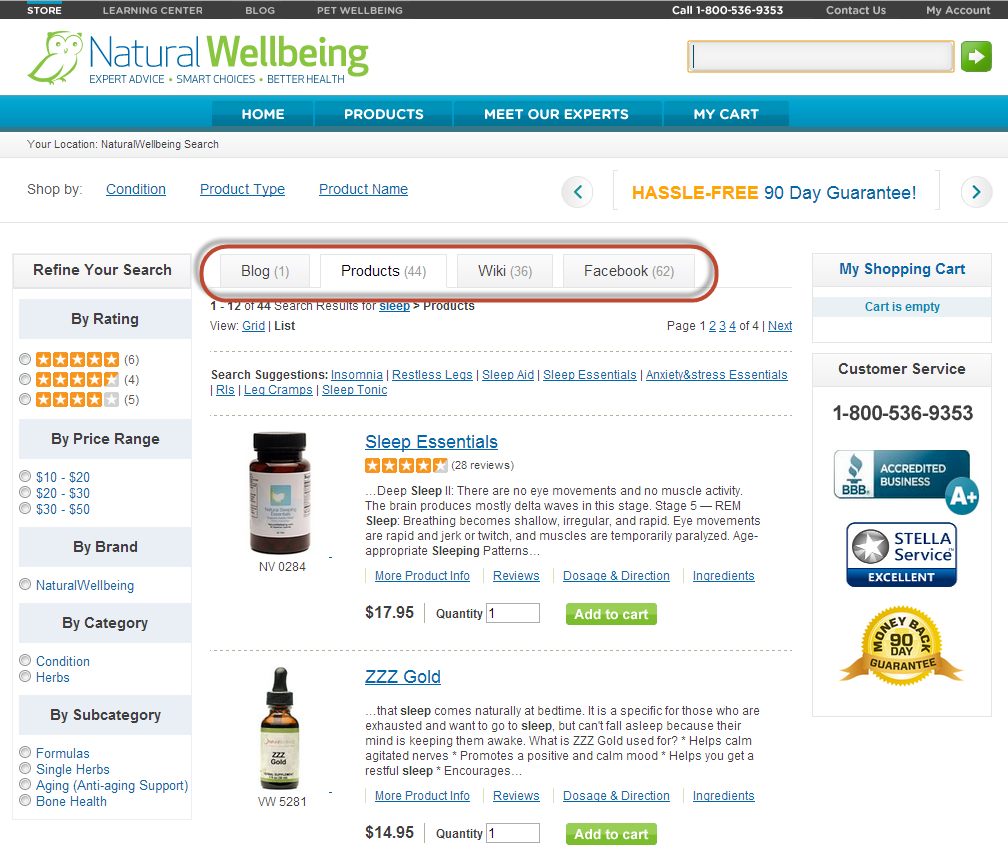
One change was to create a tabbed format to include relevant blogs, wiki content and Facebook content onto each search results page. In the below screen shot, you can see that a search for “sleep” now shows 44 related product results on the product tab, and there are additional tabs for accessing related blogs (1), wiki articles (36) and Facebook posts (62).

refinement_screenshot_11Sep13We also created a set of refinements for them (see the left column in the above screen shot), where users can narrow down the search results by rating, price range, brand, category or subcategory. For example, if a user wants to look at only formulas that contain blends of different herbs and doesn’t want to spend more than $20, they can click the $10 – $20 range in Price Range and Formulas in Subcategory. This narrows the number of product results from 44 to 25, as shown below. From that point, the user may want to look at ratings and read more about the products to decide which they want to purchase.

Since SLI’s site search continually learns and improves, the relevancy of search results improves over time. Natural Wellbeing realizes the benefit of letting SLI’s learning search do its work – it frees them from having to constantly tune results, allowing them to focus on other priorities in their business.

Both Natural Wellbeing and its sister site Pet Wellbeing also use SLI’s Site Champion product, which keeps improving SEO without any work on their part. Site Champion uses visitors’ site behavior to automatically create optimized landing pages that are indexed by Google and other Internet search engines.

In March of this year, I worked with them to add SLI’s Rich Auto Complete, which auto-displays product listings and images based on what users are typing in the search box. Since users can click on these products directly from the search box, the feature shortens the path from searching to buying, which creates a better user experience and improves conversions. Since adding Rich Auto Complete, the sites have received significantly higher page views, search users and search result clicks.

Now I’m working on ways we can help with their push for growth. I heard what they’re doing with email marketing, for example and showed them the types of custom templates and landing pages we can create for those campaigns. I’ve let them know what’s working well for others and have developed solutions that will help them achieve their current goals. It is through casual and interactive conversation that we come up with solutions that make a real impact.  Being an extension of our customers’ team is what I and all SLI Customer Success Managers strive for.

Sweet Success with Jelly Belly

Posted by Dawn MortensenSeptember 5, 2013eCommerce, Merchandising, Navigation, SEO, Site Search, Site Search Tips, Success Stories1 comment

Buttered Popcorn… Cream Soda… Toasted Marshmallow… most of us have favorite likes or dislikes when it comes to Jelly Bellies. And it’s nice to be able to order those favorites from Jelly Belly Candy Company’s online store at www.jellybelly.com. Jelly Belly’s eCommerce site is an important global sales channel for the company, which sells 100 other types of confections in addition to its 75 flavors of Jelly Bellies.

As highlighted in a newly published case study, Jelly Belly uses SLI Systems to improve its user experience and profitability. By optimizing site search and SEO, SLI helped Jelly Belly see a 33% increase in site conversions and a 10% increase in average order value. By using SLI’s customized product results pages and adding those links to email campaigns, Jelly Belly realized an 85% better open rate for emails.

Jelly Belly’s director of e-business Brandon Finch works closely with his Customer Success Manager at SLI to stay on top of search trends and best practices. Recently, Jelly Belly’s search data showed that their BeanBoozled product line of odd-flavored jelly beans was one of the most-searched for products on their site.

By the way, if you haven’t yet been BeanBoozled, watch out – a 1.6 ounce box contains both commonly liked flavors such as Peach or Licorice and identical-looking beans with flavors like Barf and Skunk Spray. It’s a higher-stakes trick than the one I did to my sister as a kid, swapping Watermelon Jelly Bellies for Jalepeno-flavored ones.

After learning how popular its BeanBoozled line was, Jelly Belly worked with SLI to add similar products to the search results page, so that shoppers buying BeanBoozled will also learn about Jelly Belly’s line of Harry Potter Bertie Bott’s Every Flavour Beans, which also have strange flavors. (In a handful of Bertie Bott’s, you may taste dirt, earwax, booger, cherry and tutti-frutti.)

SLI also worked with Jelly Belly to create faceted navigation for Jelly Belly’s site, with search refinement options in the left column of the page. For those really into unusual Jelly Belly flavors, their BeanBoozled results page offers refinement by Taste, with the choices of Icky, Assorted or Chocolate.

SLI’s work with Jelly Belly is just one fun example of how SLI continually works to improve each customer’s site for the best possible search results and conversions. You can read additional examples from Boden, American Bridal, PartySuppliesDelivered, Snow + Rock and others on our case studies page, or listen to customers speak in our podcasts and recorded webinars.

SaaS vs. On-Premise Solutions

Posted by Shaun RyanAugust 6, 2013Navigation, Newsletter, Site Search

One of the most frequently asked questions when evaluating site search solutions is why a SaaS-based solution is better than on-premise. The reasoning may follow that with on-premise, you pay for software once, instead of monthly service fees. But while having a one-time payment for a software package may seem like the most logical and cost-effective solution, it can actually end up costing more in the long run.

On-premise software solutions require an extraordinary investment not only for the up-front financial costs, but also in ramp-up time, education, support and maintenance. Typically the software will be full of features that cater to all the different uses, but many of these won’t be used by one individual customer. Additionally, on-premise software is generally slower to upgrade, with typically six or twelve month release cycles. SaaS solutions provide an answer to many of these issues, giving users more time and flexibility to support other business priorities.

Harness Deep Knowledge and Experience

When you sign on with a SaaS solution, you’re not getting a piece of software and a general 1-800 customer service number – you’re getting a consultative group of industry specialists, dedicated to helping you achieve your goal. SaaS companies earn their money by having you as a long term customer – so they are financially incented to make sure you are happy and continue to use their software. SaaS companies can see how their software is being used, which helps build their knowledge of best practices. Since service is a key component of the model, you’ll find that SaaS companies have deep technical knowledge and provide value through excellent support, recommendations on industry best practices or specific features that will make your unique site shine.

Faster Ramp-Up Time

Going with a SaaS-based solution means you’ll also take advantage of faster deployment and ramp-up times. Your IT staff won’t have to invest the time and money to become experts at installing and maintaining their software. Technology, as well as customer preferences, is constantly changing. You’ll find SaaS teams to be agile in implementing new or complex features so you can quickly adjust to shifting demands. By adopting a SaaS solution, you can keep your in-house team focused on your most important daily priorities, and let a dedicated team of specialized engineers support your SaaS operations and maintenance.

You’ll also avoid long ramp-up times spent in internal training and resources. Once implemented, you’ll receive tutorials and ongoing customer support for all of your teams. The bottom line is this: your new capabilities will be up and running more quickly, and you’ll save yourself a lot of time (not to mention headaches).

Continuous Innovation & Customization

Another great benefit of going with SaaS is that all customers receive regular, automatic access to the most up-to-date features and products. As new features, products or improvements are created, the technology is shared across all users. The best solutions’ features can also be tailored to meet your site’s specific needs, for a streamlined experience that isn’t one-size-fits-all. Often, these ongoing upgrades are available at no added cost. You avoid the hassle of later purchases and updates of traditional software licenses, as you trade one-time convenience with ongoing support, recommendations and continuously-improved technology.

Redundancy & Scalability

It’s also important to keep the stability of your software in mind. When your core business depends on whether your site is up and functional, it’s imperative that your site doesn’t fail. Make sure your SaaS provider has a network of multiple data centers and redundant server architecture to ensure that your site will continue to run smoothly even during high web traffic spikes or natural disasters. There is a high chance that your SaaS provider will have more sophisticated, redundant systems than you could ever afford.

Round-the-Clock Customer Support

If your SaaS supplier is a global company then they will have support people based around the world. One of the biggest benefits we see is the ability to provide outstanding customer service and guidance. Knowing that you have personalized attention from your customer support representative and a full team of engineers supporting your eCommerce needs around the clock gives you peace of mind and allows you to focus on other important projects.

The benefits of SaaS vs. software-based site search are clear, which is why I strongly believe in SLI Systems’ approach to providing the best site search, navigation and SEO solution for your eCommerce business. For the third year in a row, SLI was named the #1 SaaS Site Search provider to the top 500 online businesses as ranked by Internet Retailer, and a leading site search provider to the top 1,000 online retailers.

In eCommerce, Be Really, Really Redundant

Posted by Dawn MortensenJune 24, 2013eCommerce, Navigation, Site Search1 comment

In many situations in life, redundancy is undesirable. Our language and writing teachers told us to avoid use of redundant phrases – totally destroyed, armed gunman, exact same, merge together… you get the idea. In business, a company merger creates redundancies in job positions, which can mean layoffs. In many situations where efficiency is prized, redundancy almost seems to be its antonym – unless you work in high tech, especially cloud computing, where redundancy of servers and data centers is preventing the major inefficiency of downtime.

In the world of SaaS, redundancy is a competitive advantage. Software as a Service companies with redundant data centers are hosting client sites and customer data on multiple servers in multiple locations – each mirroring the other so that any of them can keep the customer site going if there’s a problem with the others. This redundancy allows the SaaS company to keep its customers’ sites running during spikes in traffic or unexpected outages.

Downtime is especially detrimental in eCommerce; online buyers can be ruthless when they encounter it. Surveys by Akamai and Gomez.com show that among shoppers who have trouble with a web site’s performance, 79% will never return to buy from that site again. Plus, 44% say they would tell a friend about their poor experience. Even a few minutes of downtime can result in dozens of lost customers on an ordinary day. Imagine the effect of downtime during a peak shopping day like Cyber Monday!

How can eCommerce businesses manage this risk and stay up and running in a way that’s affordable? In the blog Built-In Redundancy to Prepare for Natural Disasters, SLI Systems CEO Shaun Ryan explains how, as a SaaS-based provider of advanced site search and navigation, SLI processes billions of queries and serves up search results for its customers via multiple servers in each of eight data centers in locations around the world. SLI servers are filled to just a fraction of their capacity to allow for spikes in customers’ site traffic. Simply by contracting with SLI to get better results and more conversions from site searches, an eTailer has the added protection of redundancy.

During Hurricane Sandy, for example, not one of our customers saw a break in service. Though headquartered in California, SLI was founded in Christchurch, New Zealand, which was hit by two major earthquakes in the past three years. By personal experience, we’ve learned how important it is to be prepared for natural disasters. And we want our customers to be prepared, as well. That’s why we offer redundancy at no added cost to our clients.

This year, a stronger-than-normal Atlantic hurricane season is predicted through the end of November. Especially with back-to-school and even holiday shopping spikes on the horizon, now is the time to move to a full-service site search provider that can help you handle the load.

We don’t get uptime perfect – no one does. We had an unusual three-minute outage one night about a month ago. Our redundant architecture quickly kicked-in, resulting in no downtime for our customers. We found that the outage was due to human error, from a break in our process, and we made the necessary changes to ensure it wouldn’t happen again. Although none of our customers were affected, we still sent out email notifications outlining what had happened. One of our customers, Ian MacDonald of PartySuppliesDelivered.com, wrote a nice email to express his appreciation for our honest communication about the event.


Thanks, Ian. We’re honest and transparent because we know it builds customer trust (plus it’s just who we are). We appreciate you, too.

The Growing Global Need for Great Site Search

Posted by Shaun RyanJune 19, 2013Mobile, Navigation, Newsletter, Site Search

Every day we see how introducing great site search is one of the easiest and quickest ways to turn more visitors into buyers. Earlier this month our customers were telling their stories at IRCE 2013 in Chicago. These are businesses like Samuels Jewelers, which doubled the per-visit value of their site search users after implementing changes that make search results more relevant. And Party Supplies Delivered, which increased their conversions by 203% after switching from their platform’s default search to advanced search.

Al Gore’s keynote address was about the international opportunities that abound for eCommerce – an industry that is growing 15 percent each year, even during a period of global economic stress. “You need to think global,” he said, pointing out that the number of Apple iOS and Android devices activated in the U.S. was surpassed in January by those activated in China. The economic balance is shifting and we need to accept, and anticipate, change.

We spoke with many online retailers who haven’t yet optimized their site’s search and navigation, and his keynote hit home. As eCommerce grows internationally, SLI plays a pivotal role in providing the tools that enable the best shopping experiences for customers around the world. Whether for large online retailers with multiple international sites or family-owned businesses, we work to provide the best products, resources and customer service, so that all of our customers can focus on what matters most to them – their business.

Seizing the Opportunity with IPO, Expansion

As a company that has an established customer base spanning five continents, we understand the global opportunity. Brazil is one of our most recent, and fastest-growing markets, adding to our strong presence in the United States, the UK and Australia. We are working with some of the top Brazilian online retailers to improve their search and navigation, both on web and mobile sites. We are also starting to work with our first Japanese partners and customers.

The vast opportunity for further international expansion is one of the reasons SLI Systems decided to raise capital through its IPO on the New Zealand Exchange on May 31, 2013. It has been an exciting time for SLI’s founders and investors as we’ve watched shares rise since the original offer of NZ$1.50. You can hear more about our story in this June 4 interview.

We’ll use the investment to fuel sales, marketing and customer support as well as innovation, as we grow our engineering and product development teams. This will build on our tradition of bringing our customers the ongoing feature and product developments they need to make their eCommerce sites the most successful in an increasingly competitive marketplace. We believe that innovation and measured growth are the secrets of global success.

Today’s online shoppers are starting to see gorgeous magazine-like sites tailored for mobile browsing, interactive tools that aid decision making, and the convergence of social and editorial to create highly-personalized shopping experiences. More and more of our customers are eager to work with us to integrate these features into their site search and navigation. As technology advances and global opportunities continue to expand, we anticipate and remain at the leading edge of the many innovations in eCommerce yet to come.

Load More

Stay up to date with SLI

Featured Posts

  • Maximize Revenue with Enhanced Product Impact Testing
  • Top Five Ways to Prepare for Peak Season
  • Facets, Facets, Who’s Got the Facets?
  • Personalization: It’s Kind of a Big Deal
  • M is the New E: Mobile Commerce Trends and Predictions

Categories

About SLI Systems

  • What We Do
  • Who We Are
  • Why SLI

Learn

  • Webinars
  • News Room
  • Events

Connect

© Copyright SLI Systems, 2018. All Rights Reserved | US: (866) 240-2812 | Legal