SLI home
User login

A BLOG FOR E-COMMERCE LEADERS

  • Blog
  • Resources
  • Webinars
  • Customer Experience Scorecard

SLI Blog

Posts in SEO Category

Get Heard, Get Prizes: Take Our Annual eCommerce Survey

Posted by Dawn MortensenSeptember 25, 2013About us, eCommerce, SEO, Site Search1 comment

Want your voice to be heard? It’s survey time again, when SLI Systems asks our network of online retailers and other eCommerce experts to weigh in on their current experiences with site search and their plans for the coming year. The annual eCommerce survey provides the industry with benchmarks on how businesses are attracting customers to their site, improving usability and increasing conversions.

If you haven’t yet completed the survey, please take 5 minutes to do so now at now at http://www.surveymonkey.com/s/8QL7DJB. Every participant will receive a full report of the results. Plus, we’ll enter your name in a drawing to receive one of nine prizes: eight Apple gift cards and one Grand Prize of a new Amazon Kindle Fire HD tablet.

Last year, our 2013 eCommerce Survey of more than 450 eCommerce professional revealed that more than 40 percent of online merchants were making improvements to their SEO and merchandising in order to drive additional holiday shopping traffic. When asked about plans for 2013, retailers around the world identified international expansion as a major priority. Other top priorities were improving conversions (63%) and attracting more customers (61%).

For the 2014 eCommerce Survey now underway, questions are designed for learning how online retailers are using site search to improve the effectiveness of their marketing campaigns. We also ask about holiday plans and the year ahead. The results should be interesting – watch for them in early November.

This survey will be live only through next Tuesday, October 1, so please don’t hesitate. Please be sure to include your contact information at the end of the questionnaire for entry into the drawing. We’ll announce prize winners in October.

Thank you for your thoughtful insights, which always make our survey results valuable.

Optimize Your Search Merchandising for the Holidays

Posted by Shaun RyanSeptember 17, 2013Analytics, Merchandising, Newsletter, Related Search, SEO, Site Search

As an eCommerce professional, you’ve likely been preparing for the holiday shopping season for months – deciding which products to feature, planning orders and organizing marketing campaigns. Retailers predict an 11-20% rise in holiday spending for 2013, with eCommerce and mobile driving much of the growth (Retail TouchPoints, Aug. 12). While the opportunity is great, so is the challenge of making your products stand out. Here are some thoughts on how you can use search merchandising tactics to ensure your holiday campaigns are effective.

Get Insight from your Site Search Data

The first step in successful search merchandising is to look at your site search data for real-time insight into users’ behavior. Review the queries that shoppers type into your search box, along with your site analytics. Which searches are most popular? Do shoppers want a product you don’t have? Are they seeing “no results pages” because they search using different language than you use on your site? Do they move from your results pages to a purchase, or do they jump away from your site without buying?

If you gather such insights from your search data now, you’ll have time to make improvements well before Black Friday and Cyber Monday. If you don’t already have an advanced site search provider, engaging in such services now can give you the extra set of hands and tools you’ll need to be agile in response to holiday trends.

Use the Right Tools at the Right Time

The second step of a successful search merchandising plan is to know which tools can make the most impact, and how to use them. A couple of my favorite tools for holiday merchandising are landing pages and gift finders.

  • Landing Pages for Holiday Products: In most cases a relevant search results page is the best page to show your visitors when they type in a search term. However in some cases you want to have more control over their experience and a specialized landing page may be the right tool. For seasonal specials, simply create a web page with your top holiday merchandise and set the page to load when visitors type certain words like Holiday, Christmas or Hanukkah into the search box. Assign a dedicated URL to your holiday landing page, and then use it in holiday email campaigns and advertising. Not only does this promote your holiday specials, but it gives you a trackable link in your Google Analytics so you can gauge the success of the campaign.
  • Gift Finders: Gift Finders are another way to generate more sales revenue around the holidays. Set up refinements that allow someone to define a set of criteria for a gift – e.g. price, occasion, recipient type and gift type – then see a list of the products that match those criteria. Promote your gift finder on your home page or by using a landing page with a PPC link for email and ad campaigns. When done correctly, it can be a useful tool that increases users’ likelihood of buying from your site. Read more about gift finders in this blog from SLI Systems Co-Founder Geoff Brash.

Branding banners, ribbon overlays and integration of social media are other merchandising tools that can improve the odds of holiday shopper conversion. These and a dozen other tools are covered in the new white paper “Using Site Search Data to Improve Merchandising,” which is a free download from the SLI Systems website.

Lastly, be sure your site search provider offers proper merchandising controls for your site so you can quickly test and easily refine the presentation of promotional messages, products and content on your search and navigation pages. Such agility will help you compete for consumers’ spending money during the holidays and beyond.

Customer Success: Natural Wellbeing

Posted by JoeRSeptember 17, 2013Navigation, Newsletter, Refinements, Related Search, Rich Auto Complete, SEO, Site Search

Natural Wellbeing is a site rich with reports, reviews and expert advice about the holistic and natural wellness products they offer. Such quality content can really help move shoppers through purchase decisions – especially for a natural health products site, where first-time buyers can be skeptical. But in order to be useful, the content has to be easily searchable and relevant to the needs of each individual buyer.

When Natural Wellbeing signed with SLI Systems in 2009, I saw a great opportunity to help them bring their rich content into their site search capability. They had a blog, an active social media presence, and a wiki with well-written descriptions of every herbal ingredient that their certified therapists use. But none of these resources were tied to the search results page. We worked closely with them to implement a number of changes.

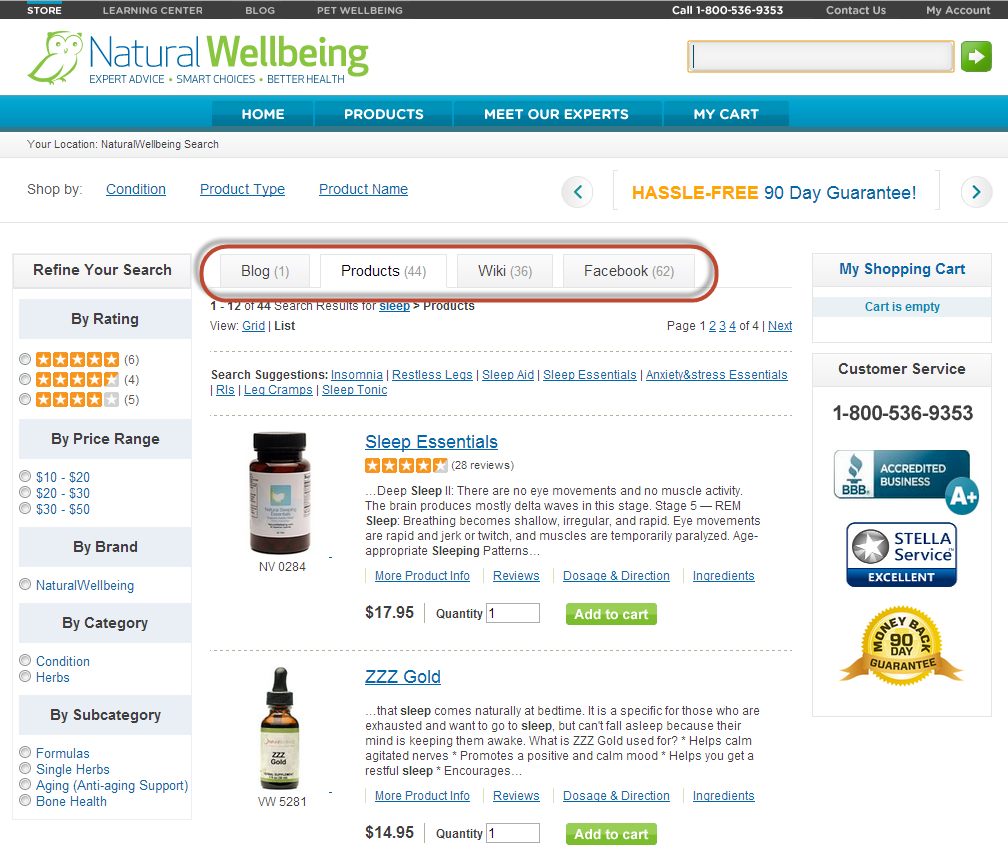
One change was to create a tabbed format to include relevant blogs, wiki content and Facebook content onto each search results page. In the below screen shot, you can see that a search for “sleep” now shows 44 related product results on the product tab, and there are additional tabs for accessing related blogs (1), wiki articles (36) and Facebook posts (62).

refinement_screenshot_11Sep13We also created a set of refinements for them (see the left column in the above screen shot), where users can narrow down the search results by rating, price range, brand, category or subcategory. For example, if a user wants to look at only formulas that contain blends of different herbs and doesn’t want to spend more than $20, they can click the $10 – $20 range in Price Range and Formulas in Subcategory. This narrows the number of product results from 44 to 25, as shown below. From that point, the user may want to look at ratings and read more about the products to decide which they want to purchase.

Since SLI’s site search continually learns and improves, the relevancy of search results improves over time. Natural Wellbeing realizes the benefit of letting SLI’s learning search do its work – it frees them from having to constantly tune results, allowing them to focus on other priorities in their business.

Both Natural Wellbeing and its sister site Pet Wellbeing also use SLI’s Site Champion product, which keeps improving SEO without any work on their part. Site Champion uses visitors’ site behavior to automatically create optimized landing pages that are indexed by Google and other Internet search engines.

In March of this year, I worked with them to add SLI’s Rich Auto Complete, which auto-displays product listings and images based on what users are typing in the search box. Since users can click on these products directly from the search box, the feature shortens the path from searching to buying, which creates a better user experience and improves conversions. Since adding Rich Auto Complete, the sites have received significantly higher page views, search users and search result clicks.

Now I’m working on ways we can help with their push for growth. I heard what they’re doing with email marketing, for example and showed them the types of custom templates and landing pages we can create for those campaigns. I’ve let them know what’s working well for others and have developed solutions that will help them achieve their current goals. It is through casual and interactive conversation that we come up with solutions that make a real impact.  Being an extension of our customers’ team is what I and all SLI Customer Success Managers strive for.

Sweet Success with Jelly Belly

Posted by Dawn MortensenSeptember 5, 2013eCommerce, Merchandising, Navigation, SEO, Site Search, Site Search Tips, Success Stories1 comment

Buttered Popcorn… Cream Soda… Toasted Marshmallow… most of us have favorite likes or dislikes when it comes to Jelly Bellies. And it’s nice to be able to order those favorites from Jelly Belly Candy Company’s online store at www.jellybelly.com. Jelly Belly’s eCommerce site is an important global sales channel for the company, which sells 100 other types of confections in addition to its 75 flavors of Jelly Bellies.

As highlighted in a newly published case study, Jelly Belly uses SLI Systems to improve its user experience and profitability. By optimizing site search and SEO, SLI helped Jelly Belly see a 33% increase in site conversions and a 10% increase in average order value. By using SLI’s customized product results pages and adding those links to email campaigns, Jelly Belly realized an 85% better open rate for emails.

Jelly Belly’s director of e-business Brandon Finch works closely with his Customer Success Manager at SLI to stay on top of search trends and best practices. Recently, Jelly Belly’s search data showed that their BeanBoozled product line of odd-flavored jelly beans was one of the most-searched for products on their site.

By the way, if you haven’t yet been BeanBoozled, watch out – a 1.6 ounce box contains both commonly liked flavors such as Peach or Licorice and identical-looking beans with flavors like Barf and Skunk Spray. It’s a higher-stakes trick than the one I did to my sister as a kid, swapping Watermelon Jelly Bellies for Jalepeno-flavored ones.

After learning how popular its BeanBoozled line was, Jelly Belly worked with SLI to add similar products to the search results page, so that shoppers buying BeanBoozled will also learn about Jelly Belly’s line of Harry Potter Bertie Bott’s Every Flavour Beans, which also have strange flavors. (In a handful of Bertie Bott’s, you may taste dirt, earwax, booger, cherry and tutti-frutti.)

SLI also worked with Jelly Belly to create faceted navigation for Jelly Belly’s site, with search refinement options in the left column of the page. For those really into unusual Jelly Belly flavors, their BeanBoozled results page offers refinement by Taste, with the choices of Icky, Assorted or Chocolate.

SLI’s work with Jelly Belly is just one fun example of how SLI continually works to improve each customer’s site for the best possible search results and conversions. You can read additional examples from Boden, American Bridal, PartySuppliesDelivered, Snow + Rock and others on our case studies page, or listen to customers speak in our podcasts and recorded webinars.

Reason to Party: 203% More Conversions

Posted by Dawn MortensenMay 20, 2013Conferences, eCommerce, Navigation, Search Conferences, SEO, Site Search

This is first in a series of success stories on eCommerce sites that are growing their business with advanced site search. See live presentations of these stories at the SLI Theater at IRCE June 4-6.

Every eTailer knows this: You can’t get people to buy what they can’t find.

In the online party supply world, for example, a consumer has dozens of choices for where to buy a $250 life-sized Dr. Who TARDIS. If your site doesn’t appear high in Google results for this item – or if your customers can’t find the science fiction party supplies on your site – then your conversion rates will be as unpredictable as is the TARDIS’ ability for accurate time travel.

PartySuppliesDelivered.com is one among dozens of online party supply stores. With more than 4,000 products and the backing of parent company Mattress USA, PartySuppliesDelivered.com had a couple great things going for it. But there was one major problem: Customers could not find what they were looking for.

The party supplier’s original site search technology was the default search included with its eCommerce platform. It ranked search results only by the number of times the search term was found in the description, instead of ranking search results by relevance. This limited approach led to skewed results and frustrated potential customers.

To solve this problem, Party Supplies Delivered put its search function and site navigation into the full-service care of SLI Systems. As customers began to find more relevant results for their searches, the business improvements were remarkable; the bounce rate dropped 40 percent, page views increased by 132 percent and conversions went up by 203 percent. Key features like focused category pages, rich auto-complete and user-generated SEO are among the changes that are turning the business around.

“Now when customers drill into a subcategory, they really browse around; pages per visit are up 111 percent. This increases their average order too,” said Ian MacDonald, VP of eCommerce & Marketing for Party Supplies Delivered.

To learn more about how advanced site search and navigation technology helps Party Supplies Delivered, read their case study. If you’re coming to IRCE, stop by the SLI Theater at booth #501, where you can see a live demo from our customers including Ian from Party Supplies Delivered – plus get a free site critique. We look forward to seeing you there!

SLI at the Search Marketing Expo!

Posted by Kemberly GongMarch 12, 2013Conferences, eCommerce, SEO

Terry Costa, VP of Marketing at SLI Systems, spoke last night at the Search Marketing Expo (SMX) in San Jose, Calif., on how to improve your eCommerce site’s search engine optimization (SEO). In addition to using techniques like User-Generated SEO, he also highlighted the importance of improving the user experience of landing pages.

According to Costa, most consumers use similar keywords when searching the Internet for an eCommerce site that offers the product they want. When searching for a product on a retail site itself, they tend to vary their search phrases more. He also mentioned that the search box on an eCommerce site is one of rare places where visitors actually tell a retailer what their intent is. Matching those keywords with products they actually click-on and capturing this data is very important in improving not only your conversion rates, but also your SEO efforts.

motorcycle superstore - MBOS1

motorcycle superstore - MBOS

Costa also talked about how imperative it is that you help customers find what they’re looking for quickly once they land on your site. Focusing on the user experience by showing visitors more sorting options, refinements, similar products, merchandising information like “3 left” or “free shipping”, is important to help reduce abandonment.

It’s also helpful to show users other recommended products when they enter your site through a link from an Internet search engine. Let’s say a customer searches google for “scorpion exo 900” and clicks on the first link with that title. It will take them to a Motorcycle Superstore product detail page.

However, if that exact helmet isn’t what they want, Motorcycle Superstore uses that search term to recommend other relevant items that match the phrase, to ensure that customers see other possible items they might like.

Surveys by SLI Systems have shown that 73% of visitors will leave a site within two minutes if they are unable to find what they are searching for. By giving them other options, you’re increasing the chance they’ll stay on the site and make a purchase.

To learn more about improving your site’s SEO, email us at discovery@sli-systems.com

2013 eCommerce Resolutions Infographic

Posted by Kemberly GongJanuary 4, 2013eCommerce, Merchandising, Ratings and Reviews, Related Search, SEO, Site Search, Social Media

Here’s our infographic from our 2013 eCommerce survey results, showing top resolutions and goals for online retailers in the New Year. You can find the full results of our 2013 survey here.


Surprising Results from SLI’s eCommerce Survey

Posted by Terry CostaDecember 11, 2012eCommerce, Merchandising, Mobile/Tablets, Reporting and Analytics, SEO, Site Search, Social Media1 comment

SLI Systems just released our latest eCommerce survey and infographic, which illuminates new trends about online retailers’ priorities for the coming year, as well as for this holiday shopping season.

Overall, improving sales conversions was still the most important goal for online retailers, with 63 percent answering it was their main priority. Close behind with 61 percent was attracting more customers to the website. The survey of 457 retailers from around the world also found that expanding to serve international customers was another major priority. The surveyed included companies located in the US and Canada, UK, Europe, Australia/New Zealand and Asia/ Pacific.

In anticipation of this year’s holiday shopping season, more than 40 percent of online merchants worked to drive more customers to their site by making improvements to their SEO, and created a more curated experience for customers by improving their merchandising. Additionally, 37 percent of retailers improved their refinements or navigation on their eCommerce site, according to the results of our survey.

Additionally, retailers are planning out their strategies to grow their site in 2013. The top New Year’s resolutions include making improvements to site search, SEO and mobile. In line with this year’s solid increase in mobile browsing and purchases for holidays shopping, nearly half of retailers said they will add a mobile version of the website, with about 20 percent planning to create a mobile app.

As more commerce moves online, the trends for retailers – improving SEO, driving conversions and finding ways to reach customers at many touch-points continues to drive the need for higher visibility from SEO, thoughtful user experience and innovative features to improve traffic, conversions and retention. We’ll take a deeper look into all of these trending features in the coming weeks and explore the best use cases we’ve seen.

These are just a handful of the results – to learn even more, click here to download the full report.

Use Site Search Data to Capture a Nice Conversion Lift from Search Engine Traffic

Posted by Shaun RyanJuly 7, 2011Newsletter, SEO, Site Search2 comments

This month, we have a tip on boosting conversions from people who land on your product pages from searches via Google and other Internet search engines. The tip is to show a tailored product banner to these visitors.

You have little control over how Internet search engines will rank your product pages so by showing (on the product page they land on from Google, Yahoo or Bing) your own list of products based on the search term used on Google, Yahoo or Bing you can make sure visitors find what they are actually looking for.

To do this we create a product banner using site search results for the search term they used on the Internet search engine (extracted from the referral URL).

A product that is ranking well in Internet search engines may have gone out of stock, out of fashion, or may simply not be your best seller. This technique allows you to put popular, in-stock items in front of the user that are relevant to what they’re looking for.

Our customer Motorcycle Superstore, an online retailer of motorcycle gear and accessories, is using this technique on its product pages. In the example below, the user searched on Google for “scorpion exo,” and clicked on the “Scorpion EXO-1000 Helmet” from Motorcycle Superstore.


When the user clicked, the relevant product page was shown and a banner dynamically added showing the site search results for Scorpion EXO helmets. Thus the user sees a range of products that may interest them, as well as the actual product that they clicked on.


Soon after creating these dynamic banners with SLI’s assistance and search data, Motorcycle Superstore experienced higher sales revenue: the retailer is seeing an average conversion lift of 2–5% for the items featured in the banner. In addition, the site search results banners are consistently in the top four most-clicked merchandising methods on the site.

We love seeing this type of innovation from our customers. We worked closely with Motorcycle Superstore to optimize these pages and were able to launch this feature in just a week. If you’d like to try this on your product pages, please contact your customer success manager. We would love to help you.

4 Stages of a Great Shopping Experience

Posted by stevewMay 2, 2011eCommerce, SEO, Site Search

SLI Systems Blog, Guest Post

Contributed by: Steve Warren, Vice President of Business Development, Fifth Gear

Every retail transaction has a lifecycle. In ecommerce, that lifecycle includes four distinct stages, each representing an opportunity to impress or disappoint your customers. The quality of this four stage process determines a shopper’s opinion of your brand, and it means the difference between a one-time buyer and a repeat customer.

Stage 1: Identify Need and Search

We all understand what it means to identify a need. Whether the washing machine goes on the fritz, or you see an ad for those shoes you didn’t know you wanted, this is where the shopping process begins.

For up to 95% of ecommerce shoppers, the next step is an internet search. This is why search engine visibility is utterly crucial for online retailers. Unless shoppers have a prior positive experience with your brand, they’ll turn to Google to find the product they’re seeking. Your site must rank in that search or your site will be overlooked entirely. Search Engine Optimization (SEO) efforts have real bottom line impact. We all know that SEO is a complex, nuanced and resource intensive process, so retailers should work with a reputable search firm to gain visibility. A solid SEO strategy is the best way to start a great experience with your shoppers.

Stage 2: Compare Solutions and Make the Purchase

Once customers arrive at your ecommerce site, they won’t want to wade through pages of tabs and links. For immediate engagement with your potential buyer, provide a prominent search box in the universal header of your site. The ease and convenience of on-site search gives you an advantage over competing sites, allowing for relevant product comparisons. When an advanced search tool is used, your shopper is three times more likely to make a purchase.

Next, be sure you’ve removed all roadblocks between the purchase decision and payment. Online retailers must make the purchase process simple, painless and intuitive. Ecommerce checkout design is the last interaction a customer has with your site. Make it a pleasurable experience.

Stage 3: Receive Your Order

Throughout the ordering process, you’ve communicated a brand promise: “We provide convenience and quality. We care about you.” The actual delivery of your product to a customer’s front door is the fulfillment of your brand promise.

The delivery must be timely, accurate and attractively packaged – meeting or exceeding every expectation of the product’s anticipated arrival. If the customer has questions before or after delivery, your contact center agents must be well informed, and in tune with the voice of your brand. Order fulfillment and customer support require costly infrastructure including facilities, staff, technology and vendor relationships. To ensure brand integrity while maintaining efficiencies, consider working with experienced order fulfillment providers who can deliver that brand promise on your behalf.

Stage 4: Form an Opinion

Satisfaction with the overall experience will determine whether or not there is a next-time purchase. Your company’s ability to form a positive opinion in the mind of the shopper is the final determining factor that will either bring them back again or send them looking somewhere else. Ensure satisfaction with a clear brand promise that matches your product delivery. Remove roadblocks from discovery to purchase, and fulfill that promise with a quality product.

In order to provide a great shopping experience to every ecommerce buyer and win them over for another purchase, retailers must craft each stage of the order lifecycle. Analyze these stages in your business, and you’ll find new ways to increase your percentage of repeat customers.

Load More

Stay up to date with SLI

Featured Posts

  • Maximize Revenue with Enhanced Product Impact Testing
  • Top Five Ways to Prepare for Peak Season
  • Facets, Facets, Who’s Got the Facets?
  • Personalization: It’s Kind of a Big Deal
  • M is the New E: Mobile Commerce Trends and Predictions

Categories

About SLI Systems

  • What We Do
  • Who We Are
  • Why SLI

Learn

  • Webinars
  • News Room
  • Events

Connect

© Copyright SLI Systems, 2018. All Rights Reserved | US: (866) 240-2812 | Legal