SLI home
User login

A BLOG FOR E-COMMERCE LEADERS

  • Blog
  • Resources
  • Webinars
  • Customer Experience Scorecard

SLI Blog

Posts in Analytics Category

Retail Executive Brief: Customer Experience Trends for 2018

Posted by Bob AngusNovember 30, 2017Analytics, Artificial Intelligence, Customer Experience, E-commerce Research, eCommerce, Merchandising, Mobile, Mobile/Tablets, Personalization, Reporting and Analytics, User Experience

Customer Experience - Convert Buyers with a Great Customer Experience

The pressure is on for retail businesses to deliver on big sales growth expectations. That’s in the face of slow consumer spending growth combined with the tectonic shift in traditional retail channels.

You need to turn more shoppers into buyers. You can’t afford for your investment to bring more shoppers in the door or onto your e-commerce store that leave with an empty cart.

That’s why optimizing your customer experience is more important than ever.

This retail executive brief helps you better understand:

  • How customer experience strategies are evolving
  • What customer experience metrics to track and analyze
  • How to improve your customer experience using top trends in 2018

Let’s first dig into how customer experience is changing.

What is Customer Experience Today?

In the past, customer experience strategies focused on the discrete interactions shoppers had in the sales process. These touchpoints took on even greater importance with online retail channels simply because it was easier to track and optimize each webpage leading up to a sale.

However, this touchpoint-focused approach to improving customer experience can easily miss one critical element… the customer journey.

The journey is the customer experience.

The overall journey can still disappoint customers, even if your online store design, in-store layout and staffing are executed well on individual touchpoints.

Understand the customer journey in your shoppers’ terms. Customer journeys include many things that happen before, during, and after the actual purchase experience.

The journeys can be quite long, though the purchase decision can be extremely fast. Consider the multiple channels, devices, and, yes, direct interactions that may occur over days or even weeks.

Put yourself in their shoes. You buy products for yourself all the time. Think about your entire experience and why you made a purchase or didn’t.

Ask questions like:

  • Where and when did you first learn about a store?
  • What was your first impression of the brand?
  • What triggered you going in the store or to the website?
  • How easy was it to find what you wanted?
  • How did you feel about the product price and value? Product quality? Selection for you?
  • How did you feel about the shopping environment in-store or online?
  • What sales help, customer service or employee interactions did you have?
  • How did the purchase transaction go? Was it fast and easy?
  • How did you get your product? Was shipping fast? Did you need to exchange or return?

Always be asking how you can improve that journey.

Next you need to figure out if you’re on the right path to improvement.

Customer Experience Measurements for Success

How do you know you are improving your customer experience? You’ll want to look at the numbers.

It’s very tempting to dive right into the weeds. Retailers now have so many powerful analytics tools. And data collection is getting easier.

However, direct contribution to macro financial metrics and sales trends can be difficult. Remember, your customer experience is a holistic journey. So your best customer experience metrics are more macro. They are not necessarily analyzing and optimizing discrete touchpoints.

Start by measuring key customer experience outcomes, customer feedback, and employee feedback.

Financial Metrics

The most common outcome metrics are financial. Let’s assume you are already tracking total revenue, profit, and transaction volume. Great financial indicators of your customer experience is Revenue per Customer and Average Transaction Value.

Make sure to also track Revenue per Visit (RPV) for your online channel or if you are a pure e-commerce business. This metric estimates the incremental value of each visitor to your online store. Simply divide your total online revenue by the total number of unique visitors to your website.

Customer Satisfaction

You also need to measure your Net Promoter Score (NPS) to capture how customers feel about you. NPS is a fantastic customer satisfaction metric to track over time. Customer experience and customer satisfaction are closely correlated.

But the most actionable customer experience metric in your NPS comes from the answer to the follow-up question – “Why did you give that rating?”

Categorizing the results of this open-ended “Why” question helps you measure the impact on different factors in the customer journey in your customers’ terms. For example, you may group results by broad areas like customer service, products, or pricing. Or you can go more granular into the touchpoints like checkout experience, shipping, or return policies.

Learn more by further breaking down your NPS by customer segments. You can segment by geography, gender or age demographics, order revenue, or purchase frequency or recency.

Employee Satisfaction

Lastly, you should also measure your Employee NPS. Employee satisfaction is also highly correlated with customer experience. Happier employees lead to better customer experiences.

After all, your employees are most responsible for delivering a great customer experience. All your employees contribute. Even someone behind the scenes in HR, the warehouse, or web development have an impact that trickles into the experience.

Here again, look closely at the “why” to measure and track the drivers that influence your employees’ feelings. Those feelings result in behaviors and actions that directly and indirectly impact your customer experience. Listen to what they say and recommend.

Track these financial and satisfaction metrics consistently. That’s how you will know your customer experience is on the right path.They are your “North Star” numbers.

Once you’ve established those customer experience measurements, you can then go deeper into specific success metrics for operational improvement initiatives. Use Google Analytics and e-commerce platform results for your online channel.

Now let’s look at the latest trends you can leverage to boost your customer experience metrics and sales.

3 Technology Trends that Help You Improve Your Customer Experience in 2018

Retailers continue to leverage technology to improve customer experiences. Much of the change comes from consumer technology use as a pulling factor. For the first time ever, more people say they plan to shop online (59%) than in big box stores during the 2017 holiday season, according to the NRF.

Here are three technology trends that help brands connect better with customers and improve their overall customer experience.

1. Rapid Growth of Mobile Shopping
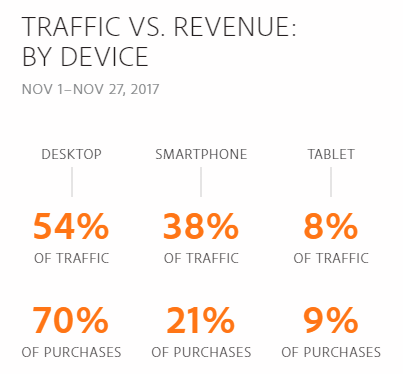
Mobile Traffic and Sales Statistics - Black Friday 2017 Cyber Monday 2017

The continued rapid growth of smartphone use is undeniably impacting retail sales. Similar to how e-commerce is the growth engine of overall retail, mobile sales are powering e-commerce.

The rising tide is driving much of that growth. Mobile traffic from smartphones and tablets peaked on Black Friday and Small Business Saturday (56% of traffic). Then leveled out to 46% of traffic, almost equivalent to desktop traffic (54%), through Cyber Monday 2017, according to Adobe Digital Insights.

However, the mobile shopping experience is a challenge for retailers. Smartphones and tablets earned a lower percentage of overall sales (30% versus 70% for desktop) and lower conversion rates through Cyber Monday.

Retailers can close more sales with mobile shoppers by continuing to improve their mobile customer experience. Shoppers now find mobile as an easy way to check emails (hopefully your emails), find store locations and hours, get product information, snap and share photos, and compare prices.

Optimizing mobile product discovery and mobile payments are the biggest opportunities for retailers to improve the mobile customer experience.

2. Personalized Merchandising with Artificial Intelligence

Customers want a personalized shopping experience. Sales people help shoppers in the store. Now application of artificial intelligence are helping online stores create a similar personal customer experience.

Online stores have massive amounts of behavioral and transactional data now. The challenge is to harness that data to power real-time merchandising decisions.

That’s where artificial intelligence excels.

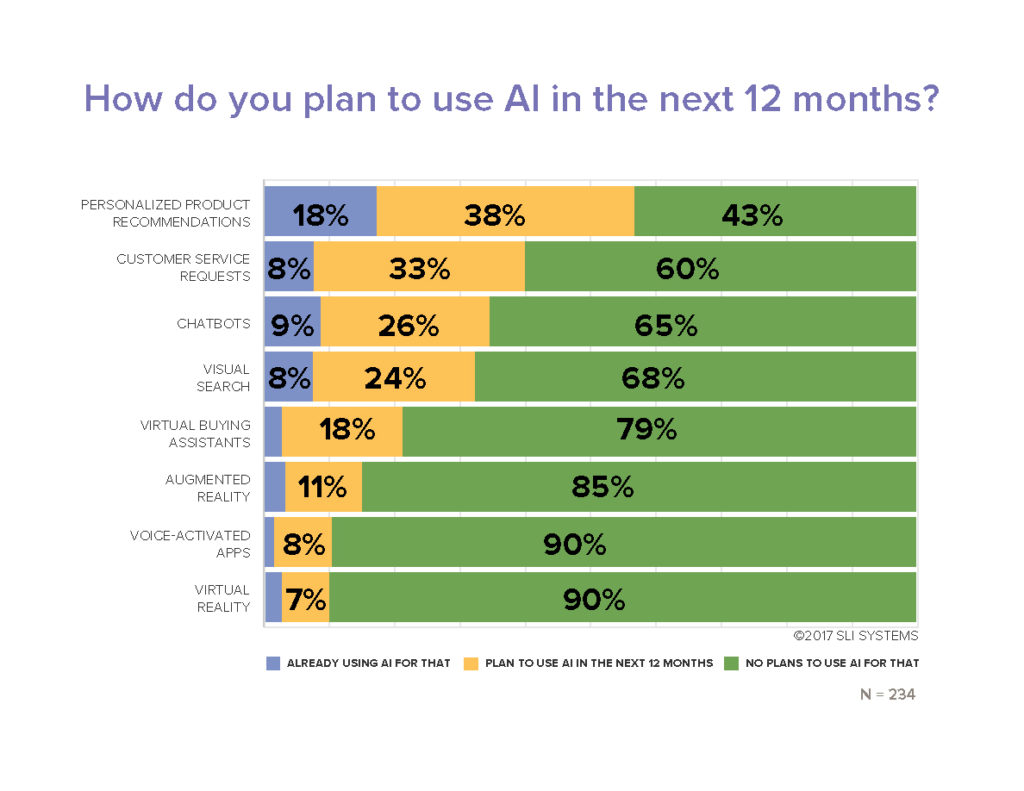
Fifty-four percent of e-commerce sites have already implemented or plan to add AI in the future, according research from the Q3 2017 E-commerce Performance Indicators and Confidence Report. And 20% expect to add AI within the next 12 months.

The top application is personalized product recommendations. Eighteen percent of online retailers report they are already using artificial intelligence in their product recommendations strategies. But that number will swell dramatically in 2018 with 38% planning to implement within the next 12 months.
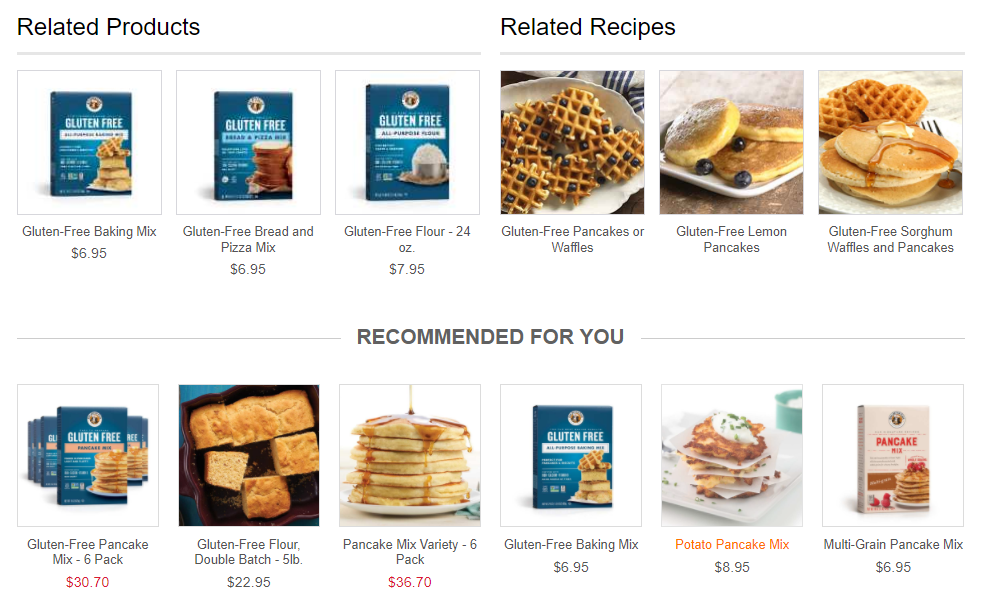
Personalized Product Recommendations Engine - King Arthur Flour

Artificial intelligence can parse user activity, preferences, and sales trends. The result is smart and timely product recommendations that are personal. For example, this type of contextual personalization can be tuned to gender, clothing size, brand preference, or shopper’s location.

Even better for online retailers, this personalization can be experienced by first-time visitors just as well as returning shoppers. So the shopper does not have to take any additional actions to receive the customer experience benefits.

3. Always on Customer Service with Chatbots

Chatbots were introduced as a new technology on the horizon for retailers in our 2017 e-commerce trend webinar. In 2018, chatbots are a must-have element of your online customer experience.

Ecommerce Chatbots - Retail live chat is always on

Think of chatbots like your online version of a sales associate or employee. Except they are always on 24/7/365.

A chatbot is an enhancement from the online chat communication channel. The old chat program still required a human sitting there typing in replies. Those employees had regular shifts. So sometimes customers weren’t getting their questions answered.

Now a chatbot is an always-on program that simulates the conversations your customers have with you. It answers questions, handles specific requests, helps shoppers choose the right product, and executes customer service procedures.

Your customer experience impact is shoppers have better and faster access to what they want when they want it. That’s a huge win. And you win more sales.

Customer adoption, and the resulting better experience and sales, is the biggest reason why chatbots are growing in e-commerce. Additionally two technology drivers are accelerating the deployment of chatbots – smartphones (again) and artificial intelligence (again).

Smartphone use is leading to speaking with a chatbot. Talking is easier than typing. Just say what you need and the chatbot tells you back. Siri, Alexa, and Google Assistant are all voice-enabled chatbots that are quickly growing is use.

Artificial intelligence is helping chatbots be more effective. The chatbot can repeat existing information easily and can be taught to mimic decision-making patterns. But artificial intelligence makes a difference by helping chatbots to actually learn. So your customer experience is continuously improving.

Design Your Customer Experience to Win More Sales

Planning and executing your customer experience strategies is a process of continuous improvement. Deeply understanding your customer’s journey sets you on the right path.

Take advantage of the key trends and technologies. Then test your innovations, measure, and optimize for the satisfaction of your customers and for the results that matter to you.

Ultimately, you can achieve what creative executive Loie Maxwell calls “designed serendipity”. Orchestrate the experiences that produce a customer journey that gives them a winning feeling. Your customers will love it. And you will win more sales.

Is Your Customer Experience Leaking Sales?

Most businesses are leaking online sales in at least 7 critical elements of their customer experience.

The Customer Experience Scorecard grades your e-commerce site using a 42-point checklist proven to increase sales, including:

  • Quickly finding products shoppers are most likely to buy
  • Personalized product recommendations
  • Mobile path to purchase

Want to find your leaks? Find out your quick-win opportunities to take your conversion rates to the next level.
E-commerce Merchandising: The Ultimate Guide to the Newest Techniques

Posted by Bob AngusNovember 16, 2017Analytics, Artificial Intelligence, Customer Experience, E-commerce Research, eCommerce, Merchandising, Navigation, Navigation Tips, Personalization, Recommendations, Refinements, Resources, Rich Auto Complete, Site Search, Site Search Tips, Testing, User Experience

E-commerce merchandising has one goal in mind – connect shoppers with the right product so that they “Add to Cart” fast. Merchandise well and you’ll increase conversion rates and boost your average order values.

But execution is always incredibly difficult.

You have different visitors with different mindsets toward actually buying. Those shoppers are engaging with different parts of your website through their shopping journey.

On top of that, you have to wrangle massive SKU quantities, constant product and pricing changes, and frequent promotions.

E-commerce merchandising is complex.

It is no longer as simple as choosing the products you want to move, setting an attractive discount, and plastering the offer all over your valuable real-estate.

You need to figure out what each shopper is most likely to buy right then.

The leading retail brands are employing the newest e-commerce merchandising techniques to successfully unlock the complex code to winning more sales. They approach effective merchandising along three dimensions:

  • Understanding different customers need different merchandising strategies
  • Deploying the right techniques along the shopping journey
  • Delivering the right product that is most likely to be purchased

Plus, they’re using data to drive that complex decision at scale. And you can too.

Let’s breakdown what you can do to optimize these three elements… and dramatically increase your sales.

Customer-Focused E-commerce Merchandising Strategies

“Traditional” merchandisers that worked for brick-and-mortar retail stores often had a pure product buying background. They would master the data. But that mastery focused inward to the business for the purpose of increasing unit volumes, maximizing margins, and avoiding too much unsold inventory.

Yes. You still need to successfully manage your product buying to be profitable through your online channel. But you also need to understand what’s pulling through those sales and why.

Today, world-class merchandisers start from a different perspective. They think about the customer first. Then they apply their product expertise and merchandising skills to fit what their customer segments want.

You will want to incorporate specific merchandising strategies to help win these different types of customers – from visitors “just browsing” to your most valuable returning buyers.

Earn loyalty with returning visitors and customers

The first segment of shoppers you should consider are your return visitors and previous buyers. Why? Your conversion rates should be significantly higher than first-time visitors.

Better yet, you have some easily executed tactics available to boost extra sales.

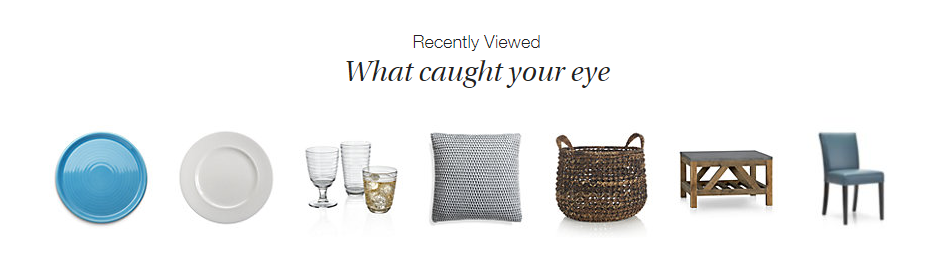
Ecommerce Merchandising Strategy Product Recommendations - Crate and Barrel Home Page Screenshot

Crate and Barrel promotes “Recently Viewed” items on every product page. This makes it super easy for a returning visitor to jump right back to what they were interested in, without having to browse around your site.

This product recommendation strategy also works great on major entry points into your site like the home page or in your shopping cart.

Another source of product data to use for “personalized” products recommendations is your customers’ wish list shopping cart history. These customers have already clearly indicated exactly what they want. So you should boldly give it to them.

Other uses of your visitors’ shopping history include:

  • Highlight a special promotion for wish list items
  • Recommend complementary products that go great with a recent purchase
  • Show a reminder for abandoned cart items
  • Add an easy “Order Again” button
  • Create custom product landing pages for shoppers who clicked your retargeting ads

All of these online merchandising strategies can help grow loyal, repeat buyers and encourage returning visitors to buy more.

But what if someone is a first time visitor? Fortunately, there is another segment of high-value shoppers that you can convert with powerful merchandising.

Win high-purchase intent shoppers

Certain customers come to your site ready to buy. The question is: Are they going to buy from you or go to your competitor?

Who are these high-purchase intent shoppers? They are the visitors that use your site search functionality. SLI studies have found that visitors that use search buy at a 2.7x greater rate than visitors who just browse.

Search users have indicated exactly what they want. They often include a specific product option like a color, size, or material in their query. So you need to quickly get them to the product page for the best selling match.

Don’t make these folks navigate their way to what they want. No extra clicks. You’ll likely lose them even if you have a great price and an amazing free shipping offer.

In fact, there is one merchandising technology that dramatically helps you convert these must-win buyers – autocomplete.

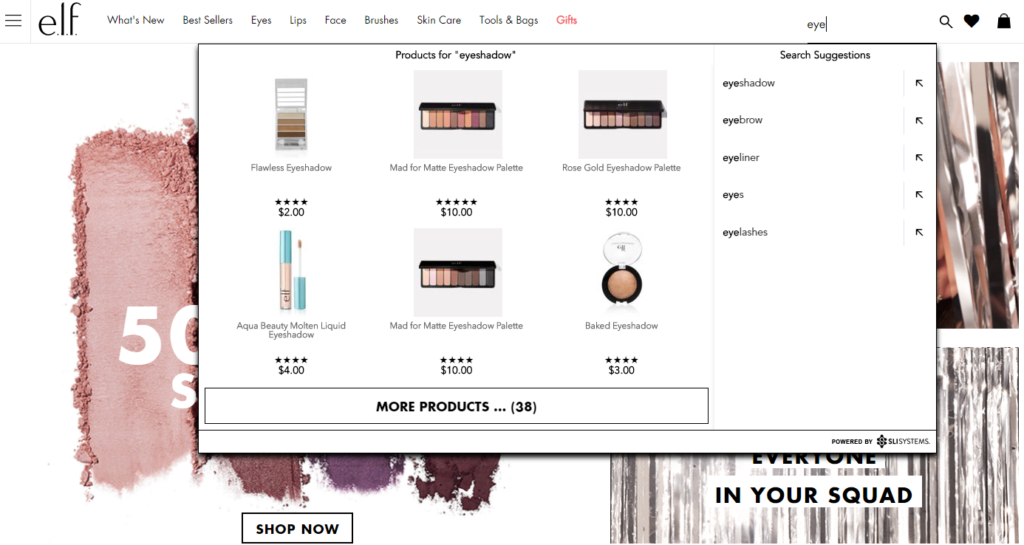
Visual Merchandising Autocomplete E-commerce Site Search - e.l.f. Screenshot

A great autocomplete example is e.l.f Cosmetics. They go beyond simply displaying matching text keywords as the searcher types. They display specific product results while adding visual merchandising with appealing product images.

You are more likely to convert these shoppers by showing a product, not a category. Again, less clicks and browsing is what you want.

That’s just the start. Lock in more sales from high-purchase intent shoppers with other tactics that use search data to improve merchandising.

Now let’s turn our attention to another customer segment, who likely make up the majority of your traffic.

Convert browsers into buyers

Some customers have an idea in mind but may not be ready to buy. In a brick-and-mortar retail analogy, these folks are the “No thanks. Just browsing” shoppers.

They may be “looky loos.” However, your merchandising can effectively nudge these visitors toward a purchase.

Classically online retailers attempt to attract these browsing shoppers by promoting categories or themed product groups like seasonal or clearance categories. However, this approach just keeps them clicking through your site and you hoping they stumble on something that sparks a sale.

And that’s one of the big reasons why many visitors leave an online store with an empty cart. The merchandising kept them in a browsing mindset, not a buying one.

Do not be afraid to promote specific products. Smart online merchandisers are now curating and promoting sets of individual products, not general categories, on their highest traffic pages.

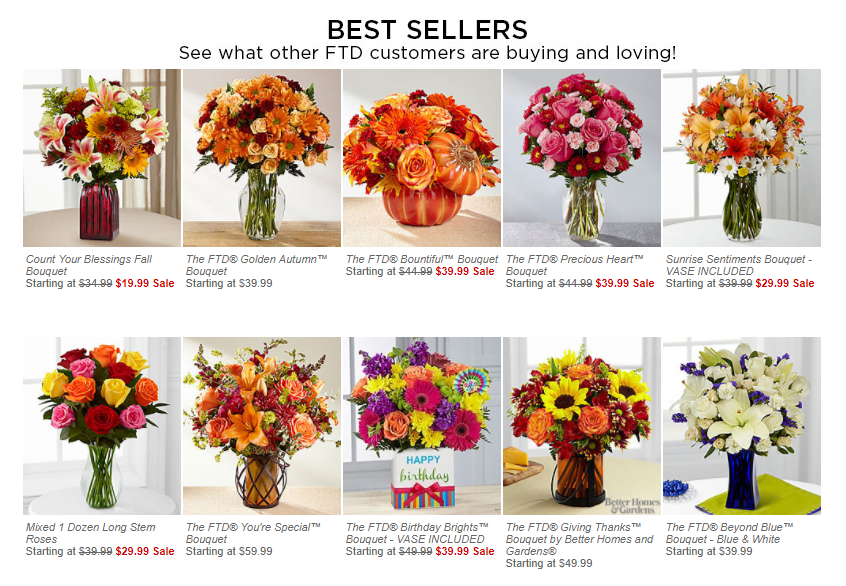
Product Recommendations Strategy - FTD Best Sellers Screenshot

FTD.com gives a big portion of their home page to promote their Best Seller products. What those product recommendations do is switch the shopper to an active “Oh. I need that too.” mindframe. And out of a passive “just looking” mode.

Tap into your massive SKU list to find the top sellers, new products arrivals, seasonal products, or specific sale items. Use your merchandising data analysis expertise.

Then continually test which products are getting the most clicks and conversions.

Simply promoting specific products can help increase the possibility of an impulse purchase, or more likely, can create a desire to come back to your site when they are ready to buy.

Now that you’re thinking from a customer perspective, let’s take your merchandising strategies to the next level. You can optimize the customer experience by where those visitors are on your site.

Merchandising Best Practices For E-commerce Websites

There is a flow to how people shop.

A brick-and-mortar retail store starts merchandising right up front as you walk in the door. Then throughout all the aisles, displays, and checkout counters. The whole store experience is intentionally designed to drive more sales.

An online customer experience also has its flow. Your e-commerce shopping journey can be designed to maximize sales too.

Every part on your site is a merchandising opportunity – the home page, navigation menus, category pages, product pages and your checkout pages.

Hundreds of online site search tips and navigation best practices have been published that can have a big impact on your sales.

Here are the top online merchandising tactics for your e-commerce website that are red hot right now.

Visual Merchandising on Product Pages

Let’s start where customers most often click “Add to Cart” – the product page.

Many elements of the product page help merchandisers showcase that that this is the right product at the right price – product title, descriptions, specs, purchase options, ratings, reviews, and, of course, pricing and discounts.

This information appeals to the rational part of your shopper’s brain.

The part that usually makes the ultimate buying decision is the emotional part of the human brain. That’s where online visual merchandising excels.

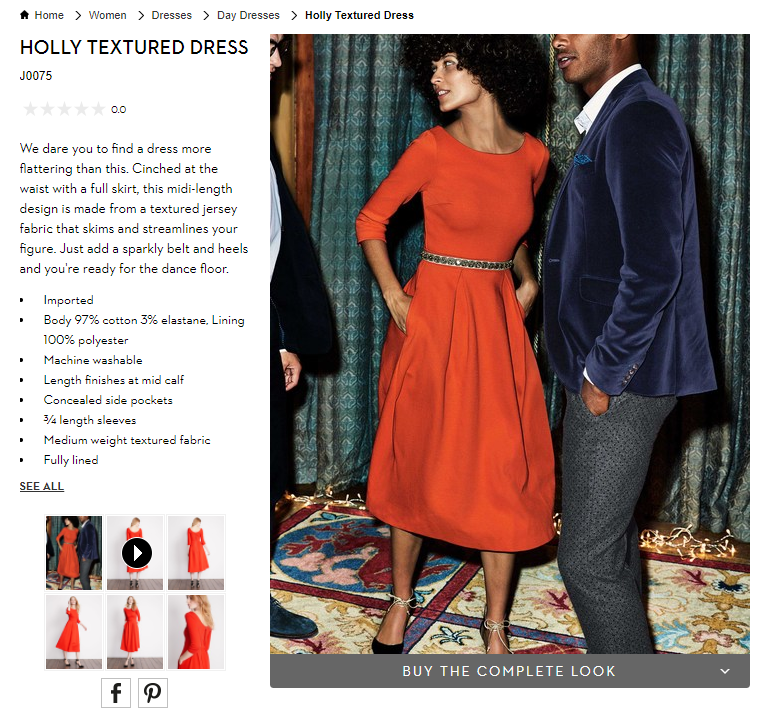
Ecommerce Visual Merchandising - Boden Product Page Screenshot

You also want to show off your products. Boden uses model videos, shows products from many angles, and switches custom images by color selection. These extra images give shoppers context when they can’t actually hold the item in their hands. You want them to easily envision what their experience will be after the purchase.

To help shoppers visualize, update product pictures instantly when they select different options like color and allow shoppers to zoom in to the smallest details.

Also, show action shots and product videos that depict how the product is used, what the buyer gets in the box, or how to install it.

Now augmented reality applications are being tested too. From arranging virtual furniture in a picture of your home to trying on different outfits in selfie mode on your smartphone, this next generation of visualization is an e-commerce merchandising innovation you will want to explore.

Personalized Product Recommendations

Product recommendations have long been a valuable online merchandising tool. You can tune your recommendations strategies using best practices for each different page on your site. Now recommendations technology is getting even smarter.

Smart product recommendations are personalized to the individual shopper in real-time. The products displayed adjust automatically based on user activity, preferences, and sales trends.

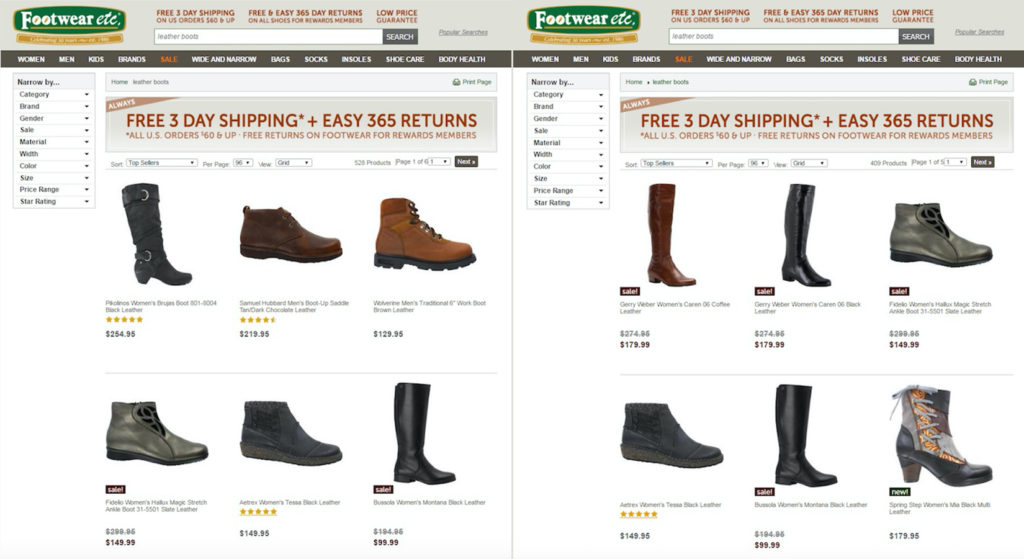
E-commerce Personalization - Footwear Etc Screenshot

Footwear etc. adds a level of personalization based on gender. Product recommendations, search results and category pages use the products or pages previously viewed by the shopper. If a shopper starts out browsing women’s sandals, then recommended product results would boost women’s shoes or accessories on subsequent pages. The screenshot above shows before and after results when a shopper searches for “leather boots”.

This type of contextual personalization can be tuned for many different facets, including gender, size, brand preference, or location.

Not only are these higher-converting recommendations displayed in real-time, but this personalization works for first-time visitors just as well as returning shoppers.

Complementary Sales in the Shopping Cart

You also want to extend those product recommendations to your shopping cart and checkout experience. Just like your grocery store places a rack of candy and magazines in the checkout line, online stores have a great opportunity to capture extra sales right at the point of purchase.

Only for online stores, this upsell merchandising strategy can be even more profitable.

Again, you can personalize the products you merchandise based on real-time data. You know what products they have added to their cart. You know the other products they have viewed.

And most importantly, you know what other products complement those items.

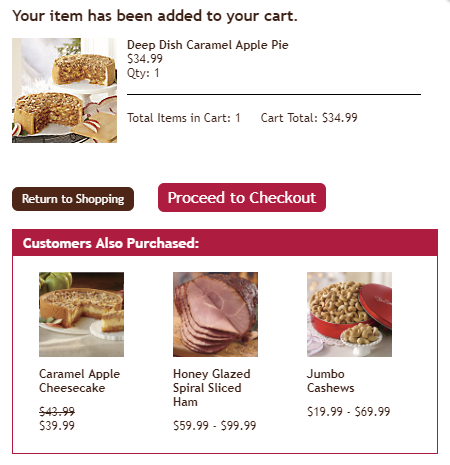
Online Merchandising Product Recommendations in Shopping Cart - Swiss Colony Screenshot

Swiss Colony promotes “Customers Also Purchased” at the beginning of their shopping cart experience.

Other popular recommendation strategies in the checkout experience are “You may also like” and “Complete the set.”

Just be careful to use complementary products. Do not necessarily use the exact same product recommendation logic as your product page. You don’t want to accidently promote an alternative to the product your customer has already decided to buy.

At best, that mistaken recommendation is ignored, meaning a wasted upsell opportunity. At worst, your customer stops and doesn’t complete their order because now they’re not sure if they’re buying what they really want.

So make sure that you are tuning the product recommendations in your shopping cart to complementary products that add to your sales, not disrupt them.

Now let’s use powerful data analytics and technology to deliver the best results without extra work.

Merchandise the Right Product to Win the Sale

You understand the customer. You know how to merchandise for each step of the online customer experience.

Now we can put it all together with great data and your product expertise to personalize the shopping experience… and get the sale.

Data Mining for E-commerce Merchandising

Your website analytics, your product systems, and your e-commerce platform transaction system combine to provide an astonishing array of data. That data can be mined and used to fuel your merchandising decisions.

You just need to look at what you have.

Data you know about your customer:

Your website analytics software offers useful demographic information about your customers and deep insights into what they are doing on your site.

Here are some of the most useful data types that can help your e-commerce merchandising strategy:

  • Traffic Channel: Where did your visitor come from?
  • History: Are they a first-time visitor or returning shopper?
  • Behavior: Where did they go on your site and what did they do there?
  • Gender: Are they female or male?
  • Age: How old are they?
  • Device: Are they on a mobile device, tablet or traditional computer?
  • Geography: Where in the world are they?

Now pair that up with what you know about transactions stored in your e-commerce platform.

E-commerce Platform Data:

Every past purchase provides information that helps you understand what customers are likely to buy in the future.

  • Product Sold: What product exactly is purchased?
  • Options: What sizes, colors, styles, and other product options are purchased?
  • Price: How much did it cost and what was the discount?
  • Order quantity: How many did customers buy per purchase?
  • Time/Date: When did the purchase occur?
  • Payment Method: How did they pay – credit card type, PayPal, on credit/layaway?
  • Shipping: How did the customer want this delivered?
  • Abandoned Carts: What products are selected but never actually purchased?

Best selling products should always be at the top of your merchandising list. But there is even more product data available to you. And that’s your merchandising experience.

Data from your experience:

Lastly, your own experience and intuition adds the special sauce to your merchandising data recipe.

  • Social trends:What’s hot right now with your customers?
  • Brand trends: What product brands can help pull in buyers?
  • Seasonality: What holiday or seasonality drives purchases?
  • Inventory: How much is in stock?

Compile all of this data, analyze it, and determine what products your customers are most likely to buy right now.

However, the challenge with the plethora of available data is… there’s so much data. It’s incredibly difficult and time consuming to effectively wrangle all the valuable data to merchandise to every single visitor on every single webpage for all your products.

That’s where new artificial intelligence technology helps.

Artificial Intelligence Fuels E-commerce Automation

Automating your data processing to power real-time merchandising decisions is quickly becoming a must-have for online retailers.

Fifty-four percent of e-commerce sites have already implemented or plan to add AI in the future, according research from the Q3 2017 E-commerce Performance Indicators and Confidence Report. And 20% expect to add AI within the next 12 months.

So what is the most popular applications for AI right now?

Not surprisingly, merchandising techniques are at the top. Personalized product recommendations is number one. Fifty-six percent of online retailers report that they are already using artificial intelligence in their product recommendations strategies (18%) or plan to implement within the next 12 months (38%).

Other merchandising solutions and visual merchandising technologies are also being accelerated thanks to AI. Virtual buying assistants, chatbots, visual search, augmented reality (AR), and virtual reality (VR) are all designed to help shoppers purchase the right product fast.

Ecommerce Artificial Intelligence Applications Research Chart - EPIC Report Q3 2017

More automation definitely helps maximize results in less time. And in new ways.

But is artificial intelligence going to take your merchandising job away? Absolutely not.

You won’t hand over the keys entirely to your automation systems. You need to maintain a mix of merchandising techniques and always be testing to get the maximum results.

Testing Your Merchandising Strategy Mix

“Always be testing” is more than just a matra. It’s a requirement to truly maximizing your conversion rates and your total online sales.

Most every online retailer tests performance of different on-page merchandising elements. That helps determine your optimal page design. For example, a simple A/B test of your search box location can pay off big by converting high purchase-intent shoppers.

Or determine how many products should be displayed in your product recommendations. Pro tip: SLI Systems’ merchandising best practices show that 4 or 5 products are ideal. And that scrolling carousel presentation of more products doesn’t generate significantly more incremental sales.

Another high-impact test determines the best rules for your site search and product recommendation results. Keyword matching algorithms alone likely do not give your shoppers the most relevant product results, which lowers your conversion rates.

Merchandising-savvy online retailers use a prioritized mix of multiple rules to drive the most sales. They combine artificial intelligence results with pre-defined tuning rules, product and category keyword matching, and sales leader products to generate the maximum online revenues.

More E-commerce Merchandising Tips

The key to your online merchandising success is to figure out what each visitor is most likely to buy.

It’s not easy. But you can drive many more sales leveraging a deep understanding of your customers, the latest technology, and the leading edge online merchandising strategies.

We’ve shared the newest merchandising techniques here. And you have many more proven strategies and tactics available to you. Make sure to grab the hundreds of site search best practices, e-commerce navigation tips, and watch what leading retail brands are doing in these online merchandising webinars.

Optimize Your Search Merchandising for the Holidays

Posted by Shaun RyanSeptember 17, 2013Analytics, Merchandising, Newsletter, Related Search, SEO, Site Search

As an eCommerce professional, you’ve likely been preparing for the holiday shopping season for months – deciding which products to feature, planning orders and organizing marketing campaigns. Retailers predict an 11-20% rise in holiday spending for 2013, with eCommerce and mobile driving much of the growth (Retail TouchPoints, Aug. 12). While the opportunity is great, so is the challenge of making your products stand out. Here are some thoughts on how you can use search merchandising tactics to ensure your holiday campaigns are effective.

Get Insight from your Site Search Data

The first step in successful search merchandising is to look at your site search data for real-time insight into users’ behavior. Review the queries that shoppers type into your search box, along with your site analytics. Which searches are most popular? Do shoppers want a product you don’t have? Are they seeing “no results pages” because they search using different language than you use on your site? Do they move from your results pages to a purchase, or do they jump away from your site without buying?

If you gather such insights from your search data now, you’ll have time to make improvements well before Black Friday and Cyber Monday. If you don’t already have an advanced site search provider, engaging in such services now can give you the extra set of hands and tools you’ll need to be agile in response to holiday trends.

Use the Right Tools at the Right Time

The second step of a successful search merchandising plan is to know which tools can make the most impact, and how to use them. A couple of my favorite tools for holiday merchandising are landing pages and gift finders.

  • Landing Pages for Holiday Products: In most cases a relevant search results page is the best page to show your visitors when they type in a search term. However in some cases you want to have more control over their experience and a specialized landing page may be the right tool. For seasonal specials, simply create a web page with your top holiday merchandise and set the page to load when visitors type certain words like Holiday, Christmas or Hanukkah into the search box. Assign a dedicated URL to your holiday landing page, and then use it in holiday email campaigns and advertising. Not only does this promote your holiday specials, but it gives you a trackable link in your Google Analytics so you can gauge the success of the campaign.
  • Gift Finders: Gift Finders are another way to generate more sales revenue around the holidays. Set up refinements that allow someone to define a set of criteria for a gift – e.g. price, occasion, recipient type and gift type – then see a list of the products that match those criteria. Promote your gift finder on your home page or by using a landing page with a PPC link for email and ad campaigns. When done correctly, it can be a useful tool that increases users’ likelihood of buying from your site. Read more about gift finders in this blog from SLI Systems Co-Founder Geoff Brash.

Branding banners, ribbon overlays and integration of social media are other merchandising tools that can improve the odds of holiday shopper conversion. These and a dozen other tools are covered in the new white paper “Using Site Search Data to Improve Merchandising,” which is a free download from the SLI Systems website.

Lastly, be sure your site search provider offers proper merchandising controls for your site so you can quickly test and easily refine the presentation of promotional messages, products and content on your search and navigation pages. Such agility will help you compete for consumers’ spending money during the holidays and beyond.

Site Search and Web Analytics Put a Wealth of Data at Your Fingertips

Posted by Shaun RyanMay 25, 2010Analytics, Newsletter, Site Search1 comment

Most likely, you already know that with web analytics, you can uncover valuable information about how and where your visitors use your site to purchase products or download information. Did you also know that when you integrate analytics (like Google Analytics) with site search you can gain great insights into how your visitors think, how they navigate your site, and why they buy (or don’t buy)?

In fact, analytics packages show differences in how site search and non-site search users interact with your site. Typically, site search users are more engaged with the site – they spend more time browsing, view more pages, and convert at a much higher rate.

Specifically, analytics packages track and analyze site search data to give you a better understanding of which keywords convert well, and which keywords perform poorly. For example, site visitors might spell a keyword differently (a common problem for complex product names), or simply use a search term for a product you haven’t accounted for (e.g., “iPods” instead of “MP3 players”).

If the keywords don’t match, then valid products may not appear for that search term – resulting in poor conversions and/or click-throughs. Analytics can help you detect such keyword challenges early on, and allow you to modify product descriptions and other content and ideally capture more sales or requests to download information.

Integrating analytics with site search can also tip you off to seasonal trends so you can modify product copy or even add products as visitors’ search habits change. For example, you may discover through keyword analysis that shoppers are looking for back-to-school products earlier than you anticipated, or that they’re actively searching for a product you don’t carry that you might want to stock.

Analytics can also help improve your success rate when using site search results pages for pay-per-click campaigns. You can easily use site search results pages as PPC landing pages, giving you more time to spend on developing ad copy and bidding on keywords. Analytics will identify the ad variants that perform well, so you can optimize landing pages for campaigns with the best click-throughs.

Remember, when you’re using site search pages as PPC landing pages, the traffic patterns are going to be very different from when the pages are accessed from the site search box. In order to properly evaluate the site search effectiveness, as well as the effectiveness of the landing pages, they should be tracked separately in the web analytics tools.

While there’s a wealth of data to dig into when you connect analytics to site search, it can be overwhelming to sort through all the numbers. If you’re curious (or confused) about any information that you’ve gleaned from web analytics in relation to site search, contact your SLI customer success manager, and we’ll help you interpret the data.

Site search analytics course

Posted by Shaun RyanJanuary 24, 2008Analytics, eCommerce, Reporting and Analytics, Site Search, Site Search Tips

I spotted that Lou Rosenfeld is running a site search analytics seminar on March 18 in Sunnyvale. I’ve chatted to Lou about this topic before and he definitely seems to know what he’s talking about. I recommend taking a look at this course if you would like to delve deeper into this very valuable area.

Stay up to date with SLI

Featured Posts

  • Maximize Revenue with Enhanced Product Impact Testing
  • Top Five Ways to Prepare for Peak Season
  • Facets, Facets, Who’s Got the Facets?
  • Personalization: It’s Kind of a Big Deal
  • M is the New E: Mobile Commerce Trends and Predictions

Categories

About SLI Systems

  • What We Do
  • Who We Are
  • Why SLI

Learn

  • Webinars
  • News Room
  • Events

Connect

© Copyright SLI Systems, 2018. All Rights Reserved | US: (866) 240-2812 | Legal