




Infographic: The Biggest Missed Opportunities for eCommerce Marketers
This new infographic highlights some of the results from the SLI Systems Global eCommerce Site Search Survey. Click here to download a full report of survey findings.

This new infographic highlights some of the results from the SLI Systems Global eCommerce Site Search Survey. Click here to download a full report of survey findings.

With the holiday shopping season upon us, eTailers everywhere are spending time to make sure site visitors have the best experience possible when browsing their sites. Positive shopping experiences result in more conversions, higher AOV (average order values) and return customers. With much of the focus still placed on desktop sites, many online retailers are missing the opportunity to concentrate on tablet and mobile optimized web sites – especially when more than 55% of all U.S. consumers have a smartphone and at least 35% own a tablet, according to Pew Research. As shopping on these devices increases in popularity, eTailers should consider investing more time and effort to improve their site usability, search and navigation to accommodate this shift.
Sales are Soaring
According to eMarketer, retail sales are expected to increase 68 percent from 2013 – 2017, with mobile commerce sales increasing a whopping 125 percent. Combine both smartphone and tablet, and mCommerce sales are expected to rise 38 percent next year. Looking at these numbers, it’s clear that mobile and tablet sites should be regularly looked at and updated along with the desktop version of your site.
Spontaneity leads to more than 80 percent of mobile purchases, and according to Brad Frost, mobile users will do anything and everything desktop users will do, considering ease of use and convenience. More than a quarter of all mobile users will abandon a transaction if a site is not optimized for mobile, with users believing that mobile transactions should be easier than online or in store transactions. Frost also reports that time spent on a mobile device is expected to overtake time spent on desktop this year, and Internet Retailer agrees that mobile devices now surpass desktops in eCommerce.
Tablets are Making Their Presence Known
Here’s some more interesting data from a recent study by Adobe: tablet users are three times more likely to make a purchase over mobile phone users. They also spend 50 percent more than PC/MAC users, which makes this group worth targeting. Initially, smartphones had the lead over tablets in eCommerce sales, but tablets are estimated to account for more sales this year and will continue to rise at a rapid rate.
Make it Easy for your Customers
Mobile sites should be optimized in a way that puts what the user is looking for right in their hands as quickly and painlessly as possible. Mobile site design should not be too busy or crowded; the layout should be simple and products should be merchandised in a way so that they are quick and easy to find. Similarly, checkout should be secure and require minimal effort as users do not want to spend time filling out information on such small screens. Overall, mobile should cater to your target audience. For examples and best practices, see our previous blog post on giving your mobile shoppers what they want.
Tablet approach should be different than mobile. Tablet users are known to spend more time on sites interacting and engaging with content and media. In addition to design and layout changes, online retailers should consider including product videos and any other features that users can interact with, as studies show that tablet users will spend more time playing with these features before making a purchase.
eTailers have just a small window of opportunity to compel the user to make a purchase. Because of this, site search becomes even more important. Your site search bar should always be prominently displayed (no matter which interface the user is viewing your site from) and should contain an auto-complete feature for faster searching.
Once your site is all set up, consider letting your users do the merchandising for you with SLI’s patented advanced search technology, Learning Search for Mobile. Learning Search watches your website’s user behavior, and automatically re-ranks your products based on user click-through rates. The faster a user can find what they are looking for, the more likely they’ll be checking out with gifts for loved ones this holiday season.
Jeff Holt is a Customer Success Manager for SLI Systems. For further product insight contact him at jeff.holt@sli-systems.com.


What do you get when you combine dark sunglasses, a fake moustache, and a bald cap wig? The principal ingredients for what is sure to be one of the most addictive costumes this season: Walter White from A&E’s hit show “Breaking Bad.”
Come Halloween night, you’ll be sure to see an eclectic mix of DIY and store-bought costumes of the main character. How do I know this? Because “Walter White” is one of the top search phrases for costume supplier Party Supplies Delivered!
With only a couple of days left until the scariest holiday of the year, Party Supplies Delivered gave us a sneak peek at some of its most popular costume searches this season.

And while top keyword searches are a fun way to predict what costumes you’ll see at some Halloween parties this year, for merchandisers, top keyword phrases, such as “sailor hat,” “pirate,” and “Alice in Wonderland,” are crucial to maximizing their merchandising, promotions and SEO efforts.
Use On-Site Search Data to Improve Click-Through Rates
Ian MacDonald, VP of eCommerce and Marketing for Party Supplies Delivered, explained why his site’s top keyword searches provide valuable data for merchandising.
“With SLI’s Learning Search and Navigation, items that are moved to the front of results or are top performers generally have a strong click through rate,” MacDonald said. “If the items are performing well on our website, we want to drive more customers who are looking for that merchandise to our site. So we make sure that top searches on our site have a strong presence in our Google Ads.”

The search for ghastly Halloween costumes starts a couple of months before visiting haunted houses, going to parties and trick or treating. MacDonald notes that keeping an eye on top searched keywords during those early search stages is a great way to keep up with Halloween demand trends. This allows companies like Party Supplies Delivered to tailor their site search and navigation appropriately.
Poor Performing Search Terms Are Also Useful
While tracking top search terms is paramount for eTailers in creating their merchandising strategy, poor-performing search keywords can also illuminate ways to improve. Party Supplies Delivered has kept an eye on search terms that don’t deliver relevant results.
“We often find the need to add new synonyms, and we occasionally reorder search results by promoting, demoting, or suppressing certain products,” said MacDonald. This allows them to always offer the most relevant product results to customer search queries.
As detailed in this case study, Party Supplies Delivered put its search function and site navigation into the full-service care of SLI Systems in 2011. As their customers began to find more relevant search results, the bounce rate dropped 40 percent, page views increased by 132 percent and conversions went up by 203 percent. Features like focused category pages, Rich Auto Complete and user-generated SEO are among the changes that are delivering remarkable results.
“Now when customers drill into a subcategory, they really browse around; pages per visit are up 111 percent. This increases their average order too,” said MacDonald.
It doesn’t take a rocket scientist – or a rogue high school chemistry teacher, for that matter – to figure out that using an effective search solution and search data will help tremendously in your merchandising efforts. Don’t wait until darkness falls and the midnight hour of Halloween strikes before using these tips to improve your search merchandising!

Sasha Butkovich is Senior Writer for Ecommerce Outtakes and a guest blogger for SLI’s Site Search Today.
In case you haven’t noticed, I’ll say the obvious: mobile eCommerce is growing like crazy. Mobile and tablet sales continue to increase as a proportion of total online sales, surpassing desktop according to reports. But retailers looking to get in on the mobile action shouldn’t dive in blindly. As I mentioned in my last post on this blog, there are plenty of mistakes to avoid in a mobile strategy. Now, it’s time to take a look at the flip side of the coin and focus on the “dos” instead of the “don’ts.” Here are examples of three mobile sites that offer a great user experience. What do these retailers all have in common? They know their audience. Take a look.
Amazon: Personalization
 As the reigning king of eCommerce sites, it should come as no surprise that Amazon has their mobile act together. Of course, Amazon also knows their customers want access to their account wherever they go. Once a shopper is logged in to their Amazon account, the mobile site becomes more personalized, much like the desktop site. Customers will see product recommendations on the homepage that are based on their purchase and browsing histories. On top of that, users can manage their entire account, including wish lists, payment options, and more. All the perks of the desktop site, all the convenience of mobile, none of the mess. It’s a beautiful thing.
If users arrive on the homepage without logging in, they’ll see some of the popular Amazon products featured, like Amazon MP3 and the Kindle line. For a site that sells pretty much everything, it’s important to put that brand recognition front and center. Notice also that the homepage doesn’t waste precious space on a small mobile screen with the lesser-shopped departments. It only features the most popular categories to start people off with what they’re more likely to want.
Folica: Emphasis on Offers & Ratings

 There’s something sleek about the Folica mobile site. The homepage doesn’t bother to feature any particular products, but instead places the focus on the special offers. It’s nice for users to see the promotions up front so they know they will be getting a good deal from this retailer. Mobile users are on the go, and won’t want to waste their time on a site that won’t offer them a good value, so this is a great way to make a happy customer.
Below the special offers banner, shoppers will find many specific categories to help them choose the avenue that will help them get to the items they want. One especially cool category is Top 10. Opening this tab, users will see a whole list of Top 10 categories, like Top 10 Hair Dryers, Top 10 Shampoos, and Top 10 Gifts. This is such a nice way to shop, because it combines product type with highest customer ratings in one simple list. Putting such a high emphasis on customer reviews shows how much this retailer values the shopper. This is especially nice for mobile shoppers because it eliminates the lower-rated items, helping the user get to the good stuff quickly.
Gap.com: Customer Service & Geolocation
 Gap is an example of a retailer with both a strong eCommerce presence and strong brick-and-mortar sales. This retailer understands how to connect the two in their mobile site to provide the best experience for their customers. People shopping on their phone might be looking to make that purchase in a store, so the Find In Store option on this site is a perfect addition. Right from a product page, users can select their size and color, then click the Find In Store button. The site uses geo-location to show the closest stores, and displays the availability of the item in each location.
Putting customer service at the forefront is an awesome strategy, too. Free Shipping and Free Returns offers are displayed right on the homepage. When clicked on, the details are shown in a lightbox, eliminating the need for the user to navigate away from this page. Another great element is the easy access to the company’s other brands, as many of Gap’s customers also shop at Banana Republic and Old Navy. On this mobile site, it’s all easily connected by a simple drop-down menu at the top of the homepage.
At the end of the day, offering a great mobile experience is all about considering a site’s specific audience. Knowing who is using the mobile site and what they’re using it for will go a long way to inform the design and navigation. Offering customers any personalization, reviews, special offers, and geo-location they’re looking for will keep them returning to the site for future purchases!

If site search is one of your upcoming high priority projects, then you know that 43% of visitors on a website conduct a search (Marketing Sherpa). If search is not one of your projects, then you should know that you are missing out on that percentage of your visitors who are three times more likely to convert than those who browse by navigation, rather than search.
Here are the top three things we hear from prospects on why search is not something they are currently optimizing:
“Search is not our main concern; we want to grow our brick-and-mortar presence”
That’s great! But as a consumer, how will I know your brick-and-mortar store will carry what I want, if I can’t first search for it online? As shoppers become more informed and more tech-savvy, the search for the perfect dress to wear for that first date usually starts on a laptop or tablet. But there is another reason why site search is important, even if the eCommerce model is not your primary business concern: mobile search. More than 70% of U.S. consumers use their smartphones to make shopping decisions, so it’s important for your shoppers to know whether your brick-and-mortar store carries the nude heels you saw online.
“Only a small percentage of our visitors search”
But how much do they account for your revenue? That’s the first question to ask. The next has to do with how much your visitors actually trust your search, and how willing they are to go through the obstacle course of navigation. Does your search for men’s pants give you women’s dresses? Does the search for a red top actually pull the right color image for your visual shoppers? With an optimized and relevant search experience you are pushing the visitor to the path of purchase, even if they are not ready to buy at the time of search. (Read more in the report: “If you Build it Correctly, They Will Buy,” MCM July 2013).
And my favorite:
“We are busy with other initiatives”
Which begs the question, how much revenue are you losing because of a poor search experience? If you’re trying to keep up with an eCommerce model by trying to balance your marketing initiatives, website redesigns, re-platforming, merchandising, and ultimately having that customer purchase, you’ll want to start with something you can improve right away and that has a great ROI. A SaaS model for site search not only allows you to improve your site search and capitalize on that higher converting market, but also gives you the space to focus on your other projects and keep up with the market’s best practices.
And if you still have some doubts as to whether site search is worth bumping up in priority among your other initiatives, here’s one last point: think about the 73% of your customers who will abandon a site because a poor search experience.
Now, show me that red dress!

(Thanks, Boden!)
Boden is a customer of SLI Systems. Learn how they improved conversions by 177% and increased order values by 215% in their case study.
Laura Santamaria is a Market Development Representative for SLI Systems. For further product insight contact her at laura.santamaria@sli-systems.com.
As consumers, it seems the more technology-savvy we become, the more impatient we also become. Once we catch a glimpse of what it’s like to have an amazing customer experience, we expect other sites to rapidly adopt the latest technology and best practices to meet the latest standard of excellence.
This is certainly the case in eCommerce. When searching for a particular product, I expect to see highly relevant results the first time I type in a search phrase. Whether I’m using my smartphone, tablet or laptop, if I ask for “women’s wool blazer,” then that’s exactly what I want to see – nothing more or less – especially if I’m on my iPhone and don’t have enough screen space to browse 50 items. I find that if a retailer gives me irrelevant results, I’ll just move on to another site that I’ve had a good experience with in the past.
I’m not alone in my impatience, said Harris Interactive in a 2013 study, which found that 30 percent of mobile shoppers who hit a snag will abandon their online cart and never return to that site again. (See Mobile Shoppers Rarely Give Second Chances). An SLI Survey showed that 73% of customers will leave a site in less than two minutes if they can’t find what they’re looking for. Personally, I think two minutes is generous – I can tell you I won’t give a site that long if I only have five minutes between appointments to get something ordered!
 Boden understands the importance of relevance in delivering a great customer experience. In my search for women’s wool blazer, they showed me the three wool blazers they have, and nothing else. Since their site is optimized for mobile use, I could easily view the images and product details on my iPhone and gather just enough information to quickly browse the items and make a decision. This is the kind of experience that will keep me coming back to shop on their site. And it’s probably why Boden has seen a 177% increase in average conversions since implementing advanced site search solutions.
Another site search feature that streamlines the user experience is Rich Auto Complete. I love sites where I can start typing the first few letters of a word and within seconds see the name, image and short description of the exact product I’m looking for. NaturalWellbeing.com uses this feature, and it makes it so easy to shop. Wanting to try melatonin for sleep, I start typing in mela- and before I finish the word or click the search button, I’m shown the two melatonin products they offer along with the price. They both look good, so I click one and it takes me straight to checkout – I’m done and on to other things.
 You can bet the next time I try shopping on a site that doesn’t have Rich Auto Complete, I’m going to experience some of that technology-induced impatience I mentioned earlier.
Usability experts such a Jakob Nielsen confirm that such impatience is common. “Today’s consumers aren’t satisfied with sites that simply make it possible to shop; the experience must also be pleasant,” he said. In his eCommerce Usability study, Nielsen found that users’ first in-site query is successful only 64% of the time. And if users don’t find what they are looking for on your site, they’ll often assume you don’t have the product and will leave, rather than changing their search query. Yep, I’ve done that.
To achieve the kind of relevancy that keeps impatient shoppers like me on your site, you should learn which products are most clicked on for each search term and all its variations, and then rearrange each associated results page accordingly. Doing this manually would be beyond tedious, so it’s important to use a site search engine that automatically learns and ranks the most relevant products in search results.
Search that Learns and Improves
Such a capability goes beyond the default search that comes with your platform. But SLI’s Learning Search is effective because it determines relevancy based on site search activity – then continues to learn and improve based on which products are most clicked on after a particular search query. This ensures that the best results are always shown first.
It’s important to remember that today’s tech-savvy eCommerce customers are also sophisticated searchers. We know the type of search experience we can get from a good search engine, and we’ll expect that experience on your eCommerce site as well. By ensuring the highest relevance, you’ll meet or even exceed our expectations for an easy shopping experience.
There are several ways you can start improving your site search relevance today. Download SLI’s Big Book of Site Search Tips to read dozens of best practices. Or sign up for a free site critique to receive personalized recommendations on how to improve your site search relevancy. You can also request a demo to learn how SLI Systems can help you turn more site visitors into buyers. Whichever you choose, you’ll find that improving your customer experience with your site search will inevitably improve your conversions and profitability as well.
Want your voice to be heard? It’s survey time again, when SLI Systems asks our network of online retailers and other eCommerce experts to weigh in on their current experiences with site search and their plans for the coming year. The annual eCommerce survey provides the industry with benchmarks on how businesses are attracting customers to their site, improving usability and increasing conversions.
If you haven’t yet completed the survey, please take 5 minutes to do so now at now at http://www.surveymonkey.com/s/8QL7DJB. Every participant will receive a full report of the results. Plus, we’ll enter your name in a drawing to receive one of nine prizes: eight Apple gift cards and one Grand Prize of a new Amazon Kindle Fire HD tablet.
Last year, our 2013 eCommerce Survey of more than 450 eCommerce professional revealed that more than 40 percent of online merchants were making improvements to their SEO and merchandising in order to drive additional holiday shopping traffic. When asked about plans for 2013, retailers around the world identified international expansion as a major priority. Other top priorities were improving conversions (63%) and attracting more customers (61%).
For the 2014 eCommerce Survey now underway, questions are designed for learning how online retailers are using site search to improve the effectiveness of their marketing campaigns. We also ask about holiday plans and the year ahead. The results should be interesting – watch for them in early November.
This survey will be live only through next Tuesday, October 1, so please don’t hesitate. Please be sure to include your contact information at the end of the questionnaire for entry into the drawing. We’ll announce prize winners in October.
Thank you for your thoughtful insights, which always make our survey results valuable.
In my last blog regarding usability, I detailed some of the design features and functionality that make eCommerce user-friendly for an older demographic. The important features to optimize site search and navigation for the 65 and older user contrasts considerably with today’s youngest set of shoppers. These digital natives, ages 12-17 years old, are comfortable with evolving technologies, new features, and shopping concepts that take shopping online to a whole new level.
Investment firm Piper Jaffray, in its 25th semi-annual study, found that 79 percent of teen females and 76 percent of males shopped online, with 70 percent of those teens shopping online at their favorite stores. Creating an engaging and valuable website is crucial in capturing the attention of young shoppers, who have never experienced a time in their lives without technology.
Important Features for the Young Online Shopper
Jakob Nielsen, a pioneer in the user experience field, has researched the usability features most important for the teen online shopper in his article, “Teenage Usability: Designing Teen-Targeted Websites.” Nielsen says sites geared toward the teen market should use less text and adhere to standard design layouts. Examples of such sites are HotTopic.com, KidRobot.com, and SpencersOnline.com. Nielsen points out some specific design features that are important for teens: use of bright color, high quality images, integrated media such as videos and music, interactive games, and links to social media.
The Influence of Social Media
Social media has become an integral part of the teen market online shopping experience. The 2013 Piper Jaffray survey confirms that Facebook and YouTube are still the favorite social media sites for teens, with 53 percent of females and 52 of males indicating that social media influences their purchases (especially Facebook).
Other non-conventional social media platforms such as Pinterest and Polyvore have created innovative ways for teenagers to connect with their friends, see what their friends are interested in, and link them directly to eCommerce sites where purchases can be made.
Polyvore, for instance, is a community-driven social commerce site where members pick and choose from a variety of clothing, shoes and accessories to create fashion collages. Users can see other community members’ and friends’ fashion boards. Below these completed fashion boards are links to external retail websites, where users can complete any online transactions.
Pinterest, like Polyvore, is community-powered and allows members to follow friends’ and like-minded individuals’ pinboards. Pinterest users can re-pin rich images of home design, nature, fashion, food and beverages, and an assortment of other items for their followers to see. Each image or “pin” links directly to an online retailer’s site, essentially sharing that link with a huge network of followers.
Surprising Findings on Usability for Teens
Compared to other demographics, the teen market is actually less affected by poor usability features such as errors (their own or at the fault of the site). In the case of negative usability, such as slower loading time, the teen market has been shown to forgive and forget more easily than the senior market. Longer load times can still be frustrating for any user demographic, and may seem even more so for a group that craves instant gratification. However, patience is something that the youth market has practiced because of all types of technology mishaps they experience on a daily basis. This is unlike the senior market, which isn’t completely absorbed by the tech craze of smartphones, tablets and laptops.
Why the Teen Market Matters
Although some will argue that tailoring eCommerce sites to attract the teen market isn’t as valuable because teens don’t have direct buying power when it comes to online shopping, they are extremely influential when it comes to the consumption levels of their parents. According to the 2012 Harris Poll YouthPulse, teen-influenced purchases account for over $211 billion worth of purchasing power! With 23 million teens in the U.S. alone, teens are making a huge impact to the economy and their parents’ wallets.
When considering the teen demographic in their site design and usability, internet retailers should implement those site search tips listed above as a starting point to capture their target market. Including non-product content such as social media links and interactive content such as Instagram, Pinterest, and Polyvore is a way to stay relevant and exciting to this young group. The key to engaging these Gen Z consumers is to keep it simple, avoid boring content, and consider using responsive website designs for multiple interfaces to keep your site fresh and fun.
Contact SLI Systems for a free site critique to learn how you can optimize your eCommerce site for this emerging youth market and other key market segments.

As an eCommerce professional, you’ve likely been preparing for the holiday shopping season for months – deciding which products to feature, planning orders and organizing marketing campaigns. Retailers predict an 11-20% rise in holiday spending for 2013, with eCommerce and mobile driving much of the growth (Retail TouchPoints, Aug. 12). While the opportunity is great, so is the challenge of making your products stand out. Here are some thoughts on how you can use search merchandising tactics to ensure your holiday campaigns are effective.
Get Insight from your Site Search Data
The first step in successful search merchandising is to look at your site search data for real-time insight into users’ behavior. Review the queries that shoppers type into your search box, along with your site analytics. Which searches are most popular? Do shoppers want a product you don’t have? Are they seeing “no results pages” because they search using different language than you use on your site? Do they move from your results pages to a purchase, or do they jump away from your site without buying?
If you gather such insights from your search data now, you’ll have time to make improvements well before Black Friday and Cyber Monday. If you don’t already have an advanced site search provider, engaging in such services now can give you the extra set of hands and tools you’ll need to be agile in response to holiday trends.
Use the Right Tools at the Right Time
The second step of a successful search merchandising plan is to know which tools can make the most impact, and how to use them. A couple of my favorite tools for holiday merchandising are landing pages and gift finders.
Branding banners, ribbon overlays and integration of social media are other merchandising tools that can improve the odds of holiday shopper conversion. These and a dozen other tools are covered in the new white paper “Using Site Search Data to Improve Merchandising,” which is a free download from the SLI Systems website.
Lastly, be sure your site search provider offers proper merchandising controls for your site so you can quickly test and easily refine the presentation of promotional messages, products and content on your search and navigation pages. Such agility will help you compete for consumers’ spending money during the holidays and beyond.

Natural Wellbeing is a site rich with reports, reviews and expert advice about the holistic and natural wellness products they offer. Such quality content can really help move shoppers through purchase decisions – especially for a natural health products site, where first-time buyers can be skeptical. But in order to be useful, the content has to be easily searchable and relevant to the needs of each individual buyer.
When Natural Wellbeing signed with SLI Systems in 2009, I saw a great opportunity to help them bring their rich content into their site search capability. They had a blog, an active social media presence, and a wiki with well-written descriptions of every herbal ingredient that their certified therapists use. But none of these resources were tied to the search results page. We worked closely with them to implement a number of changes.
One change was to create a tabbed format to include relevant blogs, wiki content and Facebook content onto each search results page. In the below screen shot, you can see that a search for “sleep” now shows 44 related product results on the product tab, and there are additional tabs for accessing related blogs (1), wiki articles (36) and Facebook posts (62).
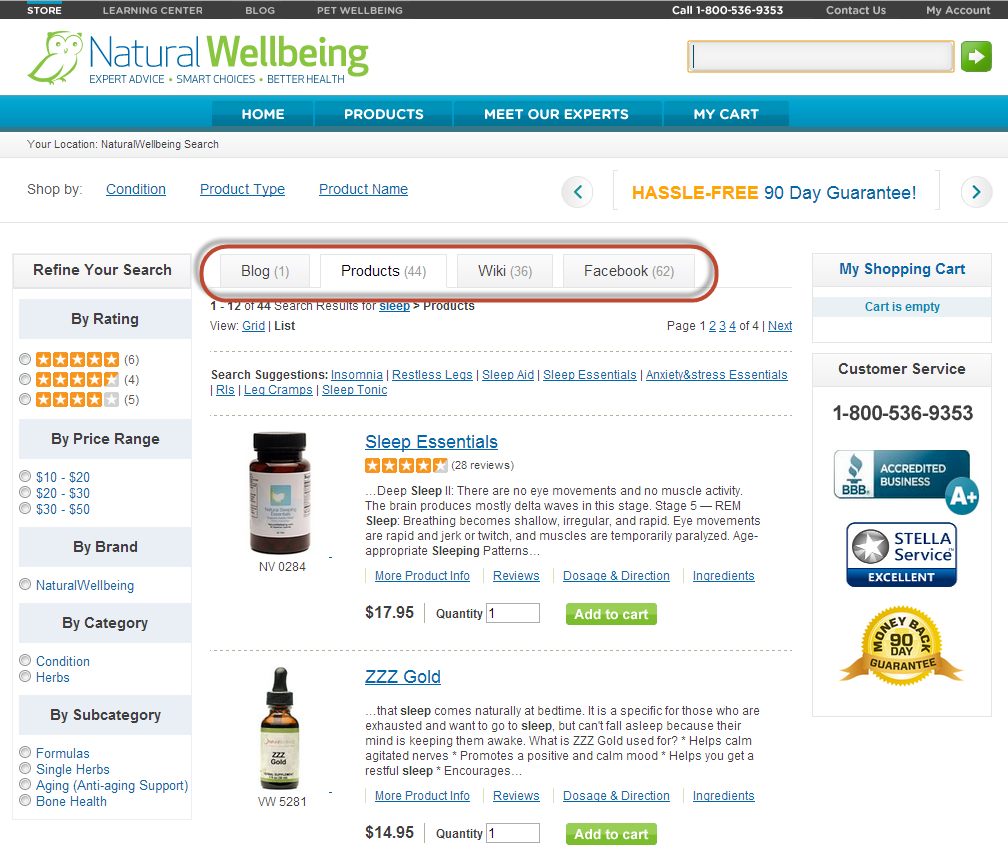 We also created a set of refinements for them (see the left column in the above screen shot), where users can narrow down the search results by rating, price range, brand, category or subcategory. For example, if a user wants to look at only formulas that contain blends of different herbs and doesn’t want to spend more than $20, they can click the $10 – $20 range in Price Range and Formulas in Subcategory. This narrows the number of product results from 44 to 25, as shown below. From that point, the user may want to look at ratings and read more about the products to decide which they want to purchase.
Since SLI’s site search continually learns and improves, the relevancy of search results improves over time. Natural Wellbeing realizes the benefit of letting SLI’s learning search do its work – it frees them from having to constantly tune results, allowing them to focus on other priorities in their business.
Both Natural Wellbeing and its sister site Pet Wellbeing also use SLI’s Site Champion product, which keeps improving SEO without any work on their part. Site Champion uses visitors’ site behavior to automatically create optimized landing pages that are indexed by Google and other Internet search engines.
In March of this year, I worked with them to add SLI’s Rich Auto Complete, which auto-displays product listings and images based on what users are typing in the search box. Since users can click on these products directly from the search box, the feature shortens the path from searching to buying, which creates a better user experience and improves conversions. Since adding Rich Auto Complete, the sites have received significantly higher page views, search users and search result clicks.
Now I’m working on ways we can help with their push for growth. I heard what they’re doing with email marketing, for example and showed them the types of custom templates and landing pages we can create for those campaigns. I’ve let them know what’s working well for others and have developed solutions that will help them achieve their current goals. It is through casual and interactive conversation that we come up with solutions that make a real impact. Being an extension of our customers’ team is what I and all SLI Customer Success Managers strive for.
Buttered Popcorn… Cream Soda… Toasted Marshmallow… most of us have favorite likes or dislikes when it comes to Jelly Bellies. And it’s nice to be able to order those favorites from Jelly Belly Candy Company’s online store at www.jellybelly.com. Jelly Belly’s eCommerce site is an important global sales channel for the company, which sells 100 other types of confections in addition to its 75 flavors of Jelly Bellies.
As highlighted in a newly published case study, Jelly Belly uses SLI Systems to improve its user experience and profitability. By optimizing site search and SEO, SLI helped Jelly Belly see a 33% increase in site conversions and a 10% increase in average order value. By using SLI’s customized product results pages and adding those links to email campaigns, Jelly Belly realized an 85% better open rate for emails.
Jelly Belly’s director of e-business Brandon Finch works closely with his Customer Success Manager at SLI to stay on top of search trends and best practices. Recently, Jelly Belly’s search data showed that their BeanBoozled product line of odd-flavored jelly beans was one of the most-searched for products on their site.
By the way, if you haven’t yet been BeanBoozled, watch out – a 1.6 ounce box contains both commonly liked flavors such as Peach or Licorice and identical-looking beans with flavors like Barf and Skunk Spray. It’s a higher-stakes trick than the one I did to my sister as a kid, swapping Watermelon Jelly Bellies for Jalepeno-flavored ones.
After learning how popular its BeanBoozled line was, Jelly Belly worked with SLI to add similar products to the search results page, so that shoppers buying BeanBoozled will also learn about Jelly Belly’s line of Harry Potter Bertie Bott’s Every Flavour Beans, which also have strange flavors. (In a handful of Bertie Bott’s, you may taste dirt, earwax, booger, cherry and tutti-frutti.)
SLI also worked with Jelly Belly to create faceted navigation for Jelly Belly’s site, with search refinement options in the left column of the page. For those really into unusual Jelly Belly flavors, their BeanBoozled results page offers refinement by Taste, with the choices of Icky, Assorted or Chocolate.
SLI’s work with Jelly Belly is just one fun example of how SLI continually works to improve each customer’s site for the best possible search results and conversions. You can read additional examples from Boden, American Bridal, PartySuppliesDelivered, Snow + Rock and others on our case studies page, or listen to customers speak in our podcasts and recorded webinars.

Is there anything people won’t buy online these days? Sofas and even major appliances now have their place in the e-commerce universe, which raises the bar for online businesses that need to serve the special requirements of these shoppers. Unlike browsing for shoes or books, shopping for DIY or home repair products like lighting or power saws needs precise navigating and searching capabilities.
The DIY/home goods space is now big business online: Online hardware and tool sales are a $6 billion market, which has grown an average of 7.8 percent a year since 2007, according to IBISWorld Market Research. To keep the growth at a steady pace, online businesses that sell home and DIY goods need to understand that these products are shopped for in different ways. For example, the expertise level of shoppers varies widely – from skilled craftspeople to someone doing their first home-painting project. Also, some products, like appliances and home décor items, are shopped for based on criteria like appearance, features, and price – whereas products like hardware and tools need to match specific shopper requirements for part number, size or dimension.
The first step in attracting (and keeping) DIY shoppers is to return relevant results for searches. Shoppers, especially the ones smack in the middle of a project, will expect to see results that match their keywords within the first page – otherwise, they’ll leave the site quickly (no doubt to visit the competition). Consider adding useful tools like Auto Complete, which offers search suggestions after the visitor types in the first few letters of a keyword. Thumbnail images within search results are also very helpful, since they provide a visual cue for shoppers trying to decide if they’ve found the products they want.
Since measurements can play an important part of DIY shopping, you should offer the option to search for products using either metric or imperial measurements – especially on a U.S. website, since both systems can be in use. Manufacturers may also use different systems of measurements (e.g. “counter depth” or “standard depth” for refrigerators), so this option can help shoppers avoid an unnecessary “no results” page or confusing results.
The same goes for searches by SKU or part number. If you’ve ever shopped online for a new knob for an oven, or hardware for a set of window blinds, you know how helpful a SKU search can be – you’ll know you have the correct item if it pops up in search results. Make sure your site search can match full or partial SKUs.
If you have store locations whose inventory mirrors what you sell online, you can turn on geolocation services that allow shoppers to see if a product is available locally.
Educating shoppers about best practices for DIY projects is another good way to encourage them to click on the “buy” button. If they’re confident about a project, they’ll want to purchase the products they need to get the job done. For instance, you can add how-to guides, technical specifications, videos, and blog posts to your site, and make this information available via search. It’s especially helpful to separate out these search results by type so that visitors will find it easy to navigate to the content type they want.
Product ratings and reviews can also help boost shopper confidence in an upcoming DIY project. These ratings and reviews should show up in search results, placing them at shopper’s fingertips while they’re looking at product options.
Whether it’s driven by homeowners trying to save money post-recession, or the plethora of home-improvement programs on cable TV channels, DIY has many enthusiastic followers. Make it fast and efficient for these consumers to complete their projects by shopping on your website.
For more research and commentary on eCommerce trends in the DIY category, download this paper: Hardware, Appliances & Tools Industry Brief.
Note: This blog was originally published by JXT Group on July 19, 2013.
Many of us know someone over 65 who is hesitant to shop online, or even use a computer or smartphone. This leads to the common perception that users 65 and over are resistant to adapt to changing technology. However, some studies show that more than half of the senior market has integrated itself in the eCommerce experience and is continually embracing this “new” way to shop.
As of 2012, 19 million American seniors are avid Internet users, and this number has been growing 16 percent per year for the last decade. According to a recent Pew Research Center study, that’s more than half of the senior population, approximately 55 percent!
As shopping online becomes as routine and easy as checking one’s email, it’s no wonder why the majority of the senior market has really embraced this shift toward online browsing and purchasing. And for some seniors with limited mobility or fixed incomes – or those just looking for a convenient way to quickly browse a number of stores – the benefits of online shopping are becoming even more apparent. The conveniences of shopping at home, combined with the opportunity to compare prices online, are driving this market to push the boundaries of their normal shopping habits.
Online retailers have recognized this shift toward online shopping for the over 65 demographic, and are making a stronger effort to cater to this market that was initially slower to adopt. Sites such as Hoveround.com, Jaystrongwater.com and AARP demonstrate the implementation of certain necessary and important design features for seniors.
Jakob Nielsen, in his article “Seniors as Web Users” observed that companies who redesign their website to give seniors a similar user experience quality as younger users can obtain 35% more business from them. Site usability is the most important aspect of any retailer’s site, as recognized by Nielsen in his research. According to the study, there are five main components that lead to successful site usability:
For the senior market, the most important usability features are the ease of accomplishing basic tasks on a first time encounter, how much they remember about the site’s design after not accessing the site for a long period of time and whether they can recover after making search errors. Users aged 65 and older are 43% slower at using websites than users aged 21–55. And when they had site search problems, seniors blamed themselves 90% of the time, compared to 58% of younger users. This is where a carefully planned user interface and site design is paramount in successfully capturing the senior market to shop on their sites and increase loyalty and retention among eCustomers.
Some design features necessary in developing senior-friendly websites include a large, distinct search bar, clear and bold navigation buttons, easily-readable text and prominence of the most important information above the fold. Other very helpful features are a Frequently Asked Questions (FAQ) page and multiple areas for contact information.
Research by MarketingSherpa suggests that visitors spend about 8 seconds before deciding whether to remain on a site or to search elsewhere. Having a clearly marked search box that returns highly-relevant results is a key component in lowering abandonment rates and increasing conversions to any age demographic – but even more so with this particular market. Online retailers who want to keep seniors coming back to their sites should consider working with search and navigation experts that can help them implement these key design features and ensure than search results are always relevant.
Looking toward the future, we can expect that the 65 and over market will be savvier when it comes to online shopping. Eventually, shopping online will be the norm and the senior market will have completely immersed itself into the experience.
Contact SLI Systems for a free site critique to learn how you can optimize your eCommerce site for 65+ buyers and other key market segments.
One of the most frequently asked questions when evaluating site search solutions is why a SaaS-based solution is better than on-premise. The reasoning may follow that with on-premise, you pay for software once, instead of monthly service fees. But while having a one-time payment for a software package may seem like the most logical and cost-effective solution, it can actually end up costing more in the long run.
On-premise software solutions require an extraordinary investment not only for the up-front financial costs, but also in ramp-up time, education, support and maintenance. Typically the software will be full of features that cater to all the different uses, but many of these won’t be used by one individual customer. Additionally, on-premise software is generally slower to upgrade, with typically six or twelve month release cycles. SaaS solutions provide an answer to many of these issues, giving users more time and flexibility to support other business priorities.
Harness Deep Knowledge and Experience
When you sign on with a SaaS solution, you’re not getting a piece of software and a general 1-800 customer service number – you’re getting a consultative group of industry specialists, dedicated to helping you achieve your goal. SaaS companies earn their money by having you as a long term customer – so they are financially incented to make sure you are happy and continue to use their software. SaaS companies can see how their software is being used, which helps build their knowledge of best practices. Since service is a key component of the model, you’ll find that SaaS companies have deep technical knowledge and provide value through excellent support, recommendations on industry best practices or specific features that will make your unique site shine.
Faster Ramp-Up Time
Going with a SaaS-based solution means you’ll also take advantage of faster deployment and ramp-up times. Your IT staff won’t have to invest the time and money to become experts at installing and maintaining their software. Technology, as well as customer preferences, is constantly changing. You’ll find SaaS teams to be agile in implementing new or complex features so you can quickly adjust to shifting demands. By adopting a SaaS solution, you can keep your in-house team focused on your most important daily priorities, and let a dedicated team of specialized engineers support your SaaS operations and maintenance.
You’ll also avoid long ramp-up times spent in internal training and resources. Once implemented, you’ll receive tutorials and ongoing customer support for all of your teams. The bottom line is this: your new capabilities will be up and running more quickly, and you’ll save yourself a lot of time (not to mention headaches).
Continuous Innovation & Customization
Another great benefit of going with SaaS is that all customers receive regular, automatic access to the most up-to-date features and products. As new features, products or improvements are created, the technology is shared across all users. The best solutions’ features can also be tailored to meet your site’s specific needs, for a streamlined experience that isn’t one-size-fits-all. Often, these ongoing upgrades are available at no added cost. You avoid the hassle of later purchases and updates of traditional software licenses, as you trade one-time convenience with ongoing support, recommendations and continuously-improved technology.
Redundancy & Scalability
It’s also important to keep the stability of your software in mind. When your core business depends on whether your site is up and functional, it’s imperative that your site doesn’t fail. Make sure your SaaS provider has a network of multiple data centers and redundant server architecture to ensure that your site will continue to run smoothly even during high web traffic spikes or natural disasters. There is a high chance that your SaaS provider will have more sophisticated, redundant systems than you could ever afford.
Round-the-Clock Customer Support
If your SaaS supplier is a global company then they will have support people based around the world. One of the biggest benefits we see is the ability to provide outstanding customer service and guidance. Knowing that you have personalized attention from your customer support representative and a full team of engineers supporting your eCommerce needs around the clock gives you peace of mind and allows you to focus on other important projects.
The benefits of SaaS vs. software-based site search are clear, which is why I strongly believe in SLI Systems’ approach to providing the best site search, navigation and SEO solution for your eCommerce business. For the third year in a row, SLI was named the #1 SaaS Site Search provider to the top 500 online businesses as ranked by Internet Retailer, and a leading site search provider to the top 1,000 online retailers.
Many eCommerce sites are flirting with mobile buyers; some eTailers have fully committed. But a recent Harris Interactive survey makes this clear: if you fail to perform during a shopper’s first visit on your site, don’t count on getting a second chance.
More than 70 percent of U.S. consumers use their smartphones to shop, and among those shoppers, 88 percent have had a negative experience. Most of us can relate to the frustration of having tried to make a purchase via smartphone only to abandon our cart mid-way through the experience. However, according to this study, an alarming 30 percent said that they would never return to that particular retailer’s mobile website again.
How can eCommerce businesses prepare for the shift to mobile?
Whether or not you have a mobile site now, it’s time to treat it seriously. Perhaps you quickly created a basic site a couple years ago to respond to the trend of mobile shopping, or you’re just thinking about moving to the mobile space. Whichever stage you are at, there are some common Mistakes to Avoid when optimizing your mobile site.
Forrester Research, in its 2013 paper Mobile Trends for Marketers, announced that “mobile on the cheap is over,” and suggested that businesses treat it as a strategic priority rather than an afterthought.
The top complaints of mobile shoppers are:
If these problems sound familiar for your own mobile site, take these proactive steps to improve the experience for your customers. You can start identifying what your mobile site needs by reviewing best practices, as outlined in the Whitepaper “Site Search and the Mobile Experience.” Then set up a site critique for specific, personalized recommendations on how to increase your conversions and boost your average order value, both on your web site and mobile sites.
Mobile shoppers are not the most patient or forgiving crowd. Considering that there are now more than a billion consumers with smartphones and more than 150 million tablets sold, it’s crucial to recognize that consumers around the world are driving a shift in how purchasing is done. By launching a new mobile site or optimizing your existing one, you’ll attract, engage and keep customers coming back.
In many situations in life, redundancy is undesirable. Our language and writing teachers told us to avoid use of redundant phrases – totally destroyed, armed gunman, exact same, merge together… you get the idea. In business, a company merger creates redundancies in job positions, which can mean layoffs. In many situations where efficiency is prized, redundancy almost seems to be its antonym – unless you work in high tech, especially cloud computing, where redundancy of servers and data centers is preventing the major inefficiency of downtime.
In the world of SaaS, redundancy is a competitive advantage. Software as a Service companies with redundant data centers are hosting client sites and customer data on multiple servers in multiple locations – each mirroring the other so that any of them can keep the customer site going if there’s a problem with the others. This redundancy allows the SaaS company to keep its customers’ sites running during spikes in traffic or unexpected outages.
Downtime is especially detrimental in eCommerce; online buyers can be ruthless when they encounter it. Surveys by Akamai and Gomez.com show that among shoppers who have trouble with a web site’s performance, 79% will never return to buy from that site again. Plus, 44% say they would tell a friend about their poor experience. Even a few minutes of downtime can result in dozens of lost customers on an ordinary day. Imagine the effect of downtime during a peak shopping day like Cyber Monday!
How can eCommerce businesses manage this risk and stay up and running in a way that’s affordable? In the blog Built-In Redundancy to Prepare for Natural Disasters, SLI Systems CEO Shaun Ryan explains how, as a SaaS-based provider of advanced site search and navigation, SLI processes billions of queries and serves up search results for its customers via multiple servers in each of eight data centers in locations around the world. SLI servers are filled to just a fraction of their capacity to allow for spikes in customers’ site traffic. Simply by contracting with SLI to get better results and more conversions from site searches, an eTailer has the added protection of redundancy.
During Hurricane Sandy, for example, not one of our customers saw a break in service. Though headquartered in California, SLI was founded in Christchurch, New Zealand, which was hit by two major earthquakes in the past three years. By personal experience, we’ve learned how important it is to be prepared for natural disasters. And we want our customers to be prepared, as well. That’s why we offer redundancy at no added cost to our clients.
This year, a stronger-than-normal Atlantic hurricane season is predicted through the end of November. Especially with back-to-school and even holiday shopping spikes on the horizon, now is the time to move to a full-service site search provider that can help you handle the load.
We don’t get uptime perfect – no one does. We had an unusual three-minute outage one night about a month ago. Our redundant architecture quickly kicked-in, resulting in no downtime for our customers. We found that the outage was due to human error, from a break in our process, and we made the necessary changes to ensure it wouldn’t happen again. Although none of our customers were affected, we still sent out email notifications outlining what had happened. One of our customers, Ian MacDonald of PartySuppliesDelivered.com, wrote a nice email to express his appreciation for our honest communication about the event.
Thanks, Ian. We’re honest and transparent because we know it builds customer trust (plus it’s just who we are). We appreciate you, too.
Every day we see how introducing great site search is one of the easiest and quickest ways to turn more visitors into buyers. Earlier this month our customers were telling their stories at IRCE 2013 in Chicago. These are businesses like Samuels Jewelers, which doubled the per-visit value of their site search users after implementing changes that make search results more relevant. And Party Supplies Delivered, which increased their conversions by 203% after switching from their platform’s default search to advanced search.
Al Gore’s keynote address was about the international opportunities that abound for eCommerce – an industry that is growing 15 percent each year, even during a period of global economic stress. “You need to think global,” he said, pointing out that the number of Apple iOS and Android devices activated in the U.S. was surpassed in January by those activated in China. The economic balance is shifting and we need to accept, and anticipate, change.
We spoke with many online retailers who haven’t yet optimized their site’s search and navigation, and his keynote hit home. As eCommerce grows internationally, SLI plays a pivotal role in providing the tools that enable the best shopping experiences for customers around the world. Whether for large online retailers with multiple international sites or family-owned businesses, we work to provide the best products, resources and customer service, so that all of our customers can focus on what matters most to them – their business.
Seizing the Opportunity with IPO, Expansion
As a company that has an established customer base spanning five continents, we understand the global opportunity. Brazil is one of our most recent, and fastest-growing markets, adding to our strong presence in the United States, the UK and Australia. We are working with some of the top Brazilian online retailers to improve their search and navigation, both on web and mobile sites. We are also starting to work with our first Japanese partners and customers.
The vast opportunity for further international expansion is one of the reasons SLI Systems decided to raise capital through its IPO on the New Zealand Exchange on May 31, 2013. It has been an exciting time for SLI’s founders and investors as we’ve watched shares rise since the original offer of NZ$1.50. You can hear more about our story in this June 4 interview.
We’ll use the investment to fuel sales, marketing and customer support as well as innovation, as we grow our engineering and product development teams. This will build on our tradition of bringing our customers the ongoing feature and product developments they need to make their eCommerce sites the most successful in an increasingly competitive marketplace. We believe that innovation and measured growth are the secrets of global success.
Today’s online shoppers are starting to see gorgeous magazine-like sites tailored for mobile browsing, interactive tools that aid decision making, and the convergence of social and editorial to create highly-personalized shopping experiences. More and more of our customers are eager to work with us to integrate these features into their site search and navigation. As technology advances and global opportunities continue to expand, we anticipate and remain at the leading edge of the many innovations in eCommerce yet to come.

This article is part of our monthly “CSM of the Month” feature, in which an SLI Systems Customer Success Manager discusses a current client example.
One of the more interesting projects I’ve been involved in recently is with Analysys Mason, a research and consulting firm who provide detailed articles to their global client base on all issues that relate to the telecoms, media and technology (TMT) sectors. While a large percentage of SLI’s customers are online retailers, we also work with publishing sites like Analysys Mason, the New England Journal of Medicine and Dilbert.com.
Analysys Mason is a great example of how SLI’s site search and navigation technology helps publishing sites improve the user experience and increase the number of page views per visitor. In fact, since implementing SLI they have seen a 21% increase in page views and a 24% increase in unique page views. The average time on site has also increased.
One of the reasons for these improvements is that SLI’s page load times are much faster than Analysys Mason’s previous search. This allows users to more quickly find the articles they’re looking for and leads to an overall better user experience.
Analysys Mason has a vast Knowledge Centre of research articles it has prepared. When I first started working with Analysys Mason, one of their unique needs was to show each user a different set of results based on their specific subscription IDs. This allowed them to have different tiers of subscribers – those with a free account who have more limited access to research, and those paid subscribers who have full access. Now that SLI brings back the correct results for each user based on their login credentials, Analysys Mason is able to make the tiered subscription model work for them.
In the below screen shot, you can see how the Knowledge Centre appears to those who are not logged in. In the left-hand column, the radio buttons under the Access section allow you to refine results based on free or paid content. In the results section, articles that are limited to logged in users display the note Subscription Required.

Analysys Mason also uses SLI’s synonyms tool for search, as it has helped them to expand their vocabulary without having to edit the content database. As an example, a search for ‘MEA’ will pull up results for Middle East and Africa, even if the acronym MEA does not show up in the article title or summary.
By tracking the search terms used on its site through SLI, Analysys Mason is also able to pinpoint specific trends in searches. These analytics allow them to improve upon results for poor search phrases, as well as to know what research papers people are looking for.
Analysys Mason is also very pleased with the search suggestions that automatically appear under each product. This feature is powered by SLI’s Learning Search technology, which directs a user to a related set of results if they can’t find the article they are looking for straight away.
Anyone who has searched for articles on a publishing site knows the frustration of finding nonrelevant results, as well as the satisfaction of finding exactly what you were looking for. I’m happy to work with Analysys Mason to ensure that their customers have a great search experience and spend more and more time on their site.


Shiny, happy SLI folks pre-race
Just this past weekend, eight of our SLI family of us (plus friends & family) ran, climbed, jumped and crawled our way through the grueling 6K Gladiator Rock ‘N Run Challenge. Team members from our sales, customer success and marketing departments came out in force to rock the 17-obstacle course in the hills above San Jose.
Looking back on the challenging uphill trail, crawls through rocky mud pits and a horrible, horrible rope climb (in my humble opinion), it’s clear to me that we are lucky to have a great company culture that takes work as seriously as we play. When the going got tough, we urged each other on, helped pull each other up and rooted each other on when pushed to the limit – which isn’t far off from how we work at SLI.
We consider our business as the leading provider of SaaS site search to be a team effort, where all members share in the challenges and successes of our work, and ultimately provide the very best products and service. Our tight team dynamic is one of the reasons SLI is known for its excellent products and customer service, and hopefully from these pictures, you’ll see that we’ll go the extra mile to make sure our customers are happy.
Does SLI sound fun to you? If you’re interested in joining the SLI Team, check out these openings here.

SLI Teammates conquering “The Beast”

Team SLI with Dan “Nitro” Clark of American Gladiators
Guest blog post by Sasha Butkovich from Ecommerce Outtakes
eCommerce is going mobile in a big way, and many studies show the trend in mobile shopping just keeps rising. In the past two years alone, the percentage of eCommerce sales on mobile devices rose from 2% to 8% in the U.S., according to research from comScore, Forrester and eMarketer (check out this infographic for more cool stats on this).
Many retailers are getting on the m-commerce bandwagon, and those who haven’t already are working on their mobile strategy. It’s so important to have that mobile site optimized for when shoppers arrive, ready to purchase! However, this isn’t always easy. As an eCommerce retailer, there are some big considerations to take into account before taking the mobile plunge. What follows are five common mistakes to avoid with your own mobile site.
Mistake #1: Not recognizing your users
When designing your mobile strategy, functionality is only half the battle. Sure, you want a site that works well and renders properly on a smartphone or a tablet. But the more important considerations include knowing who your customers are and how they’re going to be using this site. Determine the main profiles of your mobile customers – what they’re shopping for, where they’re accessing the mobile site from, which devices they’re using, and what they want from the site. Once you have an idea of this, you can design the best mobile eCommerce experience for your users that caters to their specific needs.
Mistake #2: Having the same design for smartphones & tablets
Whether a brand chooses to go with responsive design or a native app, one thing is very important to remember: smartphones and tablets are not the same. Using a smartphone to shop is different from using a tablet to shop, and as a retailer, you should tailor those experiences accordingly. Tablets offer the potential for more rich media experiences, so you can have a little more fun with the bells and whistles. Adding video to your tablet site is a great start, because tablets are perfect for viewing videos, and tablet users are more likely to watch them. Smartphones, on the other hand, are being used by shoppers on the go. This shopping experience should be simple and direct.
Mistake #3: Overcomplicating the shopping experience
Any eCommerce site should be simple to navigate and use, but this becomes even more important to the mobile shopping experience. The layout should be simple, the buttons should be large and fields should be easy to type into. Don’t clutter the pages with too many links or categories, like this example from the ASOS mobile shop. When people are shopping from a mobile device, they’re generally out and about, and don’t have time to waste sifting through the features of an overly complicated website. And make sure that checkout process is quick and easy, too. Don’t lose the shopper at the very last step in the process!
Mistake #4: Neglecting security
It might seem obvious, but security is hugely important in mobile eCommerce. I recently began the checkout process on a mobile site, only to realize the http in the url was broken. See the screen shot below for what happened in this example from the Sears site. When that little lock icon is broken, I’m definitely not entering any credit card information! I’m one customer this particular site lost. Don’t lose the sale because of a lack of security on your site. For a mobile shopper on the go, it’s pretty frustrating to have to abandon your cart because it’s not secure.
Mistake #5: Forgetting about the marketing emails
Hey, remember all those marketing emails you send out to get those customers to your eCommerce site? You’ll want to make sure those are optimized for mobile, too. If people can’t read your emails on their phones or tablets, they definitely won’t be visiting your site from their phones or tablets either. Don’t miss all those opportunities to generate traffic and conversions. And of course, direct them to the mobile site itself, not just the desktop version!
Know your users, know their devices, and keep things simple and secure. These are the keys to starting your mobile strategy on the right foot. Once you’ve got these things down, you’ll be on your way to success in the growing world of mobile commerce!

We may be halfway through the last day of the exhibit hall at the World’s Largest eCommerce Event, but there’s a lot yet to see and learn today for those at IRCE 2013, the Internet Retailer Conference and Exhibition in Chicago. Here are some of the highlights so far, and a couple opportunities still coming up today.
Al Gore Keynote: Focus on Mobile and Go Global
In his keynote address, Vice President Al Gore showed excitement about the growth of eCommerce. He noted that retail comprises 7% of the U.S. GDP, and presented other facts suggesting that he understands the potential boom in growth of online retail – especially in the mobile area, as there are already 1.5 billion smartphone users in the world.
He also focused on the need to think globally, saying “Your customers are global, your competitors are global. The Internet connects billions of people and smart devices… If you keep on your toes and innovate properly, the opportunities are boundless.”
Success Stories from eTailers
While the show is filled with vendors that promise to optimize one area or another of your online business, one of my favorite parts of conferences like IRCE is hearing from the online retailers themselves.
I have had the opportunity to listen in on success stories from seven different eTailers presenting at the SLI Theater in booth #501. JAM Paper, Samuels Jewelers, PartySuppliesDelivered and Envelopes.com have already presented on how they’ve increased their conversions with better search results and site navigation. One of these businesses, Samuels Jewelers, said in a press release today that by using advanced site search features, they were able to realize three times higher conversion rates and double the per-visit value for search users on their site.
Still on the Schedule Today
The following success story presentations are happening at the SLI Theater, booth #501, today:
1 p.m. ReNew Life
2 p.m. Steiner Tractor
3:30 p.m. Vermont Teddy Bear
If you can’t make it to the above live presentations, take a look at some of the following case studies for ideas on how to improve your online business.
This is third in a series of success stories on eCommerce sites that are growing their business with advanced site search. Also in this series, read about Party Supplies Delivered and Vermont Teddy Bear, and see live presentations of these stories at the SLI Theater at IRCE June 3-6.
Jam Paper & Envelope, a top source for paper crafts, creative giftwrap and all other things paper-related, has been featured in Real Simple, Martha Stewart Living and Country Living Magazine, among others. With its flagship New York City store, a successful online retail operation, and two other store locations, the paper company has been able to succeed both in the brick-and-mortar and eCommerce worlds.
JamPaper.com offers more than a million variations of specialty envelopes, paper, cardstock, gift cards and other paper goods, with 70% of its sales going to businesses that place large orders for marketing promotions, weddings or other events. The business started two generations ago and has remained in the family, with grandson Andrew Jacobs leading the effort to create the eCommerce site. Jam Paper first went online in 2004 and the site traffic is growing steadily.
“Our initial site search was rudimentary,” Jacobs said. “But since we’ve started online we’ve been constantly working on improving.”
One of the challenges for JamPaper.com was to help their users find the exact product they wanted among the enormous number of items and pages. Envelopes, for example, are one of their most common searches, but envelopes can come in 50 colors and 50 sizes – with many small variations for each. Since they improved their site search and navigation, Jam Paper has made the following improvements so users can more easily find and purchase the exact product(s) they want:
By analyzing their search data on an ongoing basis, Jam Paper continuously improves their online user experience. The impact on online sales is “crawling upwards and keeps getting better,” Jacobs said.
At IRCE in Chicago June 4 and 5, Andrew Jacobs will be at the SLI Theater to share the tips and tricks he’s learned for improving Jam Paper’s eCommerce site search, navigation and SEO. Stop by Booth #501 to meet him or to get a free site critique from the SLI Systems team.
Other SLI Theater presenters include Steiner Tractor, Envelopes.com, Samuels Jewelers and ReNew Life. See the full schedule of presentations here.
This is second in a series of success stories on eCommerce sites that are growing their business with advanced site search. See live presentations of these stories at the SLI Theater at IRCE June 3-6.
Ever heard of a Bear-Gram®? How about a Pajama-Gram®? The same company that sends both types of cuddly gifts to more than 150,000 customers each year is Vermont Teddy Bear. As an 11-time Platinum Honoree in BizRate.com’s Circle of Excellence awards, Vermont Teddy Bear is among the world’s best online stores in Ease of Ordering, On-Time Delivery, Product Selection, Customer Support, Repurchase Intent and Overall Satisfaction, according to millions of BizRate customers.
Since 1981, Vermont Teddy Bear has offered high-quality, U.S.-made bears in the style of the original Teddy Roosevelt Bear from 1902. The bears can be personalized and are delivered overnight in a special box complete with air hole, game and candy treat (in case the bear gets bored or hungry on the way to its new owner, says the company).
As the word about Vermont Teddy Bear’s BearGrams first spread through radio ads in the ‘80s, the company expanded to include PajamaGram, which delivers gifts of cozy, quality pajamas, as well as CalyxFlowers, which delivers bouquets and other floral gifts from growers around the world. The sister companies have operated successful online retail operations for well over a decade.
Partnering to Increase Online Sales
Vermont Teddy Bear has its own team of eCommerce experts who work with partners to optimize their online reach. Since early 2008, Vermont Teddy Bear has used SLI Systems to improve the brand’s site search, navigation, mobile commerce and search engine rankings. At PajamaGram.com, SLI Learning Search ensures that the most popular products – as well as those the company specifically wants to promote, like their family set pajamas – are those first displayed in relevant search results. SLI Learning Navigation pages also make it easy for visitors to shop for pajama gifts by size. The result? More families and gift-givers finding matching pajama sets in the right size.
Vermont Teddy Bear’s Director of eCommerce Operations, Victor Castro, will showcase the business’ online successes at the SLI Theater, booth #501, during the Internet Retailer Conference and Exhibition (IRCE) in Chicago June 3-6, 2013. See our full lineup of scheduled feature presentations, or just stop by at 3:30 on June 5 or 6 to see Victor. Wearing your pajamas is optional!
This is first in a series of success stories on eCommerce sites that are growing their business with advanced site search. See live presentations of these stories at the SLI Theater at IRCE June 4-6.
Every eTailer knows this: You can’t get people to buy what they can’t find.
In the online party supply world, for example, a consumer has dozens of choices for where to buy a $250 life-sized Dr. Who TARDIS. If your site doesn’t appear high in Google results for this item – or if your customers can’t find the science fiction party supplies on your site – then your conversion rates will be as unpredictable as is the TARDIS’ ability for accurate time travel.
PartySuppliesDelivered.com is one among dozens of online party supply stores. With more than 4,000 products and the backing of parent company Mattress USA, PartySuppliesDelivered.com had a couple great things going for it. But there was one major problem: Customers could not find what they were looking for.
The party supplier’s original site search technology was the default search included with its eCommerce platform. It ranked search results only by the number of times the search term was found in the description, instead of ranking search results by relevance. This limited approach led to skewed results and frustrated potential customers.
To solve this problem, Party Supplies Delivered put its search function and site navigation into the full-service care of SLI Systems. As customers began to find more relevant results for their searches, the business improvements were remarkable; the bounce rate dropped 40 percent, page views increased by 132 percent and conversions went up by 203 percent. Key features like focused category pages, rich auto-complete and user-generated SEO are among the changes that are turning the business around.
“Now when customers drill into a subcategory, they really browse around; pages per visit are up 111 percent. This increases their average order too,” said Ian MacDonald, VP of eCommerce & Marketing for Party Supplies Delivered.
To learn more about how advanced site search and navigation technology helps Party Supplies Delivered, read their case study. If you’re coming to IRCE, stop by the SLI Theater at booth #501, where you can see a live demo from our customers including Ian from Party Supplies Delivered – plus get a free site critique. We look forward to seeing you there!
A/B testing is one of the most important things you should be doing for your eCommerce site. In eCommerce, your site’s layout, design and feature set are a crucial part of the product – not just the physical products you sell. Yet many businesses don’t place high importance on testing. Without it, you’re essentially displaying products without ever knowing how your customers respond to your layouts.
A/B tests compare a variable against a control to determine which one is more popular. For eCommerce sites, elements of control page “A” are compared to the new version “B” to find which one increases interest in the page. This could be in the form of click-through rates, conversions, pages viewed per visit, or whatever goal is specified.
Say you want to encourage more people to click a button on your page to sign up for a service. To test the effectiveness of the button, you’d use the current page/ button design as your control and a test it against a new design. Both designs would be released simultaneously to a customer sample, and their clicks during the test period would be tallied to see which button drove more clicks. You’ll usually see a pretty clear indication of one particular design that users prefer. A/B testing is a simple, yet effective way to determine which version “wins”.
With the results of individual tests and the collective results over time, testers will get actionable data about what design, layout and features users prefer.
But repeat after me: “one design does not fit all”. User demographics and preference play heavily into what works for one site but not for another. Even though your site may sell something similar to another, your audience may be different and users may behave in very dissimilar, contradictory ways. It’s important to test your site specifically, and not necessarily follow others in your industry.
Instead of grasping at straws when deciding on design or feature changes on your eCommerce site pages, consider A/B testing to help give clearer, data-driven insights that can provide concrete recommendations to improve your site’s performance. The only thing you should not A/B test is the decision to A/B test.
Have you been shocked by results from A/B tests? We’d love to hear what you learned.
Guest blog post by Sasha Butkovich from Ecommerce Outtakes
Though online retail trends continually change, there are some tried-and-true rules for successful cross-selling and up-selling.
Don’t: Waste white space
Product pages are the perfect section of the site to suggest other items to shoppers. Of course you don’t want to clutter the page, but leaving too much empty space is such a waste. Why leave it blank when you could be suggesting similar products or making recommendations? This is the perfect spot for a cross-sale.
Take True & Co, for example; they have lots of white space here! This is such a missed opportunity for cross-sale or up-sale items that could add to the total value of the shopping cart…

Do: Provide relevant suggestions at checkout
It’s not enough to recommend just any old product on the site. Recommendations need to be relevant to the item being viewed and the purchase being made. The whole concept of a “people who viewed this item also viewed” recommendation engine is nice in theory, but not all customers shop the same way. Just browse around on Amazon.com for a while for proof of the seemingly arbitrary suggestions this feature can provide.

As a counterpoint to this, here’s a good example of relevant suggestions from B & H Photo. When I added a camera to my shopping cart, there was an additional “Essential Accessories” section in the pop-up window that showed other items to accompany this specific camera. This is a great cross-sale feature, because it saves the shopper having to look up or find each item separately. It’s all provided right here. Plus, featuring these items right in this “added to cart” window is a great way to draw attention to these products without adding a step in the checkout process. Good timing is definitely a big part of good cross-sale!
 Do: Provide additional discounted options
A great strategy for up-sale is to offer additional products at a discount. For instance, a customer who adds item A to their cart can get item B for 50% off. Similarly, nail polish site Julep offers add-ons for a lower price. When you go through the checkout, one of the steps is to select your add-ons. You can of course choose none, but it seems hard to pass up a product that’s typically $14 for only $5… Customers are limited to three add-ons, so the logic is to get the most product for the money by choosing the maximum amount—at least that’s what I did when I ordered from the site! Speaking from personal experience, I can say this is an effective strategy for sure.

Do: Integrate cross-sale on search pages
Another really cool way to provide a cross-sale feature is to offer it right on the search page. Here’s a great example from CP Toys. When you perform a search, like for “construction,” the results page shows some of the items available from CP Toys, of course. But if you look below this, it also shows products available on their sister sites, U.S. Toy and Constructive Playthings. This is an excellent cross-sale strategy because it creates a connection with the customer. It shows that if the shopper can’t find what they want on this site, they can still get help finding what they’re looking for.
Don’t: Be overly aggressive
Of course, cross-sale and especially up-sale features run the risk of feeling aggressive to the shopper. It’s important to not become too intrusive in their shopping experience. Provide suggestions and recommendations based on their preferences and behaviors, but avoid becoming too pushy with multiple pop-up windows or repetitive reminders. Otherwise, you create a shopping experience that feels a lot like this:
[youtuber youtube=’http://www.youtube.com/watch?v=N5WurXNec7E’]
Changing to a new eCommerce platform is a huge investment, not only in dollars, but time spent integrating your site and training your team on the new features and functions. When you’ve just spent so much time and money upgrading to a new platform, it’s easy to see how adding site search would seem like little more than an additional expense.
But failing to upgrade your eCommerce platform’s search is like upgrading your ski clothes without buying better skis – you may look and feel better, but your technical gear won’t perform well. Upgrading the core search ability of your site can lead to better overall performance and higher conversions.
While platforms do many other things well, they don’t offer specialized features that focus on making your search shine. It’s a fact that visitors who use site search are more likely to convert. So if search is so important, shouldn’t you be paying more attention to it? When you’re looking at your platform’s site search, it’s important to ask a few questions to make sure you’re getting the most out of it.
Are your search results as relevant as they could be?
Advanced site search and navigation improve the quality of search results based on customer shopping behavior and click-throughs, re-ranking products based on popularity. Can it dynamically build SEO pages that continually update to reflect the most popular searches on your site? Pages like this can work toward improving your organic Internet search results rankings.
Are there opportunities for customization?
No two sites are alike, and search features should reflect that. It’s important to implement the features that will appeal to your customers, and make their experience on your site uniquely tailored to their shopping behavior. Don’t let a lack of innovation stifle your site’s growth.
Does your platform share the latest features and best practices with you?
The eCommerce landscape changes quickly and having the best features can make your site stand out from the rest. It’s beneficial to have a partner that understands industry best practices and suggests improvements to site features.
Do you have access to reports and analytics?
The reporting data you get from site search is filled with important insights that can help you understand your users and better target their needs. Having access to the top search terms, poor results and top converting pages can help you anticipate new trends or better promote the most popular search queries.
Does your platform have A/B testing?
Can you make fact-based decisions on the value of certain features, designs, or buttons? A/B and multivariate tests can produce surprising results, because not all customers behave in the same way. In some tests, we’ve seen conversion rates increase when using grid view, while others increase with list view. Since every site is different, you shouldn’t trust a general “rule” – but test it for yourself.
Do you have a dedicated, responsive customer support team?
Having a single point of contact can mean the difference between personalized, responsive service and being continually frustrated from lack of response. Making sure you have strong support will give you time to focus on other business priorities.
If the answer to any of these questions is ‘no’, then I’d suggest taking a good look at what your current site search is really providing you. A good site search will give fairly accurate results and have a few bells and whistles. A great site search will not only deliver relevant results, it will give you crucial insights into what drives your customers and actionable ways to proceed. Additionally, it shouldn’t be so overly complex that you won’t use it.
If you’d like a hassle-free solution and a solid team behind you to help you grow your site, give us a shout at discovery@sli-systems.com. We’d love to hear from you.
When you are looking for a vacation rental, there are certain specifications that you need or want. Location, the number of rooms, price and amenities are all ways that people describe what they want.
My goal when I worked with VacationRentalPros.com was to take their immense wealth of data for each rental listing and make sure their users could find, sort and refine through different listings. We implemented Learning Search and Rich Auto Complete onto Vacation Rental Pros’ site.
Vacation Rental Pros’ users most frequently search by location; queries like “St Augustine” and “Palm Coast” are common. We worked with them to understand how their data was structured and how we could reference it to ensure users were served results in the correct area and given the option to refine by adjoining neighborhoods.
The results sets we serve to users are focused and relevant. If a query matches a property attribute, such as “number of bedrooms” or “pet friendly”, users are only served properties with matching criteria. An accurate result set makes it easier for a user to become qualified. It prompts customers to narrow their results by price and availability – two factors inevitably on a user’s mind while making their purchasing decision. Secondary refinement options, like property rating, are also clear and visible.

Working with the team from VacationRentalPros.com was great; they gave me useful feedback on unanticipated search queries, which helped me understand what users might be searching for but not finding. With this information, we made modifications to our search to create more accurate results.
Part of the value of SLI is that while we give a client a very strong product out of the box, we believe in tailoring the search to meet our customers’ needs. Once the main features are set, the merchandising console gives our customers the tools to continue improving their site search and merchandising to make their site really work for them.
The Vacation Rental Pros team was very clear about what was important to them and what they wanted their users to see so we could give them the best end result. Because of the collaborative work of the team, site visitors will now see a streamlined site with well-organized information that leads them to their dream destination.


Ecommerce retailers strive to give customers fast, efficient, and convenient shopping experiences, from the comfort of their home. While it is no surprise that eCommerce continues to grow, online retailers are taking steps to ease some of the pain points that customers have when shopping online.
A new trend is emerging with online stores creating a physical presence with their businesses. Additionally, online-only superstores are exploring innovative ways to improve shipping products so customers never miss a package again.
Although the initial belief behind online retail was that consumers dreaded taking time out of their day to visit a physical store, the benefits of being able to touch, feel, and experience products has been shown to be an incomparable driving force for decision making.
According to the New York Times, companies like Etsy, eBay, Piperlime and Bonobos, which have typically had an online-only presence, are now testing small showrooms in large cities across the country. These smaller stores, with smaller square footage than standard “big box” retailers, allow these online retailers to customers interact with products physically before they buy. These stores are not meant to house all products, but rather serve as a showroom for new or popular items. Because they carry limited stock, they are able to afford more expensive, high-visibility locations in major cities.
Another program being tested seeks to improve the burdens that come with shipping. Amazon is rolling out “lockers” in various test cities. Deliveries are dropped off in conveniently-located locked boxes so users can pick them up anytime, eliminating the need for them to be home for a FedEx delivery.
Many people aren’t home during the day to wait for packages to arrive. We’ve all been there – we’ve missed the delivery of a purchase…for the third time. Then we’ve needed to fetch it from a far-off warehouse that kept inconvenient hours. Improving the flexibility customers have in receiving their packages makes a lot of sense.
While eCommerce continues to grow, it’s interesting to see the changes, experiments and improvements that are made to make the online shopping process as pain-free as possible. We look forward to seeing how it evolves and strives to best serve customers.
We always like to stay updated on the eCommerce industry as it unfolds – do these pain points apply to you? What changes are you anticipating for your online business?
The best eCommerce websites understand the needs and buying behaviors of their customers. In the case of hair care and beauty products, shopping for the right product is very personal. Whether considering hair type, brand, or treatments being sought, being able to quickly sift through a wide variety of products and find the right one can be tricky.
Join our webinar tomorrow to hear Sylvia Zori, General Manager of Folica, a leading hair care and beauty site, share her strategies for improving customer retention and conversion rates with site search and merchandising. Learn how she’s pulled from user analytics and site behavior a streamlined shopping experience for customers.
You can sign up here to attend this free webinar. Don’t miss out on learning valuable tips to increase your sales volume with stylish eCommerce tools!

