SLI home
User login

A BLOG FOR E-COMMERCE LEADERS

  • Blog
  • Resources
  • Webinars
  • Customer Experience Scorecard

SLI Blog

Site Search Isn’t Sexy, It Scores Sales

Posted by Tim CallanFebruary 25, 2015eCommerce, Site Search, User Experience

There’s no question. Site search isn’t sexy, but it doesn’t have to be, because the revenue it drives speaks for itself. Internet Retailer Senior Editor Thad Reuter said it best in his February article, Reading Shoppers’ Minds:

“Site search receives little in the way of celebrity-level attention in e-commerce… But with retailers typically reporting two or three times the amount of conversions for site search users, the stakes are obvious: Better site search can translate into more profits.” Period.

However, one question still remains: Which site search approach best connects shoppers with the products they’re most likely to buy, making shopping easier and retailers more profitable? Do online shoppers use natural language search, which interprets subjective terms to serve up search results? Or do the most relevant search results come from learning site search, which “learns” what specific search terms resonate most with consumers and – with SLI Learning SearchTM technology – reranks the order of search results based on the latest activity of users?

In e-commerce, there is some uncertainty around the demand for natural language search. North Face e-commerce manager, Charles Caison, told Internet Retailer, “At North Face, for instance, most shoppers search using terms that describe the product, not ambiguous phrases that require natural language processing to decode. It may be that we have been trained by Internet search engines for keyword searches rather than natural language searches.”

A new SLI study also supports Caison’s insight. To demonstrate site search user behavior today, SLI evaluated natural language terms, focusing on subjective search terms including “cheap,” “nice” and “cute” for a Fortune 100 retailer. As you can see in the chart below, out of 67,000 searches, the word “quality” was only used 3 times while “cheap” and “nice” had similar results. The findings reveal that subjective search terms are not yet commonly used among online shoppers.

Total searches performed ~67k
Searches containing “cheap” 11
Searches containing “quality” (high-quality) 3
Searches containing “nice” 0
Searches containing “cute” 42


Lakeshore Learning, an IR Top 500 company, also finds less use of natural language search from its shoppers. Lakeshore Vice President of E-commerce Sam Sarullo told Internet Retailer, “an analysis of the retailer’s top 1,000 searches revealed that consumers use an average of 1.8 words to search – a signal that consumers remain wedded to keyword search, and that natural language-type searches may not yet be intuitive. That said, I see return customers who are more familiar with our products using these natural language or long-tail searches.”

The beauty of Learning SearchTM is that if it detects shoppers’ use of longer search terms, it will “learn” and tweak its results to reflect that behavior. Learning Search continuously analyzes the terms and phrases that prove most popular and lead conversions.

Perhaps the best argument for the value of Learning Search is to let e-commerce companies’ results speak for themselves. Here are some of the results leading retailers have experienced using Learning Search:

  • Lakeshore Learning, an education supplies manufacturer: 30% increase in online sales
  • Boden, a British clothing retailer: 1.8x higher conversion rate using search
  • e.l.f. Cosmetics, an international cosmetics brand: 21% higher per-visit value using search
  • Marine Depot, world’s #1 supplier of aquarium supplies: 11% increase in revenue
  • SurfStitch, Australia’s #1 surf retailer: 30% improvement in page position for organic search

Some say “sex sells,” but in e-commerce, Learning Search sells more.

Read More

Infographic: Top E-commerce Searches for Valentine’s Day 2015

Posted by Dawn MortensenFebruary 12, 2015eCommerce, Infographic, Site Search

valentines_infographic_2015


Besides the obvious first-place choices of diamonds and roses, see which gem stones, flowers, food gifts and types of jewelry online shoppers have searched for most prior to Valentine’s Day 2015. Design by Rosann Yip, Sr. Designer, SLI Systems


Read More

Amplify Omnichannel Marketing with Geospatial Search Results

Posted by Kemberly GongFebruary 11, 2015Merchandising, Site Search

Does your retail operation manage both online and brick and mortar shopping experiences? If so, you understand the importance of showing shoppers a wide variety of products online, while also giving them the option to find their desired product locally where they can see it, try it in person and perhaps pick it up the same day.

A popular way to provide these options to shoppers is to use geospatial information to localize the online shopping experience. By allowing geospatial queries, retailers can offer location-based searching and navigation so that shoppers can:

Filter and Order Search Results by Distance

Retailers can allow customers to see the availability of products within a geographic range, narrowing results by the distance they’re willing to travel for the item. Additionally, retailers can order results by distance so that products located closer to the specified area are listed first in search results.

Shop by Store Location

AndersenThis feature lets customers view results for products that are available at a particular store location. This can come in handy if customers are more interested in seeing products at the location closest to them. Some retailers carry different inventory in various stores or have a wider inventory online. Allowing shoppers to search by store location provides a specific, localized and convenient online shopping experience.

Andersen Windows, the largest manufacturer of windows and doors in the U.S., uses a store locator map on their site to show the closest stores where their products are sold.

Show Search Results in Map View

The easiest way to convey information about location is through a map. Showing shoppers where product inventory is located and giving them the ability to see more or less based on geographic perimeters provides a richer and very intuitive search experience.

Show Available Inventory on Product Detail Pages

When shoppers view a product detail page, retailers can provide additional information about the closest local stores where the inventory is located. This is especially helpful for shoppers who want to examine the item in person before a purchase or for those that need it quickly. It can also be helpful for products that are difficult to ship due to size or weight.

Giving shoppers a localized shopping experience streamlines their ability to find and buy products in a way that is most convenient for their needs. It’s an easy way to add tremendous value to shoppers by showing information that is directly relevant to them – it also improves the chance for a sale.

SLI supports geospatial queries in the ways listed above to help retailers create a stronger omnichannel connection between their physical and online stores.

Read More

Second Annual Super Bowl E-commerce Study Uncovers Fan Loyalty for 2015

Posted by Eileen ElamJanuary 29, 2015eCommerce, Site Search

superbowl 2015With Super Bowl XLIX on Sunday, many are asking which team is most popular. The Seahawks and Patriots are not only competing for the championship, but also for most die-hard fans. Do Seahawks fans really put Patriots fans to shame? Did ‘DeflateGate’ have any impact on fan loyalties? SLI Systems was eager to set the record straight and find out “Where The Fans Are” with a state-by-state look at Patriots’ and Seahawks’ popularity.

To determine the states’ loyalties, SLI studied more than 300,000 Super Bowl product-related searches taking place between January 1 and January 25, 2015 across 32 U.S. sporting goods and apparel retailers. While many devoted fans might be tempted to root against teams that take them out of championship, SLI uncovered that fans actually remain loyal to their region’s respective Conference (with a few exceptions). SLI’s “Where the Fans Are” map shows where all 50 states’ loyalties lie.

Not surprising, Seahawks-branded products were most sought by fans in northwestern states; and, with the exception of Alabama, Iowa and Wisconsin, fans in states on the eastern half of the U.S. favored Patriots-branded products.

What was noteworthy was that fans in Wisconsin (home of the Green Bay Packers, which lost to the Seahawks in the NFC championship) searched more for Seahawks than Patriots items. And, fans in Indiana (home of the Colts, which lost to the Patriots in the AFC championship) most sought Patriots items. Online shopping behavior shows that AFC/NFC Conference loyalty is stronger than getting revenge on past losses – and in turn, fans across the country searched for merchandise for the teams and players they know best. It seems that for Super Bowl XLIX, team loyalty takes a backseat to simple team familiarity.

For an interesting comparison, take a look at the map and infographic from last year’s SLI Super Bowl E-commerce Study. When the Seahawks faced off against Denver in 2014, Wisconsin also stood out among other midwest states in their online shopping preference for Seahawks gear. And most New England fans that are searching for Patriots items this year were searching for Seahawks items last year.

Whichever team you’re rooting for, I hope you enjoy the Big Game!


Read More

Time to Take E-commerce Personally

Posted by Shaun RyanJanuary 27, 2015eCommerce, Site Search, User Experience

Thumb up 2015At the beginning of each year, many people ask me what trends to expect in e-commerce technology for the year ahead. For 2015, I see vast opportunities for increased personalization in the online shopping experience.

Most retailers do a poor job of personalization because they don’t know enough information about their customers, or because the information they have is poor quality. Their knowledge is limited to what they can gather through the interactions customers have with them, which are inevitably a small part of shoppers’ total retail experiences – plus they often lack context.

An example of failed personalization is when I recently logged on to Amazon and saw an array of suggested romance novels – not because I’ve read or purchased them, but because my wife did so using my account. Although Amazon has information about a lot of purchases made on my account, they don’t know who those purchases are for. Other retailers know even less about me than Amazon does and are likely to make even worse recommendations.

As an industry, I think we can do a lot better with personalization.

Customers Expect a Personalized Experience

Shoppers enjoy having a seamless shopping experience. For example, in our core competency areas of search, navigation and recommendations, if these work well then they’re almost invisible to shoppers – shoppers just know that they’re getting what they want quickly and with minimal effort. There is an opportunity to use personal information to improve this experience further. Most online shoppers are willing to have a site gather and store personal information about them if they know that it will benefit them in the future. For instance:

  • In a study by ClickFox, more than 80 percent of respondents said they expected retailers to know their purchase history and past consumer experiences
  • In a survey by Accenture, 73 percent of consumers said they prefer doing business with retailers who use personal information to make their shopping experience more relevant

While consumers expect and prefer the personalized shopping experience, they also want the ability to control how their personal information is used. Trust is also a critical factor, and retailers can best earn customers’ trust by consistently providing secure and positive shopping experiences.

Personalization is a Priority for SLI Systems

At SLI Systems, advances in personalization are among our high priorities for the coming year. In supporting more than 1.5 billion search queries last month, we have a wealth of insight into search and conversion patterns for shoppers around the globe. When we combine that knowledge with our team’s decades of expertise in site search and navigation, there’s a lot we can do to continue improving the ways we help shoppers quickly and easily find what they want to buy.

Personalization takes many forms and SLI already offers several ways of personalizing the shopping experience. We show recent searches and recently viewed products, which are simple but very effective. We also offer the ability to use cookies that identify brand preferences during browsing in order to offer more personalized product suggestions.

We also have customized solutions for customers that want to auto-filter based on gender or other previously-gathered customer information. For example, when you navigate on BodenUSA.com to the women’s section of the site – then perform a search for “shoes” – the SLI engine remembers you’re looking at women’s products and keeps you in that section for your subsequent searches, unless you specify otherwise.

There’s a lot more we can and will do with personalization. I look forward to unveiling future products and features that bring personalized shopping to an entirely new level.

To hear more on this subject, I invite you to listen to the on-demand version of our latest webinar, “The Shopping Experience of the Future.” On the webinar, I am joined by Lakeshore Learning VP of E-commerce Sam Sarullo and SLI Systems CMO Tim Callan to discuss personalization and other trends for 2015. 

Read More

Winning Businesses Embrace Customer Success Management Model

Posted by SLI SystemsJanuary 20, 2015eCommerce, Success Stories

The customer is key — particularly in today’s social commerce environment. Faced with tough economic conditions, increased competition, and more informed and demanding customers, businesses must provide a superior customer experience. According to a Dimensional Research survey, 95% of respondents who have had a negative experience told someone about it or socialised it. Alternatively, 87% who had a good experience neglected to share it with anyone. This means providing a positive customer experience is essential for the success and continuation of your business.

In the Business to Business (B2B) market, actively managing customer relationships is vital. A single customer — or just a few — can significantly impact the success or even the very existence of a business. Forrester research shows that the Internet has changed the way companies do business and many now offer their products as services, instead of physical objects. This has moved businesses away from a capital expenditure-based model to the “subscription” model, thus creating a long-term customer relationship through trust and rapport. Essentially, the economic value of a customer is realised over time, instead of an up-front, one-time transaction.

The subscription economy, also known as ‘the age of the customer,’ has given the customer more control over the companies they chose to engage with for business. Customers that stay loyal to a brand can be more demanding, and if unhappy they can more readily move onto another brand. As a result, actively managing customer relationships to ensure satisfaction has become key to the success of B2B companies, particularly those supporting the e-commerce space.

The Customer Success Management Model is fast becoming the best way to provide customer support. It also ensures a company’s customers are successful with the products and able to realise the economic value from their investments. As a trusted advisor, a Customer Success Manager is dedicated to actively managing and engaging with the customer to help achieve the desired outcome.

Zogby International shows that 83% of people are willing to spend more on a product or service if they feel a personal connection to the company. For many organisations, this connection and personal interaction can be via the Customer Success Manager. One-fifth of adults surveyed said they would spend 50% more on companies that they felt put the customer first. Growth in customer loyalty and spend, increased positive word of mouth and minimal customer churn have all been witnessed as a result of positive customer experiences.

We can see an example of the impact of Customer Success Managers with Omnichannel retailer Super Retail Group, one of Australia’s top 10 specialty retailers with more than 600 stores and annual revenue in excess of $2 billion. The group has operations in Australia, New Zealand and China, and is home to Amart Sports, BCF Boating Camping Fishing, FCO Fishing Camping Outdoors, Ray’s Outdoors, Rebel, and Supercheap Auto. Super Retail Group’s online businesses work closely with Customer Success Managers from SLI Systems to improve their customers’ online shopping experiences and to boost e-commerce sales.

Elizabeth Emery, Group Web & E-Commerce Manager of Super Retail Group explains: “SLI was able to implement their site search solution on our Supercheap Auto, BCF, Rays Outdoors and FCO desktop and mobile sites within six weeks from when we signed off on the project. This was at a crucial time, leading up to our busy Christmas period. SLI was extremely dutiful and responsive. Post implementation, their flexible support model has allowed us to roll out multiple enhancements at no additional cost. Having a dedicated Customer Success Manager that is local and in our time zone has made a world of difference. I am able to engage with SLI to ensure optimal usability of our sites.”

The Customer Success Management Model works in the favor of both the company and its customers. Providing a positive customer experience through speed and responsiveness enables a significant competitive advantage. Metrics published by Dell show that 97% of unsatisfied customers can be rescued with proactive intervention and more than 40% of those customers will then become brand advocates.

A good customer experience drives growth. In today’s business environment, where the value of a customer is realised over time, the duration of the customer relationship has enormous impact on the company, its revenue and its overall success. Over time, the Customer Success Management Model will be a differentiator for companies. Those that adapt will succeed, while those who refuse to reshape or neglect the idea of customer engagement will be left behind.

Read More

Time to Rethink Holiday Promotions Timing

Posted by Eileen ElamJanuary 12, 2015eCommerce, Press, Reporting and Analytics, Site Search

When it comes to holiday shopping, peak shopping days and times are experiencing a dramatic shift that could impact the timing of critical promotions. Consumers are shopping on days that were previously considered taboo for this type of activity, such as Thanksgiving Day and Christmas Day. It’s time for retailers to take note to ensure they don’t miss big opportunities to reach their buyers when they are actually shopping.

boxing day image 1

In Australia, it is well known that Boxing Day (the day after Christmas) is the peak shopping day of the year. Yet, according to a new SLI study, many consumers are starting their shopping on Christmas Day. SLI researched e-commerce site activity across 100 Australian retailer sites, analyzing 20 million queries over the month of December. Online shopping activity peaked at 8:00 p.m. AEDT on Christmas Day and 10:00 a.m. on Boxing Day. While Boxing Day exhibited 49.6 percent more activity than Christmas Day, the spike in shopping activity on Christmas night is certainly a new trend worth exploring.

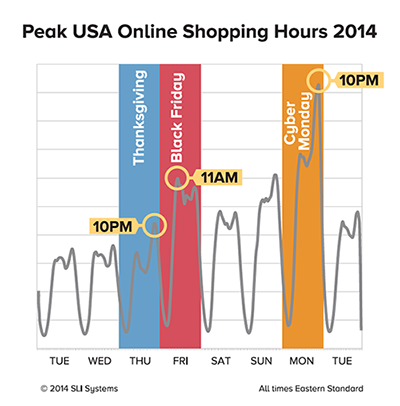
In the U.S., similar shifts in shopping behavior occurred. Most notable was a spike in shopping activity at 10:00 p.m. EST Thanksgiving Day, the night before the renowned Black Friday. There was also a spike in shopping activity on November 30, the night before the busiest U.S. online shopping day, Cyber Monday. To gather these results, SLI studied e-commerce site activity across 500 retailer websites in the U.S. (100 were Internet Retailer Top 1,000 retailers), analyzing 45 million queries during Thanksgiving week.

image peak US shopping hours 2

Consumers (increasingly online night owls) are beating retailers to the punch on unexpected days and times. By timing key promotions accordingly, savvy online retailers can take advantage of these new opportunities and have a jump on their competition in 2015.

Read More

Say It with Video – 1 Billion Are Watching (and Buying)

Posted by Dawn MortensenDecember 16, 2014eCommerce, Site Search Tips, Social Media, Success Stories

With 1 billion people using YouTube today, video is the most powerful means of spreading information to the world’s 7 billion people. And since more than 6 billion hours of video are watched each month on YouTube, that’s almost one hour for every person on this planet!

As a content marketer in the e-commerce space, I’m especially interested in watching the speed of adoption of video in online retail. Product videos offer details that static images can’t, like how someone might hold or wear the product. According to an Animoto study and infographic, 73% of U.S. adults are more likely to purchase a product after watching an online video that explains it.

A Proven Way to Differentiate

BRStv 15Dec14Many sites use video as a way to set themselves apart from big-name brands. Bulk Reef Supply has created more than 300 videos for its saltwater aquarium and reefing products, even branding its video channel as “BRS TV” to make it more visible on YouTube. This is a smart way to increase product discovery, establish expertise and provide affirmation to buyers that they are choosing the right product. Simply by providing the information consumers need to make the right purchase, Bulk Reef Supply differentiates itself from potentially less knowledgeable competitors.

Northwest River Supply is another business that succeeds by providing expert advice that’s typically not found on many sport supply sites. Search for “kayak” and you’ll see a menu of more than 200 videos about kayaking. You can refine the search by whitewater, tour/rec and other types of rafting sports to find how-to videos that meet your particular interest.

As mentioned in Shaun Ryan’s recent blog, “shopping haul” videos are another type of video format that retailers can leverage in 2015. As the popularity of these videos increases, so does the opportunity.

Worth 1.8 Million Words?

I’ve often found truth in the maxim: “A picture is worth a thousand words.” So naturally, I’ve wondered how many words a video might be worth. I recently found that Dr. James McQuivey of Forrester Research actually made an attempt at calculating the comparative worth – he estimated that one minute of video is worth 1.8 million words. Well, the writer in me thinks that’s too high. But whether or not his assessment is true, it’s evident that video is an incredibly effective way to influence consumers who want bite-sized bits of information and entertainment that will fit into their busy lives.

Read More

Meet Neil Thomas, SLI’s New Chief Revenue Officer, President North America

Posted by SLI SystemsDecember 9, 2014Newsletter, Reviews, SEO, Site Search

Neil_Thomas_headshot-low

Neil Thomas knows what it takes to grow a world-leading Software as a Service (SaaS) company. In his previous role as Senior Vice President of Worldwide Sales of cloud-based business analytics firm Adaptive Insights, Thomas grew the company’s sales team from five to 150 and its customer base from launch to thousands of enterprises in 80+ countries. This success followed a near twenty-year track record for establishing, developing and continuously improving global sales teams.

The UK-born Thomas says, “SLI’s success in expanding beyond its home market of New Zealand, recruiting world-leading brands as customers and growing around the world, particularly in the UK and the United States, is no mean feat.

“This says to me that SLI has a product that is attractive, wanted and needed. It also shows that we have an organisation that is able to deliver solutions successfully in different economic and cultural environments. I think the secret of this achievement has been the commitment of the SLI team to customer success and delivering excellent service.”

“SLI is well positioned to ride the next wave in e-commerce. Retailers and business-to-business websites worldwide are increasingly looking for solutions that ensure their websites serve up the products and services consumers are seeking in a timely, efficient and appealing way.”

SLI CEO Shaun Ryan says, “Neil has led a sales organization through the type of growth that we intend to achieve over the next few years. This expertise and experience will further accelerate SLI’s growth. We are delighted to have him on board.

Subscribe_button

Read More

SLI CEO Honoured

Posted by SLI SystemsDecember 9, 2014Newsletter, Site Search

SLI Systems CEO Dr. Shaun Ryan and his brother and co-founder Dr. Grant Ryan were named “2014 New Zealand Engineering Entrepreneurs of the Year” at the New Zealand Engineering Excellence Awards. This accolade is one of the 10 awards SLI received this year.

NZ-engineering-entrepreneurs-award

Holding awards: Grant 2nd from left, Shaun in the middle

The 10 awards SLI received during 2014 are:

  1. New Zealand Engineering Entrepreneurs of the Year at the New Zealand Engineering Excellence Awards
  2. Silver place in the Most Customer Friendly Company of the Year category for the Best in Biz Awards 2014, the only independent business awards program judged by U.S. press and industry analysts
  3. 2014 Customer Engagement Awards Retail TouchPoints – SLI customer Lakeshore Learning was awarded Gold in the Analytics category for measured results driving new market revenue using SLI Systems. Lakeshore joined 12 U.S. merchants, including Saks Fifth Avenue, Lowe’s and Sears.
  4. Best Technology Solution award at the ECMOD Direct Commerce Supplier of the Year Awards as voted by UK retailers
  5. Best Product at eCommerce Awards for Excellence 2014
  6. SLI customer Wine Enthusiast won The Search Agency’s Stars of Search award
  7. SLI customer Wine Enthusiast won Retail TouchPoints Channel Innovation Award
  8. Highly Commended Online Technology Vendor of the Year at the UK’s Retail Systems Awards 2014
  9. SLI customers Appliances Online and SurfStitch won Australia’s Online Retail Industry Awards (ORIA)
  10. SLI customer Appliances Online won Customer Experience of the Year at World Retail Awards Paris

 
Subscribe_button

Read More

SLI Reports on Halloween and Thanksgiving Shopping Trends

Posted by SLI SystemsDecember 9, 2014Newsletter, Site Search

SLI’s capabilities to deliver insights into online shopping during Halloween and Thanksgiving is receiving exposure in global news outlets such as Forbes and CNN Money. The company studied 2014’s most popular Halloween costumes with Frozen leading the pack.  Also, the company studied recent U.S. shopping behavior and found Cyber Monday (Dec. 1) saw nearly 30% more online shopping activity than any other shopping day during the 2014 Thanksgiving-to-Cyber Monday holiday timeframe.

2014 Most Popular Movie Theme Costumes PeakHolidayShopping_2014-low

 
Subscribe_button

Read More

Major Corporations Endorse SLI

Posted by SLI SystemsDecember 9, 2014Merchandising, Navigation, Newsletter, Reviews, Rich Auto Complete, SEO, Site Search

Hear in a recent video testimonial how U.S. gourmet food and gifting company Harry & David saw a US$437,000 increase in 2014 sales after implementing SLI’s Site Champion™. Other recent video testimonials include the U.K.’s largest mail order seed company Thompson & Morgan and the U.K.’s number one winter sports apparel and equipment retailer Snow + Rock.

Cameron Gabriel
E-commerce Manager
Harry & David


Clare Dixey
E-commerce Manager
Thompson & Morgan


David Kohn
Head of Multichannel
Snow+Rock

Subscribe_button

Read More

SLI CEO Confident of Long-Term Growth Prospects

Posted by SLI SystemsDecember 9, 2014Newsletter, Site Search

Shaun Ryan, CEO of SLI SystemsWelcome to the first edition of our new bi-annual investor newsletter. In this newsletter we plan to provide updates on the company and its customers along with the deeper information you need to fully understand SLI’s market. This time I’ll kick it off with an overview of the e-commerce market and where we believe it’s going.

Our Market

When SLI started business in 2001, the e-commerce industry was in its infancy and the market opportunity for our site search solutions was relatively small. Today that market has matured, vastly expanding the opportunity for our services to improve the bottom line for online retailers around the globe.

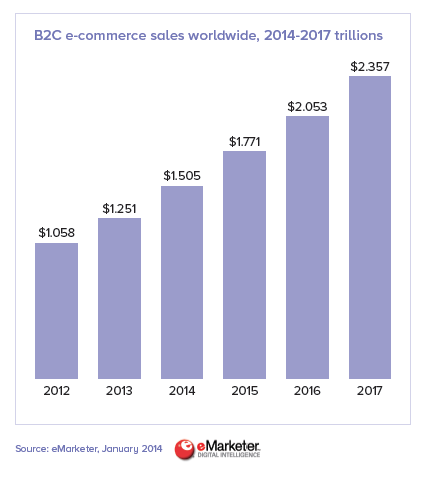
Worldwide business-to-consumer e-commerce sales are expected to increase 20% this year to reach US$1.5 trillion, according to eMarketer, with a compound annual growth rate of 17% between 2012 and 2017. RJ Metrics projects that 110,000 English-language e-commerce sites do business today. We believe that only a small portion of these sites have sophisticated site search capabilities in place. SLI is well positioned to capitalize on this global e-commerce growth. We have the people, processes and technologies to service a large number of retailers globally.

With this continued growth the online retail market is moving toward more personalized experiences for individual shoppers. By providing each individual shopper with a specific, tailored experience, websites are able to further improve the customer experience and ultimately sales. SLI is well positioned to be a leader in this personalization trend. Our products are all built on patented technology that allows the website to “learn” from each individual shopping trip and to use the discovered information to present shoppers with an online experience that results in higher sales for the retailer.

Our Offerings

SLI offers Software-as-a-Service (SaaS) solutions to provide websites with site search, navigation, product recommendations, and user-generated Search Engine Optimization (SEO). SLI solutions increase the top line for e-commerce sites by making it easier for their customers to find what they are looking for and therefore easier to purchase. And this year our opportunity to help retailers improve business has just increased with the introduction of our two newest products – SLI Learning Recommendations™ and SLI Dynamic Product Banners™.

Learning Recommendations, an extension of the company’s foundational product SLI Learning Search™, displays highly relevant product recommendations in different areas of websites. Because the product automatically learns based on previous shoppers’ behaviour, Learning Recommendations can display the products that are likely to succeed in driving incremental sales for the retailer.

Dynamic Product Banners reduce bounce rates by showing related products to visitors arriving on product pages from Internet searches. By presenting shoppers with alternatives that are proven relevant to the products they have chosen to view, Dynamic Product Banners increases conversion rates and hence revenue from those people coming from search engines such as Google.

And we have the results to prove it. For example, U.S. educational products retailer Lakeshore Learning saw a 30% increase in revenue on its e-commerce site after implementing SLI solutions. Chemist Direct, the UK’s leading online pharmacy, experienced a conversion rate improvement of 175% and a search average order value increase of 196%.

PressRelease-ARROur Progress

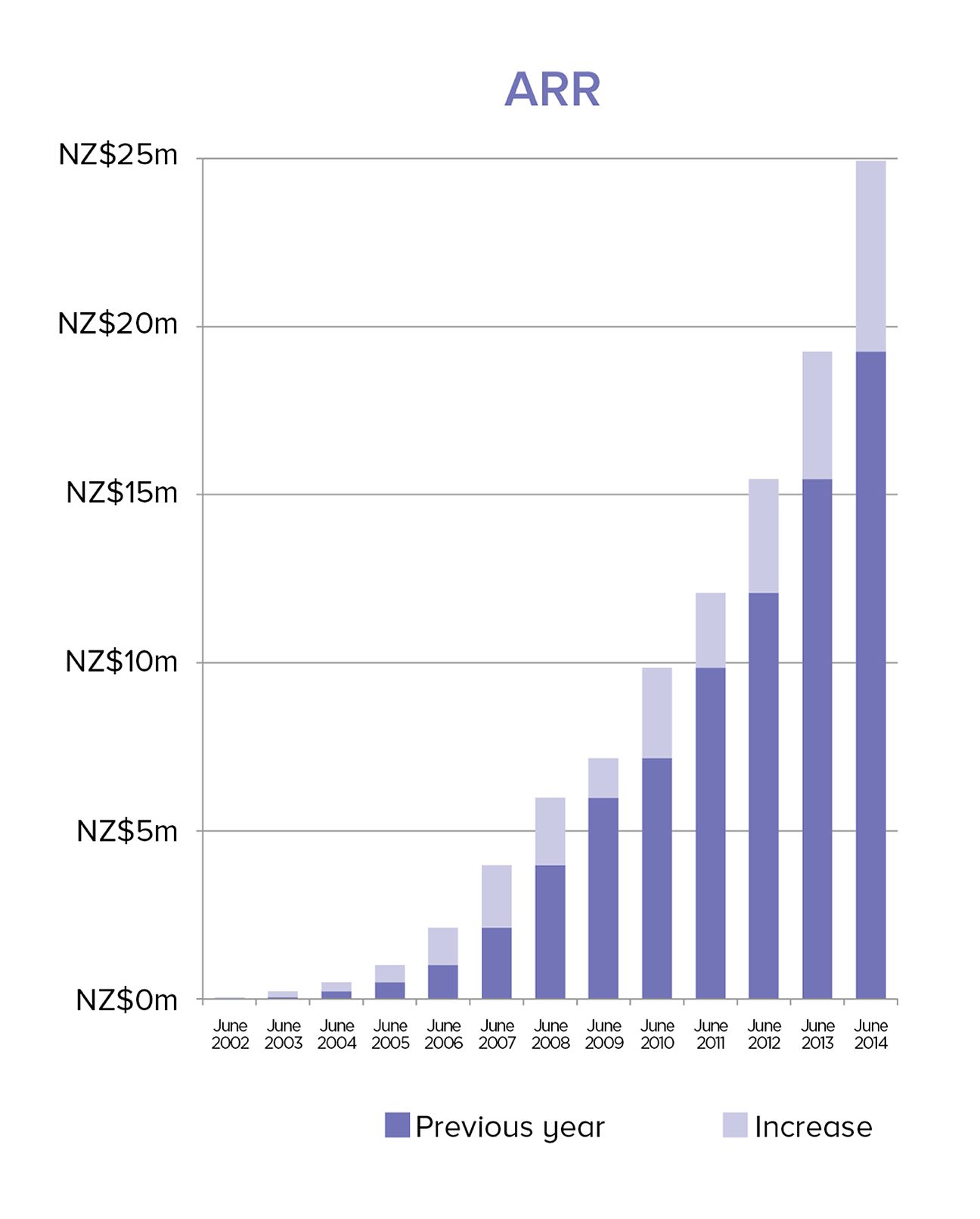
We passed a significant milestone of a year and a half as a publicly-listed company and we are proud of our achievements during that time. Over this period we continued to build on our strong record of sequential growth. Annualised recurring revenue (ARR1) – our key measure of financial performance – rose 29.4% in the year to 30 June 2014.

We have expanded our client portfolio with some exciting names this year including Battery Mart, LakeShore Learning, Exclusively Wedding in the U.S.; Brazilian pharmacy store Ultrafarma; Bathstore, Paul Smith, Jigsaw, Claire’s Accessories and Eason in the UK; and Kathmandu in Australia. These customers join names such as Fabergé, Sports Authority, World Soccer Shop, Harrods, plus many others.

We are excited about having Neil Thomas join SLI as Chief Revenue Officer and President of North America. Make sure you read our article on Neil in this edition.

We are also enthusiastic about the holiday season and the role SLI solutions will play in this critical time for retail. Our focus in the coming year is to ensure that the significant investments we have made in the business continue to deliver long-term value. We remain confident we can achieve these goals.


1Annualised Recurring Revenue (ARR) is calculated based on the subscription revenue generated from the existing customer base in the reference month and then annualised. ARR is calculated based on the exchange rates at that time. When ARR is presented for a historical time series all points are calculated on a constant currency basis.

Subscribe_button


Read More

E-commerce Search Queries Hit New High Thanksgiving Weekend

Posted by Tim CallanDecember 4, 2014eCommerce, Site Search

As 2014 holiday shopping statistics roll in, SLI Systems found some interesting trends among search query data for the 800+ e-commerce sites it serves. In addition to seeing a record-breaking Cyber Monday, we identified the weekend’s peak U.S. shopping times, discovered that 40% of weekend shopping was done from mobile devices, saw huge international growth in Black Friday shopping, and hit a new milestone with the number of search queries SLI served.

PeakHolidayShopping_2014Late-Night Shoppers Prevail

Overall, it’s clear that holiday e-commerce shopping is up significantly from last year – The Custora E-Commerce Pulse reported an increase of 15.4% in e-commerce revenue for the holiday weekend (Thanksgiving through Cyber Monday) over the same weekend in 2013. As mentioned in an SLI press release issued today, 10 p.m. EST on Cyber Monday was the peak hour for online shopping in the U.S. Thanksgiving Day shopping also peaked at 10 p.m. EST.

Mobile Monday?

SLI research also found that 37% of Cyber Monday shopping in the U.S. was conducted on mobile devices – this is up from the 29% reported by Marketing Land in 2013. As the percentage of mobile shopping continues to rise – and the term “cyber” becomes more dated (“Cyber Monday” was first coined by Shop.org in 2005 to describe the online shopping peak on the Monday after Black Friday) – this $2 billion shopping day may be on its way toward the new name of “Mobile Monday.”

Black Friday Now a Global Event

While the chart above looks at peak U.S. shopping times, our data surprisingly showed a significant amount of Black Friday traffic coming from Brazil and the UK. Even though these countries don’t celebrate the Thanksgiving holiday that Americans enjoy on the fourth Thursday and Friday of November, retailers have launched Black Friday campaigns in Brazil and the UK to capitalize on the U.S. shopping trend. Amazon was the first to offer Black Friday discounts in the UK in 2000, and clearly, the trend has skyrocketed.

Record Queries Served by SLI

Due to the international growth of Black Friday shopping and online shopping in general, SLI also hit a new record of serving more than 100 million site-search queries in a single day. There are many ways we prepare for supporting our clients’ peak shopping days – from the highly redundant and scalable cloud architecture we offer year-round to the additional site optimizations our engineers conduct well in advance of expected peaks. We’re pleased to be able to support the increased search traffic on any of our clients’ sites, no matter what day of the year.

Read More

Checklist for a Holiday-Ready E-commerce Site

Posted by Jason MillerNovember 17, 2014eCommerce, Site Search Tips

shopping cart mouseWith the holidays upon us, e-commerce retailers are fine-tuning their sites in preparation for Black Friday. Here’s a quick checklist to help make your 2014 Holiday Season brighter by gauging your site’s readiness. I’ve included several tips and tools for testing that have worked well for me in the past.

1. Is your site up to speed?

With 47% of users expecting a web page to load in less than two seconds, speed is crucial. Slower sites increase bounce rates and decrease conversions. Walmart found that for every one second page speed was improved, conversion rates increased up to 2%. Think about what that means to your bottom line. Holiday shoppers aren’t willing to wait for your site to load.

This brings up an interesting point when we talk about page load speeds. To your users, the page is complete when it appears visually ready and they can interact with it. A great way to measure this is www.webpagetest.org, which lets you compare your site against your competitors. This will help identify scripts and elements you can load later in the page cycle to improve performance.

We can’t really talk about speed and the holidays without talking about stress testing your site for the surge in traffic that peak season will bring. You want to make sure your web infrastructure and content delivery network are properly configured so you don’t experience any downtime. Properly load testing a site requires coordination with your CDN and IT teams to ensure you don’t unintentionally DDOS your own site.

2. Do you have a consistent user experience across channels and devices?

Tablet and mobile traffic has now eclipsed desktop traffic, according to Branding Brand’s Mobile Commerce Index for 2014. Today’s users often interact with multiple device types before they convert. The majority of emails – 65% – are opened on a smartphone or tablet. According to Limelight Networks, Inc., 80% of customers abandon a mobile site if they have a bad user experience.

Users expect a seamless experience between different devices. If you don’t optimize these first-touch customer experiences, you risk losing buyers. There are many different ways to address this issue, from responsive design to dedicated mobile sites, each with its own challenges. For instance, responsive design requires careful coding and CDN configuration to minimize download time while dedicated mobile sites need special attention paid to redirecting links based on device.

It’s all about reducing friction for the user as they travel down the conversion funnel. For mobile users, don’t use incompatible desktop features like hover and make sure email links are optimized for smaller screens. On the other side, make sure links shared via mobile open properly for desktop users.

Here are a few more things that work well no matter the device format: Limit the amount of form fields on checkout, put the search bar in an obvious place near the top of the page and use predictive analysis to help auto complete search queries.

3. Do you have the right merchandising and product mix?

Knowing the right products to offer and displaying these products first on your category pages increases conversions. For customers using SLI Learning Navigation, all category pages are automatically merchandised based on user behavior, such as clicks, conversions, sales and margin, to ensure that you display the most relevant products first.

Wondering what promotions or product mixes your competitors had last year for Black Friday? Try the Internet Archive Wayback Machine.

4. Are you using gift finders?

At this time of year, you will have shoppers who aren’t your regular customers coming to your site to buy a gift. A parametric search lets you provide a guided shopping experience and walk the user down a path. A user might say she is shopping for a man, wants to spend $100 and wants the gift to be in sporting goods. This quickly gets the customer to relevant products. This type of search works well anywhere a guided experience is useful, such as a trip finder where filtering by region and price make it easier to see a large range of products.

5. Do you provide recommendations?

Customers appreciate a personalized experience while shopping. Being able to offer them other contextually relevant products enhances the customer experience and increases both conversion and cart size. When shoppers interact with the related products displayed on SLI Dynamic Product Banners, retailers are seeing a 10-20% increase in conversion rates.

As the customer moves through the site you can make more fine-grained recommendations. On the homepage, new customers might see “top sellers.” As they go deeper into a site, based on behavior, you can show recommendations like “customers who viewed this item also viewed” or “frequently bought together.” At the cart, you can suggest accessories related to the items they are buying, and at order confirmation, you have the opportunity to upsell again.

The most personalized recommendation you can offer is “recently viewed,” which performs really well. In this case, customers have shown an explicit interest in a product. If you make it easy to quickly jump back to that product – even if they come back to the site after a few minutes or a few days – it increases conversions dramatically.

My advice on recommendations is to test all the variances you can on the page to see which one preforms best. I would even test the call to action verbiage around the recommendation because context is very important to recommendations. Customers will value the recommendations more if they understand the logic of why you are showing the items.

To learn more about preparing for the holiday season, see a video of a webinar I recently presented on this subject.

May your season be bright, and your site bring in much revenue!

Read More

How Might Retailers Leverage Shopping Haul Videos?

Posted by Shaun RyanNovember 11, 2014eCommerce

There is a largely untapped resource that most retailers aren’t leveraging to the fullest. I’m talking about shopping haul videos, also called unpacking videos. For those of you who aren’t familiar with this weird phenomenon, let me give you a brief description.

2014-holiday-shopper-research-shopping-never-sleeps_articles_02Shopping haul videos are made by people that have been shopping – either at a store, or online – and when they have the goods at home they turn on the camera and record themselves opening up all their goodies. It sounds quirky, right? However, these videos get an amazing number of views and they continue to grow.

Now the nice thing about these videos from a retailer’s point of view is that they are video reviews that feature their products and their stores. They are taken at the time when the shopper is most positive about their purchases, in the afterglow of the buying, before they’ve had an opportunity to be disappointed by them. They are authentic – typically done in their home. So these are authentic, positive video reviews of retailer’s products. Dang!

So how could retailers use shopping haul videos? I think it would be great if they could make the videos viewable on the product pages that are featured in the video. Retailers know the value of videos for improving engagement, yet videos are fairly expensive to produce. With the shopping haul trend, there are millions of videos that have already been produced that retailers can use.

So how do retailers find these videos? A simple search of “[Retailer name] haul” will give you a good start. Then you need someone to watch the video and work out which products are featured. The video can then be embedded in the product page. You could do this now for a few products, test it and see if it helps.

I came up with this idea a few years ago when I first heard about shopping haul videos at the online retailer show in Australia and then heard how popular they were. I had proposed creating a tool to make it easy for retailers (or anyone) to tag these videos and to embed them into product pages. It’s not unlike the recommendations we imbed in product pages now: some supplementary content that helps improve conversions. It could also feature in the search and nav in the same way that we index retailer’s videos as part of our Learning Search offering now.

However my idea has never made it to the top of our priority queue (we have a lot of cool stuff we’re working on). What do you think of it? Have you considered doing something like this? How many shopping haul videos are there for your store?


Read More

Top Costumes for Halloween 2014: Spine-Chilling or Just Chilly?

Posted by Eileen ElamOctober 30, 2014eCommerce, Site Search

When you open up your front door for trick-or-treaters this Halloween, you are more likely to be visited by Queen Elsa, and other ‘Frozen’ characters like Princess Ana and the lovable Olaf, than bloodcurdling zombies. This prediction is based on a large sampling of e-commerce searches over the past two months.

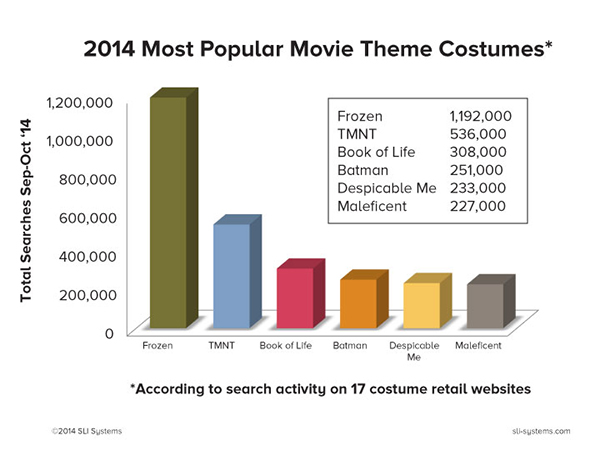
costumes chart 2014‘Frozen’ is the most sought-after costume theme this season, with the category receiving nearly 1.2 million consumer searches, or 122% more search activity than costumes related to the second most popular film this year, Teenage Mutant Ninja Turtles (TMNT). The gap is even greater between the icy theme and other popular movie characters including those from Book of Life, Batman, Despicable Me (minions) and Maleficent.

As noted in a recent Forbes article, SLI Systems tracked more than 80 million searches across 17 websites selling Halloween costumes between September 1st and October 26th of this year. Of the top 15 most-searched costumes for 2014, seven are film-related:

  1. Frozen – 1,192,000 (includes searches for Elsa, Olaf & other characters)
  2. Zombie – 863,000
  3. Ninja – 863,000
  4. Pirate – 796,000
  5. Clown – 659,000
  6. Witch – 588,000
  7. Vampire – 565,000
  8. Teenage Mutant Ninja Turtles – 536,000
  9. Book of Life – 308,000 (includes searches for “day of the dead”)
  10. Flapper – 277,000
  11. Batman – 251,000
  12. Despicable Me – 233,000 (78% of related searches were for minion characters)
  13. Maleficent – 227,000
  14. Monster High – 206,000
  15. Star Wars – 148,000


So, what’s the hottest Halloween costume this year? The forecast calls for a “cool” cast of characters.

Read More

Holiday E-commerce & Personalization Among Top Themes at SLI Connect

Posted by Shaun RyanOctober 21, 2014Conferences, eCommerce

Shaun SLI Connect

I’ve written before about the many benefits of face-to-face meetings, and after our inaugural SLI Connect event in Seattle earlier this month, I can affirm the immense value of gathering our customers together in one place.

SLI Connect provided a full day of retailer presentations and discussions about best practices for site search, navigation, product recommendations, mobile, merchandising, SEO and more. As retailers shared their current challenges in breakout groups, many were able to help each other identify “quick win” solutions. And as SLI executives shared our tentative product roadmap, we received real-time feedback about which innovations are most important to our customers.

We all enjoyed discussing the shopping experience of the future. Plus, we had fun dining, networking and laughing together at evening events. The relationships we built or enhanced were worth the effort of gathering from various parts of the world. Many SLI customers contacted us afterward to share their enthusiasm, indicating that their time was well spent.

There were many clear takeaways, but a few themes stood out most for me:

Holiday 2014

We requested that attendees complete a survey, which asked: “Which capabilities are expected to be the biggest drivers of your e-commerce business this holiday season?” Given nine options, retailers identified the top three drivers as SEO, Optimized Site Search and Optimized Mobile Sites. The answers indicate that getting shoppers to arrive on your site is just as important as ensuring they find the products they seek once they’re on the site.

We also surveyed SLI Connect attendees about their business drivers and new initiatives for the 2014 holiday season. When we asked: “Is Omnichannel an important part of your 2014 holiday season strategy?” 85% responded “Yes,” indicating a clear priority for multi-channel retailers to optimize interactions across mobile, social, desktop and/or brick-and-mortar store channels.

Personalization

I believe e-commerce is just at the cusp of what can happen with personalization, and I am not alone. Others at SLI Connect shared an interest in enabling their customers to find (or be pushed) relevant product information or content at the right time, via the right channel. In a panel discussion, Alicia Fiorletta, a senior editor at Retail TouchPoints, explained: “All retailers just want to get closer to the customer – to get to where the customer is and interact with them in a way that relates to them.”

During her presentation about using SLI to help customers find products amid tens of thousands of SKUs, Lisa Dahlke, web operations manager at Silver Star Brands (a multi-channel retailer that includes Miles Kimball, Walter Drake, Exposures and others) said: “We are trying to understand who our customers are, how we need to treat them differently, and how our smaller brands can most stand out.”

Sam Sarullo of Lakeshore Learning shared: “We’re seeing a high trend in text/SMS messages converting, so we’re changing our strategy to do more text blasts.” His comment underscored how the strategies for reaching and converting shoppers in a relevant way across channels are ever-evolving.

Partners in Innovation

During SLI Connect, SLI CTO Wayne Munro and I offered a sneak peek into SLI’s product roadmap, with an interactive session that gave customers and prospects the opportunity to share their priorities for 2015. In addition to hearing what’s on deck, customers learned more about the products and features already available for accelerating e-commerce.

Following the event, Gavin Trippe of 2 Wheel Parts Supply said, “I attended SLI Connect knowing SLI was going to play a big part of our success in e-commerce, and I was extremely impressed with the event and the SLI team’s knowledge. It was clear that SLI really understands the future of e-commerce. The company continues to improve and invest in the product, offering a huge amount of features.”

He added: “One of the most important things SLI offers is the willingness to develop our integration past the initial installation − it shows they agree that a site will never be finished and will always have room for improvement.”

I appreciate Gavin’s comment, because I take pride in our business model; we provide ongoing innovations and advice that will continually improve our clients’ sites – not as a separate professional services or support fee, but as an included service. And I think it’s this way of doing business that makes it valuable and enjoyable for our customers to spend time with us. They know that we are genuinely listening to and responding to their requests for improvement, rather than pushing sales pitches.

I thoroughly enjoyed the time spent with those who attended SLI Connect, and I look forward to hosting the event again in the future.

If you missed the event and would like some tips on improving your holiday results, please enjoy this on-demand version of our latest webinar, the E-Commerce Holiday Playbook.

Read More

6 Ways to Optimize the Mobile Shopping Experience

Posted by Jason MillerOctober 16, 2014eCommerce, Mobile, Mobile/Tablets, Site Search Tips

The stats are in and the message is clear: people are shopping on their smartphones and tablets more and more every day. Mobile commerce in the U.S. is:

  • Growing 3x faster than overall e-commerce (BI Intelligence)
  • Grew 48% to $8 billion in Q2 of 2014 (U.S. Census Bureau/comScore)
  • Grew 113% in sales from smartphones and 86% in sales from tablets in 2013 (Shop.org)

Mobile shopping is outpacing desktop shopping; billions of dollars are on the line; and yet smartphone conversion rates remain at an embarrassingly low 1% or less for many retailers. Why? 80% of shoppers say they typically abandon a mobile site if they have a bad user experience (Limelight). To take advantage of this massive opportunity, online retailers need to provide shoppers with an excellent customer experience.

While there are many different ways to address all these different device formats, such as dedicated mobile or tablet sites or even a complete overhaul like Responsive design, there isn’t a one-size-fits-all solution. Whichever approach you choose, here are six tips to help you optimize your mobile customer experience:

1. Speed Matters

Nearly half of consumers expect a web page to load in less than two seconds (KISSmetrics). Remember that there is a distinct difference between what a computer calculates as page weight/load time and what a user will consider the page speed. Optimizing web pages for “visually complete” – or the user’s perception of when a page is complete – and optimizing actual page load times will create a better user experience. Tip: Use Google Page Speed Insights for overall comparison and WebPageTest to compare visually.

Image size also matters. Make sure to serve appropriately sized images and remember that even images hidden via CSS for a mobile view will still be downloaded.

  • If using a mobile site, make sure images are sized for that form factor; don’t simply reuse desktop images as they will force users to download excessively large images.
  • If the site is Responsive, make use of client side conditional loading (imager.js) or dynamic image compression (e.g. Akamai’s ION product line) to ensure users aren’t downloading unneeded bytes. Tim Kadlec found that by using a responsive image technique, sites could save up to 72.2% of image weight.

2. Reduce Customer Friction

Conversion rates on average are four to five times higher for people who use on-site search. Additionally, the type of visitors who utilize the search box are showing explicit intent and are more likely to purchase (PFSweb). Mobile users specifically are more likely to use search so make sure your search box is in an obvious place near the top of the page. Tools to ease the on-site searcher’s path-to-purchase include:

  • Rich Auto Complete ­­­­– Ease the pain of typing in search terms on small mobile devices by adding Rich Auto Complete to your search box. Through predictive analysis, this will offer suggested keywords and products as the user is typing the search term. This saves the user time and frustration and is a great way to reduce a customer friction point.
  • Spelling Suggestions – One of the difficulties that come with shopping from a mobile device is that the keyboard may be small or difficult to use, and customers may not be able to type in search words correctly. Account for misspellings or similar words by employing autocorrect or synonym rules. These rules create linkages between words to show the correct products when a word is misspelled or a different term or slang is used. 
  • Reviews & Social Media – Show ratings and reviews with your product results. Provide this social currency on site so users don’t need to leave your site to research products. Also, more shoppers are using social media to get ideas for gifts or find new items they’d like to purchase. Make sure you are catering to your mobile visitors by allowing them to share their favorite products easily among their social networks.

3.  Touch-Enabled Devices

When designing for touch-enabled devices, it’s important to remember the size of the human finger and thumb. The touch target for an index finger is 57 pixels and a thumb is 72 pixels. Making touch targets smaller than these targets can lead to user frustration and incorrect clicks. Moreover, don’t require users to pinch and zoom in order to navigate pages as these actions also lead to a negative user experience.

A very common mistake in mobile development is attempting to port desktop features directly to a mobile device. With a touch-enabled device, the user is not navigating the page with a mouse cursor so keep in mind that functions like hover don’t translate into a positive customer experience. At best, the user will attempt to click the item multiple times to activate the link; at worst, the user will be unable to click through at all. According to Thomas Fuchs, “The easiest way to deal with this is simple: don’t use hover on touch-enabled devices.”

4. Make Checkout Easy

Smart e-commerce companies create as few steps as possible at mobile checkout. When you allow visitors to checkout quickly and easily, they’re more likely to complete the purchase. To speed customers through checkout:

  • Reduce form length (fewer than 6 fields); if multiple steps, show progress
  • Top Align form labels for easy readability while typing
  • Allow guest checkout (to again, “reduce friction”)
  • PayPal/Google Wallet payment options get customers through the process quickly

5. It’s Time to Revolt Against Sliders (on Desktop and Mobile)

There have been numerous studies showing that sliders are useless. Site visitors are highly unlikely to take the time to read each slide or interact with the slider. Notre Dame performed a test with a slider on their homepage, only to find that the first image was the only image to receive interest from visitors (and only 1% of visitors). Take a serious look at your analytics and evaluate whether or not the extra download time and screen real estate is actually providing your customer value or simply satisfying everyone on the committee. Instead of sliders:

  • Show relevant sales items, or personalized offers based on season or geography
  • Show returning customers something based on their shopping affinity or past purchases
  • Avoid banner blindness and focus on what you really want the customer to do

6. Without Testing, You’re Just Guessing

Mobile customer expectations are evolving at a rapid rate so adapting to these ever-changing requirements is critical for success in an extremely competitive e-commerce environment. Performing tests, whether A/B or multivariate, can identify whether a feature can help or hurt your bottom line and is the best means of identifying which tips will best improve your conversion rates.  Looking at what your competitors do and industry best practices are only starting points; you also need to know what your audience responds well to.

To learn more about how to improve conversion rates and increase revenue from your mobile sites and apps, visit https://blog.sli-systems.com/solutions/mobile-site-search.

Read More

Brazil’s $35 Billion E-commerce Boom

Posted by Eileen ElamOctober 9, 2014eCommerce

In 2014, Brazil is much more than FIFA World Cup host or Carnival central when it comes to business. It is also the next hot spot for e-commerce business. According to Forrester, e-commerce in Brazil grew 21% to a whopping $15 Billion in 2013, from $12.4 billion in 2012. And over the next five years, e-commerce in Brazil is expected to grow at a compound annual growth rate of 18% to reach annual online retail sales of $35 billion by 2018.

“Brazil is a top five Internet audience now. It shows no signs of stopping in terms of the audience size, the growth, the engagement, the use of search, the use of video, the use of social media,” said Alex Banks, the Latin America head for market-research firm comScore Inc. “If Brazil is not part of your international expansion and you’re an Internet company, then you’re doing something terribly wrong.”

While SLI recognized several years back the incredible opportunity to expand into the Brazilian market to help retailers boost their online presence, others are now also promoting their desire to do business with Brazil. In fact, the Wall Street Journal recently published an article about Alibaba’s plans for business in Brazil.

To compete with the likes of Alibaba, retailers in Brazil need to have compelling e-commerce sites. One critical aspect is to have strong site search tools so that shoppers can readily find the products they are most likely to buy. Companies accelerating their e-commerce sales with strong site search include Raia Drogasil, the largest pharmacy group in Brazil; retail giant Colombo; and others such as Centauro, Saraiva and Nike. All are working with SLI to boost customer conversion rates by as much as 30%.

For SLI, expanding into Brazil was the best decision; the company’s annualized recurring revenues in Brazil grew 95% during its 2014 fiscal year. This in part is due to a strong sales program, good relationships, effective solutions and the availability of SLI solutions in Portuguese. See it for yourself at http://usblogsli.wpengine.com.br/.

To learn more about how SLI helps global e-commerce retailers accelerate sales by connecting shoppers with the products they’re most likely to buy, check out our best-practice case studies.


Read More

Time for a Change! SLI Reveals Its New Brand

Posted by Tim CallanSeptember 25, 2014About us, Press, Social Media1 comment

At SLI Systems, we’re proud of our 13-year history of providing high-quality learning-based site search, and our status as the leading SaaS-based site search provider to the Internet Retailer Top 1,000. We’re also proud of our culture of ongoing innovation, which has led us to expand our solutions to include learning-based navigation, recommendations, user-generated SEO, mobile search and an array of merchandising tools and analytics. To communicate our commitment to meet the expanding needs of e-commerce retailers around the world, today we launch our new brand identity.

new brand image-1-smallE-commerce Accelerated

Seen in this photo with CEO Shaun Ryan, the new SLI Systems logo and tag line embody our mission to accelerate e-commerce by connecting shoppers with the products they are most likely to buy. As mentioned in today’s press release, the ‘S-like’ symbol in the new logo represents a shopper’s seamless path to purchase. The interwoven elements reflect the customer collaboration that is core to SLI’s ongoing success and the success of our customers. The color palette considers the nuances of cultures across the five continents where SLI operates. We believe the logo enhances our already-strong brand recognition among the world’s leading e-commerce businesses.

As you see our new identity carried out on our web site, ads, tradeshow graphics, etc., I hope you’ll take a fresh look at what SLI has to offer – solutions that are proven to deliver e-commerce results, like the 30% increase in site revenue Lakeshore Learning experienced after implementing a range of SLI solutions, or the 10% sales lift Boden saw after implementing SLI Dynamic Product Banners.

We timed the launch of our new brand to coincide with several important events in the next week, including Shop.org 2014 in Seattle Sep. 29 – Oct., the SLI Connect customer summit in Seattle on Oct. 2, and the E-Commerce Expo in London Oct. 1-2. If you’re not joining us at any of these events, I hope you’ll browse the rich array of on-demand webinars, e-books and case studies available on our website at sli-systems.com, or connect with us on social media. We look forward to hearing from you!


Read More

Back-To-School Shoppers Search for Charts, Magnets and… Common Core?

Posted by Eileen ElamSeptember 24, 2014eCommerce

Nothing softens the summer’s end and back-to-school blues like a little retail therapy. According to eMarketer, online shoppers spent more than $50 billion during the 2014 back-to-school shopping season, which represents a 16% gain from $43.3 billion in 2013. Sixteen percent!

A key aspect of the back-to-school shopping blitz is of course school supply shopping – and purchasing materials online is becoming more and more convenient for time-strapped families and teachers.

To uncover the most highly sought after school supplies driving unprecedented online sales for the 2014-2015 school year, SLI’s data team analyzed more than 33 million searches conducted between June 1 and August 22, 2014. We looked at three popular U.S. online retailers selling office and school supplies, including instructional materials. These e-commerce retailers are SLI customers that use our site search software to ensure thousands of products are easy for educators, parents, and office managers alike, to find and purchase.

Our analysis revealed that teachers and parents were busy readying classrooms, supply kits, and bookshelves with a variety of materials, from charts to stickers. The most popular items searched for were “chart pocket” at 96,000+ searches, “magnet” with 88,800+ searches, and “calendar” with close to 76,000 searches. Trailing down the top 20 list, we saw that “pencils” garnered 40,800 searches and “Dr. Seuss” more than 32,000.

Common Core Materials

A not too surprising discovery among the site search data analyses was the volume of interest around the term “Common Core,” indicating that many teachers – and possibly parents as well – searched for materials related to the mandated, yet controversial standard.

The Common Core State Standards Initiative is an educational initiative in the U.S., currently adopted by 44 of the 50 U.S. states and the District of Columbia, that details what students in K-12 grades should know in English, history, social studies, science and mathematics at the end of each grade. It seeks to establish consistent educational standards across the states and ensure that students graduating from high school are prepared to enter college programs or the workforce.

Our data analysis revealed that during the back-to-school season, there were more than 72,000 searches for “Common Core.” Digging deeper into the numbers, we found:

  • Top Five States – Site searches originated most from CA (with nearly 3x that of the next state), followed by NY, IL, and FL with between 4,200 to nearly 5,000 searches each, and then GA with 3,000+ searches.
  • Top Five Grades – While 75% of the searches conducted for “Common Core” did not include a specific grade, “Common Core + 2nd grade” garnered the most interest with 4,500+ searches, followed by 3rd, 4th and 5th grades, which averaged 3,300 searches each. First grade saw just shy of 2,000 searches.

A value add of SLI is that we provide online retail retailers with insight regarding the products consumers are seeking. Accordingly, vendors know which products to stock and can promote those items consumers are most likely to buy. And through our easy-to-use search, consumers can readily find the merchandise they desire and get recommendations on related products that they may have overlooked, leading to a truly rewarding shopping experience.

Visit our library of best-practice case studies to see how SLI helps leading e-commerce retailers accelerate sales by connecting shoppers with the products they’re most likely to buy.

Read More

Get Face-to-Face with E-Commerce Peers at SLI Connect

Posted by Shaun RyanSeptember 18, 2014Conferences, eCommerce

Technology allows us to connect with anyone anywhere more easily than ever before, but there’s still something special about face-to-face meetings. The quality of communication is better when you meet someone physically, and that enhanced connection continues long after the in-person meeting.

My theory is that you form a more complete mental model of an individual when you meet them in person and that model improves your future communication, whether it’s on the phone, via email or on a video conference. We see this time and time again when SLI team members visit each other in our global offices, and it’s why I’m excited to be traveling to Seattle next week for our customer summit, SLI Connect.

We held our inaugural customer summit in London earlier this year and it had a wonderful feeling of community. We intend to replicate this in Seattle. SLI Connect will give our customers the opportunity to plan strategies, learn from peers and give direct feedback to members of the SLI executive team.

An Invitation to Connect

We planned SLI Connect to coincide with Shop.org 2014. So, after you’ve networked with thousands of your peers at Shop.org and are teeming with inspiring e-commerce solutions and ideas, you can connect with SLI, face-to-face, to start putting those ideas to work. You’ll have the opportunity to strategize with your customer success manager and account manager on how to increase your online sales. You’ll hear how your peers have done this already and how SLI can help. You’ll be able to give us direct insight into your upcoming priorities and get a sneak peek into our product roadmap.

I hope you can join us for this full day of valuable insights as we continue to build and foster SLI’s growing community of more than 800 e-commerce sites.

Here’s the Who, What, When, Where and How of SLI Connect:

WHO/WHAT: SLI Connect is a day of learning and sharing ways to accelerate your e-commerce strategy and sales through the holiday season and into 2015. The full-day agenda includes:

  • E-commerce trends talk with SLI CEO Shaun Ryan and SLI CTO Wayne Munro
  • Industry panel with Alicia Fiorletta, editor of Retail Touchpoints
  • Retailer presentations with best practices for site search, navigation, SEO, mobile and more:
    • Sam Sarullo of Lakeshore Learning talks about how SLI helped Lakeshore increase online sales by 30%
    • Lisa Dahlke of Silver Star Brands shares how Silver Star uses SLI to help customers find products from their tens of thousands of SKUs
  • Sneak peek into the SLI product roadmap
  • Drinks, dining, interactive discussions and plenty of networking

WHEN: Thurs, October 2, 2014 – after Shop.org (kick-off dinner the prior evening of Oct 1)

WHERE: The Hyatt Olive 8 at 1635 8th Ave in downtown Seattle

HOW: Click here to secure your free registration for SLI Connect today!


Read More

SLI Systems’ CEO Takes ALS Ice Bucket Challenge

Posted by SLI SystemsSeptember 11, 2014Social Media

Personal 034There is one more celeb Silicon Valley hasn’t seen take the #ALSIceBucketChallenge yet: our very own CEO Shaun Ryan! After Kim K finally responded to her fans to take the challenge this week, Shaun knew he couldn’t let his team down. Thanks again to Nextopia for nominating SLI Systems for this great cause, which raises awareness and funds for ALS, also called Lou Gehrig’s Disease.

As any fearless leader would, Shaun bravely accepted the challenge on behalf of the company. Here is the video for your enjoyment!

Shaun Ryan Takes the ALS Ice Bucket Challenge in Downtown San Jose

We nominate our partners Magento, ROI Magazine, and Gorilla Group to take the challenge next. You’re up, and good luck!

As of September 11, the ALSA has received $112 million in Ice Bucket Challenge donations from 3 million donors! To learn more about the challenge and the fight to treat and cure ALS, visit http://www.alsa.org.

Read More

E-Commerce Sales Growing, but We Can Do Better Than 9%

Posted by Shaun RyanSeptember 4, 2014eCommerce, Site Search, User Experience

Each year, online sales take a bigger slice of the ‘total retail sales’ pie. This year, analyst firm Forrester expects e-commerce sales in the United States to reach $294 billion, a small 9% slice of all sales in the country. That means that 91% of retail sales still occur in brick-and-mortar stores. The question is: can e-commerce do better? Can e-commerce grab a larger slice of that pie by making simple changes? A recent large-scale study on e-commerce search by the Baymard Institute says YES.

“When e-commerce search works, it’s fast, convenient and efficient. It’s no wonder that so many users prefer searching over clicking categories. Unfortunately, our recent study finds that search often doesn’t work very well,” said Christian Holst, Baymard Institute co-founder.

The Baymard Institute found:

  • 16% of e-commerce sites do not support searching by product name or model number
  • 18% of sites provide no useful results if the product name was off by a single character
  • 70% require users to search by the exact jargon for the product type that the site uses, failing to return relevant products for “blow dryer” if “hair dryer” is typed
  • Searches with symbols and abbreviations are not supported by 60% of e-commerce sites
  • Only 40% of sites have faceted search, despite it being essential to e-commerce search because it is the foundation of contextual filters

Consistent with Baymard Institute findings, our own SLI study conducted last year found that 57% of e-commerce brands were not using their site search data to enhance marketing campaigns. Only 25% of retailers integrated site search data into email marketing campaigns to better customize offers; 27% created SEO landing pages populated with site search results and custom banners; and only 13% took advantage of site search to power mobile search.

It’s also interesting to note that amid generally weak Q2 earnings, the retail giants that announced spikes in e-commerce sales ranked as having excellent site search in Baymard’s search study:

  • #2 Wal-Mart global e-commerce grew 24%, heavily contributing to a $3.2 billion increase
  • #4 Wayfair, multinational e-retailer, reported a 50% YOY increase to total $574 million
  • #5 Sears, multinational department store chain, reported strongest sales came from e-commerce
  • #11 Staples, the world’s largest office-supply chain, grew its web sales 8%
  • #13 The Home Depot, the largest home improvement retailer in the U.S., increased its online sales 38% to $1 billion

The take-away? The e-commerce industry can do better than 9%. As more e-commerce sites optimize site search, online shopping experiences will improve and e-commerce will gain a greater share of the $1.7 trillion retail pie.

To see how small changes in your site can significantly impact revenue, schedule a demo with an SLI Systems sales director.

Read More

Make Back to School Shopping a Breeze – Even with 60,000 Products

Posted by SLI SystemsAugust 27, 2014eCommerce, Site Search, Success Stories

This is first in a series of guest blogs where online retailers offer insight into their e-commerce success.

pencilsAt Chalkfly, providing everything our customers need while making it easy for them to find those products is a fine line we walk. As an office and school supply e-commerce retailer, we sell nearly 60,000 products that range from kitchen goods to office chairs to scratch and sniff stickers (which are still as awesome as they were when you were in third grade).

Given our broad selection of products and the looming presence of some pretty hefty competitors, we knew that great site search would provide us with a critical edge. After implementing SLI Systems, conversion rates increased 30% and average order value increased by 33% for customers who searched our site.

For other retailers looking to simplify the search process for customers – during back to school season and beyond – I’d like to share a few things we’ve learned.

Shorten the Search

Since our robust site inventory is organized into dozens of categories, the parents, teachers and students shopping with us can end up in many corners of our site. To streamline our customer experience, we’ve used historical data and worked with local Parent Teacher Organizations to learn which supplies are most important for which grades. Using this information, we created curated categories and Back to School Kits, organized by grade, that provide refined options for shoppers. These curated kits not only make shopping easier, they also increase our average order value by marketing other, in-demand back to school products to users.

Sweeten the Results

Screen Shot 2014-08-15 at 9.37.54 AMWe’ve paired many of our search results, especially within back to school categories, with custom search banners that drive customers to some of our best-selling products. These banners make shopping simpler for customers by placing some of our most popular products right at their fingertips. The SLI functionality that allows us to easily create these banners is a major plus for us because it simplifies search for customers and allows us to put selected products front and center.

When searching for “pencils” customers are presented with an attractive banner that brings them right to one of our best-selling products.

Search is a Gold Mine

At Chalkfly, we use SLI and Google Analytics to monitor the search terms our customers use. This data is chocked full of actionable insight for any e-commerce store. You should always test the top search terms on your site and ask: “Are these the best, most relevant results?” If not, tune those results to increase conversion rates. We analyze the top 50 terms on a weekly basis, and SLI’s reports help us answer several questions:

  • What are the popular seasonal products? (e.g. an uptick in searches for “supplies kit” means its time to feature our back to school kits throughout the site)
  • What are our highest converting search terms?
  • Are customers searching for information that can be answered through our blog? (e.g. queries that start with, “how to…”)

As your customers buy the supplies to start the new school year out right, optimize your search and curated products to ensure they continue shopping in their pj’s instead of “searching” through the aisles at a store.

Lissa Cupp is the CMO of Chalkfly, a Detroit-based e-commerce company that sells offices and school supplies and gives 5% of every purchase to a teacher of your choice. Read today’s press release about Chalkfly here.

Read More

From Blog to Buy: Content That Converts

Posted by Dawn MortensenAugust 20, 2014eCommerce, Site Search, Site Search Tips, Social Media, Success Stories

It’s no secret here at SLI that we are arming online retailers with the e-commerce tools they need in the battle against Amazon – and creative content is proving to be a valuable weapon of choice. Many savvy e-commerce retailers use content (videos, blogs, social posts, etc.) to draw shoppers and turn browsers into buyers.

Target is a great example. Target’s e-commerce site now allows shoppers to buy items directly from its blog, A Bullseye View. All a shopper has to do is click a red box (“shop this look”) that hovers over the image of the desired product. Instantly, a box pops up with the item ready to be added to the consumer’s shopping cart.

TargetTarget’s new catchphrase? “Buy the products you want from the content you love.”

Creative content is driving sales in a way that it never has before. Converting shoppers into buyers directly on a compelling blog post is what all retailers strive for with their content. While a blog is a pretty traditional form of content, here are two great examples of SLI customers using non-traditional forms of content to ease the shoppers’ path-to-purchase:

1. King Arthur Flour Shares Recipes

Retailer of specialty flours and baking tools King Arthur Flour combines aspects of its community and knowledge base into its site, providing a wealth of searchable recipes, videos and blogs from expert bakers. Visitors can find enticing recipes with high ratings, see that they have been Pinned to Pinterest 1,000+ times, or read reviews from other users who have made those dishes themselves. Since customers can click a link in the recipe to buy ingredients they need from King Arthur Flour, it’s a seamless path-to-purchase for those eager to try the recipe.

Since working with SLI Systems to integrate this recipe content into its e-commerce search (versus its previous use of Endeca), King Arthur Flour has seen its conversion rate jump from 3.7% to nearly 6%.

If you’re an online retailer that sells any kind of food or kitchen product, you’ll want to offer recipes to showcase your expertise and the value of your products. When you create links from your recipes to the products or ingredients needed to complete the recipes, you’ll see the increase in sales.

FTD Infographic2. FTD Gets Graphic

Online flower delivery retailer FTD uses infographics to drive visitors to its site and help generate sales. When the brand created an infographic using interesting stats about Mother’s Day, it was a nice visual article showing that 76% of moms polled would choose flowers as their gift. It was a popular infographic to share on Facebook, Twitter and Pinterest as millions of sons and daughters considered what to give their moms for Mother’s Day. The infographic not only provided the insight and incentive for buying flowers for mom, but it also linked straight to the FTD site, offering easy access to purchase that Mother’s Day bouquet.

Infographics combine visual appeal with condensed information, making them perfect for grabbing people’s attention and giving them content quickly. They are also nice for the skimmers out there – those of us who are short on time or attention span. Finally, infographics are easy to share. Whether on social media or blogs, infographics are just the kind of content thought leaders love to re-post.

To learn more about how e-commerce sites can increase conversions by creating remarkable content, watch a recorded webinar on this subject or download our free e-book, Use Creative Content to Turn Online Shoppers into Buyers.

Read More

At eTail East, Plan for a Profitable Holiday and Beyond

Posted by Dawn MortensenAugust 11, 2014Conferences, eCommerce, Search Conferences

As eTail East begins today in Philadelphia, we want to point out some of the highlights we’re looking forward to at this year’s show.

Monday Roundtable:
Use Creative
and Social Content to Convince Shoppers to Buy
Moderator: Jason Miller, Product Evangelist, SLI Systems
Grand Ballroom C, D – Table 6
August 11, 10:05-11:05 AND 3:10-4:10

At this eTail East Roundtable, SLI Product Evangelist Jason Miller will share examples of leading retailers that increase site conversions by using rich content like videos, blogs, social posts and how-to articles – all integrated into their site search and navigation. He’ll discuss why compelling content helps entice and convince shoppers to convert. Learn and discuss best practices that leading retailers use to create a site experience that turns shoppers into buyers. If you can’t make this session, listen to our on-demand webinar, “Use Creative Content to Turn Shoppers into Buyers.”

Vault 11_27_08Monday Dinner with SLI Systems:
Del Frisco’s Steakhouse, private Vault Room
August 11, 2014, 7:30 p.m.
For retailers only, by invitation
RVSPs accepted until 2 p.m. EST today

To kick off the first night of eTail East in style, SLI Systems is hosting an unforgettable dining experience at Del Frisco’s Steakhouse. We’ll have the privilege of dining in the private Vault Room of Del Frisco’s, located inside what once was the First Philadelphia Bank. If you are a retailer and have not yet reserved a place at the table, you may RSVP here until 2 p.m. EST today.

Wednesday Main Session:
Easy Upgrades to Optimize Holiday Profits
Presenters: Victor Castro, Director of E-commerce, Zachys Wine & Liquor and Tim Callan, CMO, SLI Systems
Grand Ballroom E, F
August 13, 12:50 p.m.

With no time to spare before the 2013 holiday shopping rush, Zachys Wine & Liquor’s Director of E-commerce Victor Castro implemented e-commerce acceleration solutions to the Zachys site and saw an incredible 130% increase in site revenue by the end of the season. In this main-stage presentation, hear from Victor about the solutions he used and how you can optimize your own e-commerce site before Holiday 2014.

Enjoy eTail East!

Read More

Appliances Online and SurfStitch Win Online Retail Industry Awards

Posted by SLI SystemsAugust 5, 2014Conferences, eCommerce, SEO, Site Search, Success Stories
urfStitch SLI's Learning Search

SurfStitch Showcases SLI Learning Search

Aussie retailers Appliances Online and SurfStitch have been picked as equal winners for ‘Best Pureplay Online Retailer’ at the Online Retail Industry Awards (ORIA).

The annual awards, which recognize the pinnacle of excellence in digital retailing, handed out the top accolade to the joint winners. Both online retailers use SLI Systems’ Learning Search solution that ‘learns’ from past site search activity. It does this by tracking visitors’ search behavior, and then uses that data to deliver the most relevant results. The technology also brings clients’ non-product information (such as user ratings, reviews, social content, blogs and videos) into search to deliver an impressive user experience that compels shoppers to buy.

“It’s a great achievement to win the top award at the ORIAs,” said CEO John Winning for Appliances Online. Since implementing SLI Learning Search, Appliances Online noticed that people who use site search spend twice as much time on site as visitors who don’t use site search. The appliances retailer also witnessed a 20% increase in site revenue.

As well as using SLI Learning Search, SurfStitch also uses SLI Site Champion, which builds upon SLI Learning Search technology to deliver high-quality organic search traffic to sites. It learns from site visitors and dynamically creates SEO-optimized landing pages that are indexed by Google and other Internet search engines, extending the site’s SEO footprint and making more content findable.

Since  inception in 2008, SurfStitch has recognized that investing in its e-commerce platform, customer service and engagement is key to offering customers an optimal online shopping experience.  Learning Search and Site Champion have eliminated dead-ends for SurfStitch’s customers, as site visitors no longer find themselves lost or stuck looking at products they don’t want. In addition to experiencing a 90% reduction on ‘no results’ pages, average sales are up 15% for SurfStitch and site visitors spend 25% more time browsing. Appliance Online has seen a 20% increase in revenue.

“SLI is committed to offering the world’s leading e-commerce acceleration solutions such as Learning Search and Site Champion. I congratulate our customers Appliances Online and SurfStitch on their achievement in winning this award,” said Shaun Ryan, CEO, SLI Systems. “We are excited to see these two important customers increase customer conversions through the use of our solutions, and to have them recognized for their successes.”

Read More

E-Commerce Sites Fend Off Firefly with Social, Search & Video

Posted by Tim CallanJuly 30, 2014eCommerce, Success Stories, User Experience

Think again, Amazon. The Fire Phone’s new Firefly feature – an alleged “showrooming on steroids” – may be one more way you drive more shoppers to your site, but it can’t beat the hundreds of thousands of e-commerce sites in the U.S. that are driving visitors to their own websites with incredibly creative content. In fact, more than 40% of marketers report that inbound marketing, such as blogs and social media, demonstrates a positive return on investment for their company.

Using compelling content, smart online retailers like Kidrobot, ReNew Life and Artbeads give customers unique and memorable shopping experiences that create powerful brand loyalty and convince customers to buy. Here’s a peek into how they do it:

1. Kidrobot Goes Social

Designer art toy retailer Kidrobot regularly sees its Instagram posts receive 1,000+ Likes, and many of its YouTube videos have received 10,000+ views. So Kidrobot brought its videos, Instagram photos, Twitter feeds and Facebook content into easy view on the search results pages of its site. Now when shoppers search Kidrobot for a product, they’ll also see Tweets, Instagram posts and other social content related to the product searched.

Social content can certainly motivate shoppers to buy. When Kidrobot integrated its social media content into its search result pages, online orders increased 13%.

When going social, the most important consideration is to leverage it in a way that aligns with the way your customers use it. If you have more fans on Pinterest than Twitter, cater to those users with high-quality photos perfect for pinning.

2. ReNew Life Uses Standout Site Search

One of the latest best practices for site search is an advanced autocomplete function that can suggest search terms, categories and specific products – as soon as shoppers type in the first couple letters of their searches. This type of autocomplete is especially powerful for retailers with products that don’t lend themselves to very specific searches, such as health and wellness retailers that often have users searching for conditions rather than specific products. ReNew Life is a great example. A search for “cleanse” offers up product suggestions for a variety of types of cleanses, along with other popular search terms.

Optimized site search has allowed ReNew Life to grow sales in a big way.  The conversion rate for ReNew Life customers who use site search is nearly 10%, more than 4x higher than non-search users.

Implementing content-rich site search is a great way to improve conversions on your e-commerce site. A standout site search can go above and beyond customers’ expectations, building loyalty and driving sales.

Capture3. Artbeads Offers How-To Articles and Videos

Retailer StacksandStacks.com found that a customer who viewed a product video was up to 144% more likely to buy the product.​ Online shop for beads and jewelry supplies Artbeads.com truly exemplifies the power of how-to videos by showing shoppers exactly how to create stylish jewelry looks with their products. In addition to more than 125 videos on its YouTube channel, Artbeads also incorporates these how-to’s into its e-commerce site, displaying links to the exact products viewers need to purchase to make the pieces shown in the videos.

With rich content integrated into its site search, Artbeads’ conversions from search increased 30% (over a 4-week promo period), while overall site conversions rose 8.6%.

Offering how-to articles, particularly in the form of nicely edited videos, displays your brand’s expert knowledge to users. When shoppers see that your company is an authority in the field, they will return to your site as a reliable resource again and again.

To learn more about how e-commerce sites can increase conversions by creating remarkable content, watch a recorded webinar on this subject or download our free e-book, Use Creative Content to Turn Online Shoppers into Buyers.

Read More

Posts pagination

< 1 2 3 4 5 6 7 8 … 22 >
Facebook
Twitter
LinkedIn
YouTube
Flickr

Stay up to date with SLI

Featured Posts

  • Maximize Revenue with Enhanced Product Impact Testing
  • Top Five Ways to Prepare for Peak Season
  • Facets, Facets, Who’s Got the Facets?
  • Personalization: It’s Kind of a Big Deal
  • M is the New E: Mobile Commerce Trends and Predictions

Categories

About SLI Systems

  • What We Do
  • Who We Are
  • Why SLI

Learn

  • Webinars
  • News Room
  • Events

Connect

© Copyright SLI Systems, 2018. All Rights Reserved | US: (866) 240-2812 | Legal